
Heirloom Vegetable Gardening by William Woys Weaver is the culmination of some thirty years of first-hand knowledge of growing, tasting and cooking with heirloom vegetables. A staunch supporter of organic gardening techniques, Will Weaver has grown every one of the featured 280 varieties of vegetables, and he walks the novice gardener through the basics of planting, growing and seed saving. Sprinkled throughout the gardening advice are old-fashioned recipes — such as Parsnip Cake, Artichoke Pie and Pepper Wine — that highlight the flavor of these vegetables. The following excerpt on heirloom potato varieties was taken from chapter 13, “Chayote.”
To locate mail order companies that carry these heirloom chayote vegetable varieties, use our Custom Seed and Plant Finder. Check out our collection of articles on growing and harvesting heirloom vegetables in Gardening With Heirloom Vegetables.
A Brief History of Heirloom Chayote Vegetable Varieties
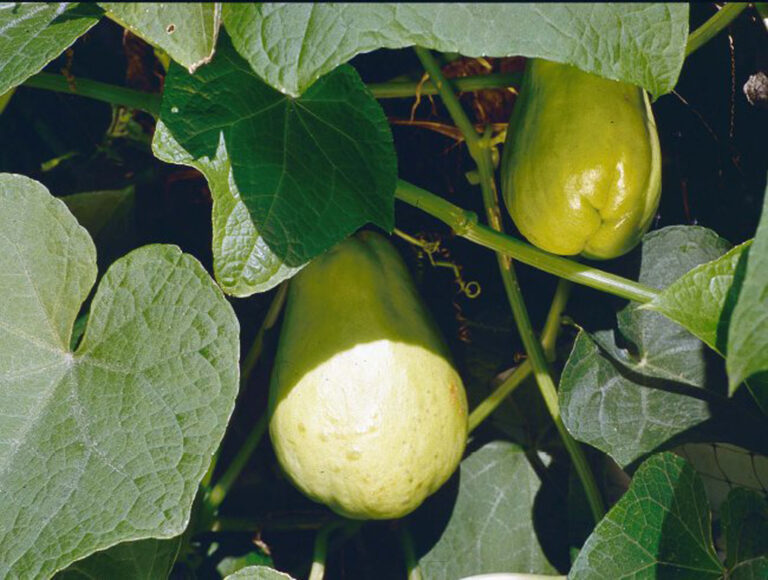
Although treated as an exotic by most of our greengrocers, this truly versatile vegetable has a long history in American cookery, especially in the Deep South. Prior to 1900 there were about a dozen recognized varieties, some white, others green, many with sharp spines on the surface of the skin. The plant is a rampant grower, with vines similar in appearance to large tree-climbing gourds. Each vine is highly productive, yielding as many as 100 fruits, which are usually harvested when 6 to 8 inches in length. Where the ground does not freeze in the winter, the plant can be cultivated as a perennial; otherwise the roots may be dug up after the first frost and stored like dahlia tubers. Furthermore, the pear-shaped fruit can be used in innumerable ways in cookery as a substitute for squash, cucumbers, and potatoes. It can also be pickled as a passable substitute for artichoke hearts, makes convincing French fries and delicious gratins and pies, or can be eaten raw in salads. In Lena Richard’s New Orleans Cook Book (1940, 84) chayotes are stuffed and baked like eggplants. It amazes me that this vegetable is not more popular in this country; it will even store for several months in a refrigerator.
The chayote (Sechium edule) is native to Mexico but has been naturalized throughout Central America and the Caribbean under a variety of colorful local names — evidence of its popularity in the folk cookery of these regions. It was raised as chocho in Jamaica during the eighteenth century and exported to North American markets along the eastern seaboard. It was also grown along the coast of the United States as far north as Charleston, South Carolina, well into the 1850s, especially by people of African descent. The Civil War completely disrupted its cultivation, and it was not until the 1890s that serious attempts were undertaken to reintroduce it as a truck-farm product under the name Vegetable Pear. However, in Louisiana, where it is known as the merliton, it has been a basic ingredient in local American cookery since the 1700s.
Growing Chayote
The vines require a sturdy fence or trellis for support and can be trained over arbors like grape vines. It is important to tie the stems to the supports at critical places, or the weight of the fruit will pull the entire plant to the ground. Where the plant can be cultivated as a perennial, the root will develop into a yamlike tuber that can be harvested and used in cookery much like a potato due to its high starch content.
To raise the fruit in Pennsylvania, where I treat the plants as annuals, the vines must be started in a hothouse in January (a sunny windowsill will serve as well). Let a ripe chayote stand in a warm place in the kitchen until it begins to sprout, then stick it into potting soil, sprout end up. The fruit will shrivel and grow quickly into a vine that can be planted outdoors when the threat of frost has passed. Since the plant requires twelve hours of sunlight to produce fruit, it is important to get it in early enough so that it is blooming by early June. Most important, two plants are required for cross-fertilization. One vine alone will produce no fruit. Once established, the plants will yield prodigiously over the summer.
Meehan’s Monthly (November 1891, 76) remarked that growing the chayote vegetable was troublesome, which I wholeheartedly question. It is not particular about soil and grows like a weed even during droughts. Aside from requiring a long growing season, my vines are remarkably free of pests and are not subject to squash beetles or powdery mildew. For the organic gardener, this is the perfect vegetable: it thrives on neglect.
Find seeds for these heirlooms and more with our Custom Seed and Plant Finder.






