Community food forests are capturing the imagination of people in neighborhoods, towns, and cities across the United States. Their popularity reflects a value shift in urban cultural pockets. The message is a desire for public space, where possible, to be ecologically designed with perennial and annual plants that produce food and herbal medicine, enhance nutrition, promote food literacy, and provide a useful and safe place to gather, recreate, and work together. This is all while engaging people in active participation to create the places they want to live in and to voice their opinion through action. By developing these spaces, people are stating that ecologically healthy green spaces and sustainable local food production are valued, especially in the face of urban population growth. Communities will innovate, using all the resources they can harness, to increase the presence and quality of such resources in urban landscapes.
Community food forests also serve a deeper purpose by helping community members form bonds through collective labor and learning. Participants often discover shared interests such as local and foraged food, social justice, environmental stewardship, resiliency, and self-sufficiency. Uniting around common causes, people invest in and build diverse assets in their community and this personal development and civic collaboration benefits society. Questions emerge on why we feel disconnected from land and how to develop the culture of sharing abundance, human skills, and knowledge needed for survival in the modern world.
Many communities today embrace the belief that local food should be readily available, and that much of it could come from within city or town limits using ecologically sustainable design and safe urban production methods. The reinvigoration of this form of community spirit has helped focus a new urban agriculture agenda. Community food forests are strongly linked to local food, food justice, and civic agriculture movements. Participation in a community food forest project can lead to critical reflection on our current agricultural system and urban landscapes. Typically it motivates people to work on influencing political action and policies.
Community food forests raise important questions about access to fruit trees and other edible perennials in public places. They introduce people to foraging for “wild plants”–edible and herbal species — in public parks, forests, and rights-of-way or to gleaning unharvested produce to supplement community supply. These issues are increasingly observable in the public agenda in terms of sustainability, food security, environmental justice, and urban green infrastructure.
Community food forests can be found in a variety of places. Churches, universities, and intentional communities have planted food forests on their campuses. They are increasingly found on public property managed by public works agencies or parks and recreation departments. Regardless of where they are located, these projects are open to the public. Volunteers and civic organizations are often involved in their development and oversight. Enthusiastic faculty and students tend community food forests on university property. Dedicated groups of congregational volunteers encourage and guide member participation in projects coordinated by churches. On public grounds, the collaboration and communication between agency employees, project leaders, and volunteers is essential for effective management and community support.

Community food forests are part of a cultural transition and represent local efforts to build abundance and share opportunity. Even more important, they can contribute to meaningful personal, civic, and ecological stewardship that often is lacking in our lightning-fast, digitally driven, consumerist lifestyles. Community food forests offer a way of experiencing the direction in which this shift is taking us. It is this possibility of deeper meaning in our lives that makes community food forests such a compelling and inspiring movement.
During the Great Recession of 2008, the notion of raising food as a community offered a way for people to envision being both productive and cooperative in the midst of a shared struggle. A broad range of people faced issues of food insecurity and lack of access to affordable, nutritious food following nationwide economic upheaval. Social movements such as the Occupy Movement organized people around their distrust of Wall Street, big business, and government.
In the midst of their fear and disappointment, people bonded during discussions about community issues. They also brainstormed local solutions and actionable steps to create the changes they thought would build a better future. In the process, they formed a type of social capital that would serve as a foundation for some of the earliest community food forest projects. Around this time, there were very few active community food forests in the United States, but planning for many more soon began. For example, a group known as Occupy Vacant Lots arose out of the Occupy Movement in Philadelphia and made turning abandoned areas into food forests their mission. The momentum has only increased following the Great Recession. At least eight community food forests were established between 2010 and 2011. From 2012 to 2014, at least twenty more began. By the time of this writing, there were some seventy, if not more, new projects across the United States.
The rapid growth in community food forests suggests that a new environmental and agricultural consciousness is taking root. A common thread running through all of them is a desire to share topics and knowledge that were once central to community life but were in large part lost during the technological and social transitions of the last century. An ecologically grounded approach to agriculture includes an understanding of how to use natural principles for holistic crop production. When combined with an intimate knowledge of local resources, conditions, and techniques, these topics are inseparable from community food forests. The Community Food Forest Handbook illustrates these concepts and emphasizes their role in shaping the future of local food production and community cohesion through the stories of community food forests from regions across the United States.
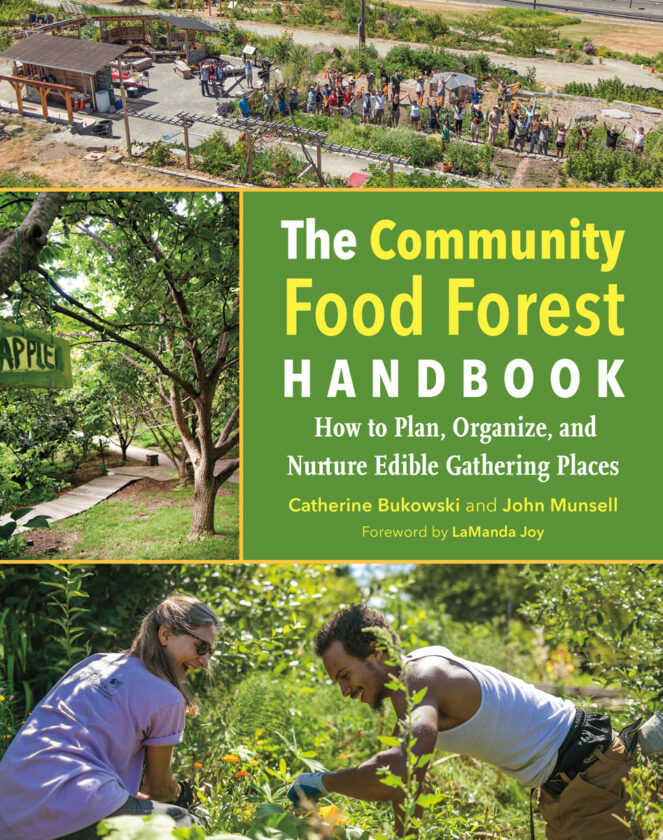
More From The Community Food Forest Handbook:
This excerpt is adapted from Catherine Bukowski and John Munsell’s book The Community Food Forest Handbook: How to Plan, Organize, and Nurture Edible Gathering Places and is printed with permission from Chelsea Green Publishing.
Food Forests
Food forests can help increase biodiversity, protect valuable habitat for beneficial insects, and promote food security and resilience, all while providing an abundant harvest The Food Forest Handbook is a practical manual for the design and management of a home-scale perennial polyculture garden. Order from the Mother Earth News Store, or by calling 800-678-4883