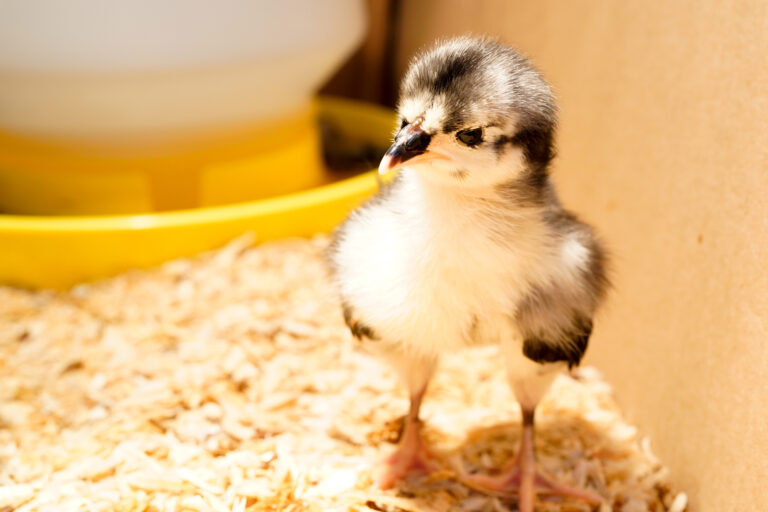
Raising chicks can be a fun experience for children and adults alike, but it’s crucial that chick brooder environments be set up correctly. Here are the brooder temperature and light requirements you need to know.
As long as you maintain the principles of security and warmth, the possibilities for raising chicks in a brooder are limited only by your imagination. Any brooder must be designed to minimize stress since stress drastically reduces the chicks’ immunity, making them susceptible to diseases they might otherwise resist. Stress is minimized by making sure the chicks are neither too cool nor too warm; have a clean, safe environment; are provided sufficient space for their numbers; and can always find feed and water.
Stress may also be reduced by approaching the chicks from the side rather than from the top. Commercial box and battery brooders are designed with this feature in mind. Most other brooders are designed for the convenience of the chicken keeper, who scares the living daylights out of chicks by approaching them from above — after all, most predators swoop down on baby chicks. Whenever you approach chicks from the top, the polite thing to do is talk or hum to let them know you’re coming.
Chick Brooder Temperature
A chick’s body has little in the way of temperature control, although a group of chicks can keep themselves warm by huddling together in a small space — which is why a box full of newly hatched chicks may be shipped by mail. When given sufficient space to exercise, eat, and drink, chicks need an external source of warmth while their down gives way to feathers, starting at about 20 days of age.
Chicks tend to feather out more quickly in cooler weather, but if the air temperature is quite low, they need auxiliary heat longer than chicks brooded in warmer weather. For this reason, chicks hatched in winter or early spring typically require brooder warmth longer than chicks hatched in late spring or early summer.
Start the brooder temperature at approximately 95 degrees Fahrenheit and reduce it approximately 5 degrees each week until the brooder temperature is the same as ambient temperature. Within the chicks’ comfort zone, the more quickly you reduce the heat level, the more quickly the chicks will feather out.
Commercial box brooders, batteries, and hovers operate by adjustable thermostat. Most homemade setups provide heat with either incandescent lightbulbs or infrared heaters that have no thermostat.

An incandescent lightbulb is the least expensive heat source for raising chicks in batches of 25 to 50. If your brooding area is large enough to handle the extra heat, you’re better off using two bulbs in case one burns out when you’re not around. Screw each bulb into a fixture with a reflector and hang it over the brooder. The heat may be adjusted two ways: by raising or lowering the fixture and by decreasing or increasing the bulb’s wattage. Start with 100- or 60-watt bulbs, depending on the size of the chick brooder and the number of chicks.
One 250-watt infrared heat lamp provides sufficient heat for 25 to 100 chicks. Infrared heat lamps with either red or clear bulbs are available at farm stores, electrical supply outlets, and some hardware stores. A red lamp is more expensive than a white lamp but won’t burn out as quickly, and the red glow discourages picking; as long as everything looks red, truly red things won’t attract attention.
An infrared lamp gets quite hot, so use a porcelain rather than a plastic socket because the plastic might melt. A standard brooder lamp holder has a porcelain socket, as well as a couple of stout wires bent across the front so the lamp can’t come into direct contact with bedding — for instance, if the lamp falls — or other flammables and create a fire hazard.
Hang the heat lamp by an adjustable chain, starting about 18 inches above the chicks. As the chicks grow, raise the lamp to reduce the heat. A general rule is to raise the lamp about 3 inches each week.
Be especially watchful with chicks confined in a small chick brooder since an infrared lamp can get pretty hot, and you don’t want the chicks to be cooked alive. As they get older and require less heat, give them more room so they can move away from the heat or switch from infrared lamps to incandescent bulbs.
A safer infrared option is an Infratherm heating panel, which is more expensive than an infrared heat lamp but uses so much less electricity that in the long run the panel turns out to be considerably cheaper. A panel directs heat only beneath itself, making it easier for chicks in a small area to move away to maintain their comfort level. Panels come in various lengths and, unlike light bulb and heat lamp fixtures, are entirely sealed, making them much easier to clean and sanitize.
Theoretically, chick brooder temperature is measured with a thermometer placed 2 inches (5 cm) above the brooder floor (and at the outer edge of a hover), but you shouldn’t need a thermometer. Just watch the chicks and adjust the temperature according to their body language.
Chicks that aren’t warm enough — due either to insufficient heat or to draftiness — crowd near the heat source, peep shrilly, and may have sticky bottoms or outright diarrhea. In an effort to get warm while they sleep, the chicks will pile up and smother each other. Piling is most likely to occur at night when the ambient temperature drops, so in cold weather, check your chicks before you go to bed, and if necessary, increase the heat overnight.
Chicks that are too warm move away from the heat and spend less time eating, and as a result, grow more slowly. They pant and try to get away from the heat source by crowding to the brooder’s outer edges, perhaps smothering one another. If the brooder is hot enough to raise their body temperature above 117 degrees, chicks die.
Happy chicks that are warm and cozy wander freely throughout the brooding area, emit musical sounds of contentment, and sleep sprawled side by side to create the appearance of a plush-down carpet. The sight can be dramatic to someone who has never seen chicks resting comfortably. An overnight guest once woke my husband and me early one morning in a panic because “the chicks are all dead.” Meanwhile, his commotion had awakened the chicks, and by the time we rushed back to check on them, to the astonishment of our guest, the chicks were busy having breakfast.
Brooder Light
Chicks are attracted more to light than to heat, which is why commercial brooders have a small light, appropriately called an attraction light, near the heat source. One 25-watt bulb will adequately light about 10 square feet. To help chicks find feed and water, light the brooder continuously for the first 48 hours. If the brooder gets natural daylight after the first 2 days, you can turn the light off during the day. Windows on the south side furnish the best sunlight.
Even if the light is also your source of heat, turn it off for half an hour during each 24-hour period — but obviously not during the coolest hours — so the chicks learn not to panic later when the lights go out at night or in the event of a power failure. Putting the brooder light on a timer will save you the trouble of remembering to turn it off and on each day.
Light affects the growth rate of chicks, so never keep them in the dark. Even if you have to dim the lights to control cannibalism, the light should still be bright enough for you to see what’s going on in the brooder. A rule of thumb is that dimmed lighting should be at least bright enough to barely read a newspaper.

Reprinted with permission from Storey’s Guide to Raising Chickens (Storey Publishing, 2010) by Gail Damerow.