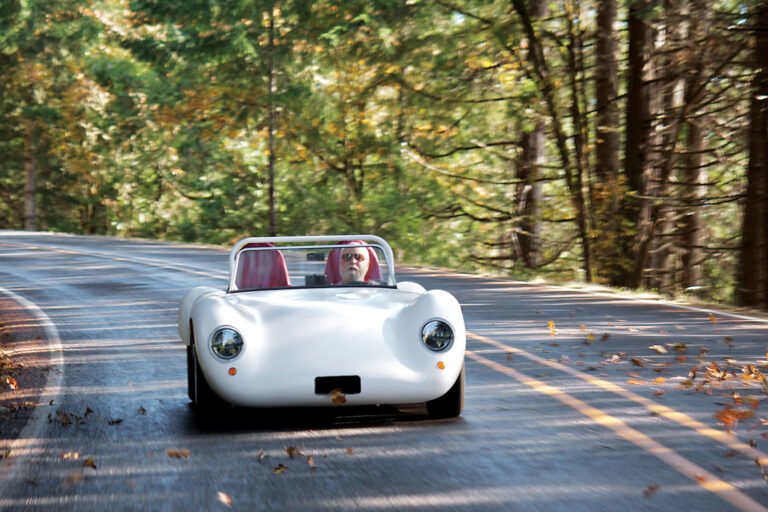
Build your own car from scratch with these tips. Inspired by classic race cars but grounded in frugality, MAX may be the world’s coolest car that gets 100 MPG.
What started in the summer of 2008 as an ambitious project to create a do-it-yourself, 100 miles-per-gallon sports car within a budget of $10,000 has come full circle. MAX (Mother’s Automotive eXperiment) now has more than 100,000 miles in its logbook and consistently achieves 100 mpg at speeds from 45 to 55 mph.
The project proves triple-digit fuel efficiency is feasible — even on a tight budget, and especially if you build your own car. If I can make a 100-mpg car in my Oregon garage, what could the major automakers be giving us?

That said, it’s important to understand upfront that MAX is not comparable to a modern sedan, with all of the creature comforts most drivers expect. But it doesn’t need to be.
MAX is marvelously practical as a second car, or as a primary car for those who rarely need more space than a two-seater provides. You can use MAX to get groceries or go to work. It won’t replace the minivan when you need to get your kid’s soccer team to practice, but you likely don’t need a minivan for most of your drives.
MAX is ideal for somebody like me. I live 30 miles from town and put in a lot of miles on extended business trips. I rarely need to take more than one person with me. MAX suits me well, and it can also meet the everyday driving needs of many people.

The biggest thing you lose when you drive MAX is your anonymity. It’s a conversation starter. Car enthusiasts love its resemblance to a classic race car, so expect to field questions from curious strangers any time you stop at a gas station. Fortunately, you won’t have to stop at gas stations often. This 100-mpg car can run on diesel, biodiesel or straight vegetable oil. The engine is a 32-horsepower turbocharged diesel — specifically, a Kubota D1105T, which normally powers anything from RV generators to heavy-duty lawn mowers.
Is MAX Legal? Is It Safe?
Every state’s department of motor vehicles (DMV) has its own rules for custom-made DIY cars. I reviewed all 50 states’ vehicle codes and found that most have relaxed registration rules for antique and classic car replicas. In many states, a replica has to meet only the equipment and emissions standards of the year it replicates. This encouraged me to style MAX after antique and classic cars. To register your own MAX, tell your local DMV clerk that it’s a replica of a 1958 Lola Mark 1 or a 1960 Lotus Seven (depending on the body style you choose).

As for safety, MAX is built to road racing standards more so than federal government standards. MAX has superior safety equipment, such as tubular steel impact barriers on its sides and rear (covered by the fiberglass body), roll bars and headrests behind the seats, racing safety harnesses, and a removable roll bar (and deer deflector) behind the windshield.
My DIY car doesn’t have air bags for the same reason an Indy 500 race car doesn’t: The driver wears a five-point safety harness that crosses the lap and both shoulders. Buckling up like a racer takes a few extra seconds, but if MAX is ever in an accident, I’ll stay where I’m safest — in my seat, surrounded by the impact-absorbent frame.
Time and Tools
Wondering how to build a car for yourself, but don’t know where to start? The basic plans for my DIY car came out of a book, Build Your Own Sports Car (now out of print) written by English auto shop teacher Ron Champion. British students have built these by the hundreds using the simple, Lotus-like body and engines from Ford Cortinas. It’s called a “Locost” in that form because it’s reminiscent of the Lotus Seven and is “low-cost.”

To build your own car from scratch and keep the cost under 10 grand, you’ll need to weld your own chassis. You can take an evening welding class at a local junior college (as I did), or ask a welder among your circle of friends to instruct you. Perhaps you can barter services with a neighbor. And you can always have a chassis built for you by a professional.
The rest of the job is just normal car work. You’ll need the usual automotive hand tools and a few unusual ones (a drill, an angle grinder and a POP riveter). Choosing a streamlined body requires you to tackle some fiberglassing to fit the body on the chassis. None of the jobs is particularly difficult, but there sure are a lot of them. An experienced auto mechanic working with a pre-built chassis would invest at least a hundred hours in the project. Inexperienced mechanics would work most Saturdays to finish within a year.
Keeping It Simple
There are two major reasons MAX met its 100-mpg goal. First, its guiding design was to keep it simple. I wanted MAX to be small, light and streamlined, so I chose an efficient engine with the least amount of horsepower needed. Second, MAX doesn’t reinvent the wheel: It uses the Locost chassis, a 32-horsepower Kubota diesel engine, and running gear (transmission, axle, brakes) from a Toyota Corolla.
I drove MAX for two years with an off-the-shelf Locost body because I had it in stock at my shop, Kinetic Vehicles. All that time, I knew I’d have to make a better body to achieve 100 mpg. But over the course of thousands of test miles, I learned volumes about engine, drivetrain and chassis compatibility. At that stage, my only invention had been an adapter to fit the Kubota engine to the Toyota transmission.

This keep-it-simple principle paid off in 2008 during the Escape From Berkeley, a three-day road rally for alternative fuel vehicles. To qualify, I converted MAX’s fuel system to run on vegetable oil, and I didn’t even have to invent that — Plant Drive makes a conversion kit. Our only close competition during the 800-plus-mile Berkeley-to-Vegas race was Wayne Keith, who also takes the keep-it-simple approach with his wood gas truck (read about it in Wood Gas Wizard). MAX beat Keith’s truck by a nose, and the pair of us finished a day ahead of third place.
MAX got 70 mpg on veggie oil during Escape From Berkeley. After that, it was time to find a better body design in order to get closer to 100 miles per gallon. There were two vintage race car bodies streamlined enough to do the trick — the Lotus 11 and the Lola Mk1 — and I chose the Lola because race results showed it had a slight edge. By widening the Lola nose and stretching everything else, I made a close-enough-for-the-DMV “replica” body that boosted MAX to 90-plus mpg. Adding a couple of bumps to the dashboard to deflect the wind took away the cockpit turbulence so my passengers could actually read maps while we drove.

The last few miles per gallon to 100 mpg took lots of attention to detail and optimization: Goodyear Fuel Max tires reduced rolling resistance; Drag DR-9 wheels decreased rotational inertia; and Lucas Synthetic lubricants minimized engine, transmission and wheel-bearing drag. I switched out all of the incandescent lights (including headlights) for Truck-Lite LEDs and covered most of the radiator air inlet with duct tape. The clincher was streamlining the belly by mounting a thin plywood sheet on the bottom of the car, from cockpit to taillight. That brought MAX to 100 mpg on the highway.
Comfort and Fit
The major automakers make compromises so their cars will fit everybody, whereas DIY cars can be built to the dimensions and tastes of their builders. Because I built my own car, it fits me like a tailored suit. It’s the most comfortable car I’ve ever owned for cross-country cruising.

MAX’s bucket seat is a perfect fit for my personal bucket, and the pedals and steering wheel are exactly where I want them. The windshield and convertible design did hurt mileage a bit — MAX currently gets about 95 mpg — but I’m hoping to get it back with a contoured fiberglass roof that has cleaner curves than the current ragtop. I’ll make it a removable hardtop and probably take it off in the summertime.
Losing 5 miles per gallon sounds pretty serious, but on MAX that’s only 1 gallon of gasoline every 2,000 miles — a small price for feeling the wind in what little hair I have left.
Make Your Own MAX
Want to try your hand at building a 100-mpg car? Study the book Build Your Own Sports Car: On a Budget by Chris Gibbs, and find all of the plans you need at Kinetic Vehicles (my shop can even build a chassis for you). Become a part of the MAX community by trading tips, tricks and tactics in the online forum.
You don’t have to build your own car exactly like MAX. There’s already an electric MAX on the road, and another builder is seeing just how low his budget can go. The more MAX cars we build, the more information we’ll have to share.
Read more: Read the complete history of MAX at 100-mpg Car: Max.
Jack McCornack first wrote for MOTHER EARTH NEWS in 1979, about a lightweight, ethanol-powered aircraft.