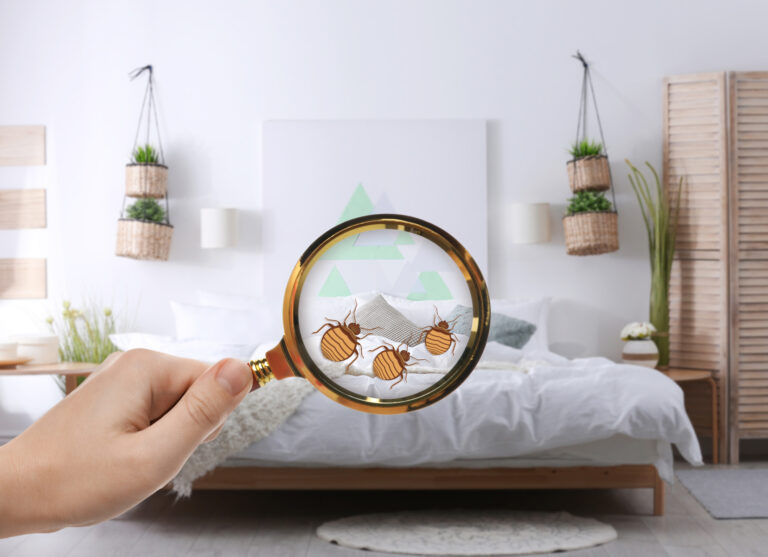
“Bed bugs” are small nocturnal insects that feed on blood. (Cimexlectularius is the most common species of bed bug.) Some people who are bitten by them get itchy welts on their skin. However, the bugs have not been found to transit any diseases to humans.
Bed bugs are typically found on mattresses, box springs and bed frames, bedding, clothing, and in any dark cracks, seams, or crevices in beds, furniture, walls, or floors. They can travel through water pipes, wall voids, and ducts, and can spread from room to room.
Adult bed bugs are about 1/4-inch long and 1/8-inch wide; younger ones are smaller (often about 3/16 of an inch long or the size of a pinhead). They have flat, grayish-brown or reddish-brown bodies with six legs, and after feeding, they become round and red. They give off a sweet, musty odor. Their eggs are white and very small, and their excrement appears as tiny brown or black spots, which can look like small blood stains if smeared.
Here are some rules for prevention, as well as tips for getting rid of bed bugs if they do appear.
Keeping Bed Bugs Out
- Consider getting a protective plastic cover for your mattress(es) and box spring(s) to keep bugs out/off of the bed. Tape up any tears or holes that appear in the mattress, box spring, or plastic covering.
- Eliminate excess clutter (particularly near your beds and clothing), to reduce the number of places where the bugs can hide.
- If you have been staying elsewhere or traveling, check your luggage and belongings for bed bugs before bringing them inside. Unpack your clothes directly into the laundry and wash everything with hot water.
- If you are considering buying any used/second-hand items, check them carefully for bed bugs before buying them, and wash them before bringing them into your home.
Getting Rid of Bed Bugs
While some pests can pose health concerns for building occupants, so can many pesticides. Pesticides and insecticides are poisons, and as such they are often poisonous to humans as well as to pests. Studies have linked some pesticides to cancer, birth defects, neurological disorders, and immune system disorders, as well as allergies. Therefore, pesticides should only be used as a last resort.
If the steps below are not sufficient to eliminate a bed bug problem and an insecticide must be used, ask an experienced professional to recommend the least-toxic insecticide that will be effective, and have it applied by a professional who will take safety precautions. The bed bugs’ eggs are not affected by insecticides, so the treatment will probably need to be applied several times to kill the hatchlings. Note: Bed bugs have become resistant to some pesticides, and using harsher pesticides could just end up making the bugs stronger, as they could build up resistance to those.
If you want to research insecticide options on your own, check out the EPA’s Bed Bug Product Search Tool. As a general rule, avoid products that are labeled “Danger–Poison,” as those tend to be the most toxic to humans. Never use pesticides indoors that are intended for outdoor use. And don’t use (or allow others to apply) any product that does not specifically list bed bugs on the product label. Some sticky traps are designed for bed bugs. (Note: Baits for ants and cockroaches will not work on bed bugs.)
But before using any pesticides/insecticides, first try these non-chemical strategies:
- If you think you’ve found bed bugs, first make sure that’s what they are. Have a professional identify them, or using a flashlight and ideally a magnifying glass, compare the bugs to photos of bed bugs to make a positive identification. (There are many websites with close-up photos of the bugs. Just do an online search for “bed bug” images.)
- Infested materials can be rid of bed bugs by being heated to at least 113 degree for an hour (or by being frozen at less than 0 degrees for at least 4 days).
- Wash your bedding and clothing with hot, soapy water, and dry them on the hottest dryer setting.
- Vacuum cracks, crevices, and other hiding places in walls, floors, and furniture where adult bed bugs or eggs are found. Dispose of the vacuum contents right away in a sealed trash bag, in an outdoor garbage bin.
- Use hot, soapy water to wipe all surfaces and crevices where the bugs might be living.
- Seal up any cracks where the bugs are living. Seal/tape up any tears in mattresses or other areas where the bugs could hide.
- Eliminate excess clutter (particularly near your beds and clothing), to reduce the number of places where the bugs can hide.
- Try sprinkling food-grade diatomaceous earth in areas where the bed bugs have been seen, to prevent them from hiding in those places again. (Food-grade diatomaceous earth can be found at feed stores.)
- If a mattress or box spring is infested with bed bugs, it will probably need to be disposed of (unless the entire thing can be put into a large freezer), as the bugs can live inside the mattress where they can’t be reached. Mattresses should never be treated with insecticides, unless a specialist verifies that the treatment is non-toxic to humans. Infested mattresses should never be donated, but can be recycled. When disposing of a mattress or other infested objects, deface them so that others will not be tempted to take them home.
- Tightly wrap in plastic any infested possessions (including mattresses) before carrying them out of a room for disposal, to avoid spreading the infestation to other rooms.
Consult with a licensed, experienced pest control professional for further advice and treatment options.
For additional information, go to these webpages:
Beyond Pesticides: Bed Bug Info (factsheet, articles, etc.)
Nontoxic Bed Bug Control is Possible (San Francisco Chronicle article) – Includes a non-toxic product recommendation
Center for Disease Control’s Bed Bug FAQs
Miriam Landman is an accomplished writer, editor, and sustainability advisor with expertise in green living, green building, and sustainable communities. For daily links to sustainable solutions and success stories, connect to her Facebook page for The Green Spotlight.