Learn how to milk a cow by hand and tips for the milking process from collection to production.
Keeping A Family Cow (Chelsea Green Publishing, 2013), by Joann Grohman, guides potential and current small farmers on how to care for and benefit from raising dairy cows. The following excerpt from chapter three (Milking Your Cow) describes how to effectively milk your dairy cow and techniques to tackle potential difficulties.
John Seymour, in his superb book Self-Sufficiency, devoted three chapters to the cow and her products, yet to instructions for milking only one sentence: “Now sit down and milk your cow.” Milking, like riding a bicycle or making bread, does have to be learned by doing, but these suggestions may help. A cow is customarily milked from her right, and if your cow was previously owned, this is what she will be accustomed to. The reason has to do with the slightly greater reach and strength offered by your dominant arm — which for most people is the right one. If you are left-handed, there is no reason you can’t switch sides, provided your cow is amenable.
You will need something to sit on, and it must be very low and suited to your height. It should be light and easily moved in case the cow shifts her position. The classic milking stool has three legs, making it easy to rock forward as needed. It often has a handle like a pan, the better to grab it when the cow shifts position. It is the rare cow that stands motionless throughout milking.
Once a cow has come in to be milked three or four times, you will need merely to open gates and doors and she will walk to her position. Have everything ready beforehand, including closing any gates or doors you do not wish her to enter; she is sure to notice if you’ve left something open. It is customary to give the cow her grain at this time, and if she knows it is waiting for her, you may be sure she will come in readily. If you don’t feed grain, try cut-up apples or carrots. Don’t ask her to walk up any steep ramp or across slippery spots. She will do it but will soon injure herself, sometimes very badly. This is the voice of experience. Preferably do not make her wait in muck or walk through it on the way in. You want her feet to be as dry and clean as possible.
If flies are bad, it helps to set up a system to brush them off as she comes in. Otherwise they will ride in on her back. You can hang up a curtain of bags or string or just sweep off the flies with your extended arms so they jump up in the air. Flies do not like to enter the dark, so if you dim the inside lights until the cow walks in, you can have fly-free milking.
You will find it a great deal easier to milk if you have a perfectly flat floor that is not slippery. A cow must have some grip for her feet. Cement that has been scored lightly before drying will do, but it is not ideal because it is hard to keep clean. And new cement takes months to quit leaching harsh chemicals. Rough wood works fine. It makes comfortable standing. Keep a bucket of lime handy and throw some down anywhere your cow might slip.
A locking stanchion or headgate works better than a simple tie-up to keep a cow in place for milking. A tie-up permits a cow to move away from you or toward you, making it necessary for you to shift your stool backward and forward. If your cow is not accustomed to being in a stanchion, tact is called for. Teach her that it is not a cow trap but is instead a lovely spot for a snack. Put treats in the feed pan and let her find her way into it a few times without locking the gate. When you finally lock it, stand by with more treats and some sweet talk. For a stoic older cow going to all this trouble may be unnecessary, but I have known a cow to become frantic the first time she was locked in. If this happens, she will be reluctant to stick her head in again.
If you have not built a stanchion, fasten her with a short rope or chain, using an easy clip.
Unless she is unaccustomed to the concept of being milked or to your family, your cow will probably stand still until her grain is gone. This is a grace period that you don’t want to squander. That’s why you want everything standing ready.
What to Have Ready
First, brush the cow’s back, sides, and belly with a stiff brush to remove any debris.
Have ready a bucket with several quarts of quite warm water to which you have added a couple of ounces of vinegar. Alternatively, use a squirt bottle containing vinegar and a little liquid soap and squirt this on a cloth to wet it. This mixture will keep her udder and your hands free of chapping as well as anything else I have found, and so far as I can tell, it is a successful germicide. I keep a bag of clean white cloths beside me and use as many as needed, never double-dipping a cloth that has touched the cow. The hot water stays perfectly clean. Give her whole udder a good wash with special attention to the teat ends. You’ll need a good light for this. She won’t mind hard scrubbing. A final rinse with plain water is not necessary. Dry her with another towel. Get her good and dry so there is no chance of drips into the milk pail. By this time milk will usually be streaming, as the warm water and towels stimulate letdown.
If not actually dripping, her teats should be fully puffed up, not withered looking. Filled teats are a sign she has fully let down and is ready to be milked. This is especially important if you are machine milking, as applying the vacuum system to a dry teat may be injurious.
How to Milk a Cow by Hand
Take a couple of squirts from each teat, avoiding your milk pail. This gets rid of the waxy plug sealing the teat; also, the first squirts have a higher bacterial count.
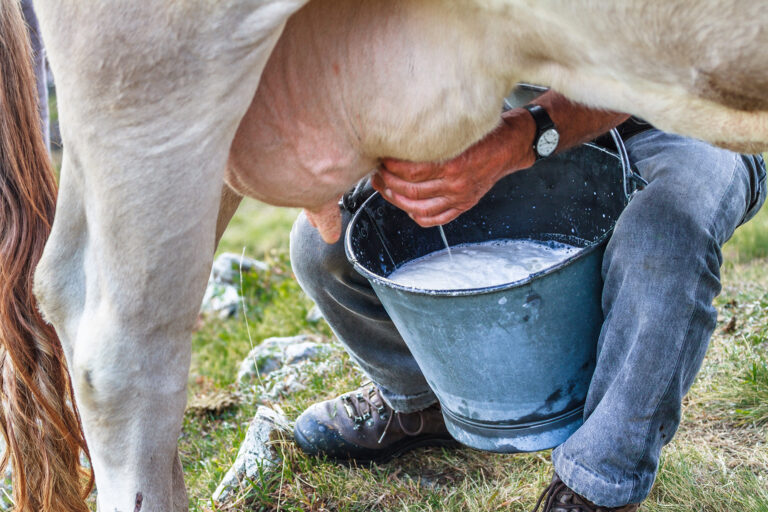
Position yourself and the pail and grab a teat in each hand. Do not be tentative about this. Cows hate a tickly approach. Most people put their head or shoulder into the cow’s side. Wrap your thumb and forefinger around the teat as high up as possible, squeeze the teat off so milk does not backflow, and, with all your fingers firmly wrapped around the teat, pull down. You don’t need to pull down hard. Alternate squeezes, left, right, left, right, in a steady rhythm. If your cow is newly freshened or is a heifer, the teats may be small or partially effaced. Time will eventually cure this, but in the meantime, you may have to milk using only two or three fingers, at least until some of the milk is out. If, on the other hand, your cow is old and has long teats, position your hand low enough on the teat so that you are not creating a ballooning effect at the teat end. Ballooning will damage the teat end and predispose to mastitis. Also the cow doesn’t like it and will switch her tail. Milking success depends upon coordination and persistence, not strength. Just because you have trouble opening ketchup bottles doesn’t mean you can’t be a good milker.
As you alternate squeezes and before each pull, push your fisted hand up into her udder. This simulates the bunting of the calf and maintains letdown. Have you driven through farming country and seen those wooden whirligig lawn ornaments of a little farmer milking his cow, his arms flying up and down? Soon your arms, too, will be flying up and down.
Aim for a good, steady rhythm with as few breaks as possible, and aim for speed. When you are able to finish with a strong layer of foam on the milk, consider yourself a pro. I usually milk the back teats about halfway out first, move to the front, then return to the back and finally the front again. Pause occasionally to bounce the cow’s udder around a bit to shake loose the milk. Finish by doing each teat singly while you knead the quarter of udder above it to be sure you’ve got all the milk. Aim to get all the milk and ask for more until you’re down to tiny squirts and all four quarters feel limp.
There are two reasons that it is important to get all the milk. Milk left behind is an invitation to mastitis. And milk left behind is a message to the udder: don’t bother making so much milk next time; nobody needed it. Thorough milking is of key importance to maintaining high production and udder health.
Milking the Fresh Cow
When a cow first freshens (calves), her udder may be alarmingly swollen and her teats nearly effaced. Get at least a little colostrum out of each quarter to make sure it is flowing. Most people agree that it is best not to take it all for a couple of days — as if you could. There may be very little teat to take hold of. If her udder is alarmingly swollen, try to determine whether she has mastitis or edema. Edema is fluid seeped out of the blood supply to the udder. Push your finger into it. If a dent remains, it is edema. Help the swelling to leave by massaging upward toward the cow’s belly. A lotion such as Uddermint is helpful. Mastitis will also cause swelling, but unlike edema it will be localized to one quarter or part of a quarter and will feel hot. If you believe the swelling to be mastitis, that quarter does need to be milked out as completely as you are able. If the case of mastitis is mild and the cow has not been medicated, the milk need not necessarily be discarded. Breastfeeding mothers nurse their babies right through mastitis. But if in doubt, feed the milk to your rose bushes.
Exercise will help in both prevention and treatment of edema. Get your cow to walk around.
How much to milk out after freshening and when to milk out completely is a difficult judgment call. And with any cow that has just calved, watch for milk fever.

My Aching Back
When you first learn to milk, your back will ache and your hands will be in pain and there will be no foam on the milk. It’s like getting into any new sport. There is going to be pain until your body rises to the challenge, which it will if you persevere. Here are some things that will help.
Take extra vitamins C, D, and E. This will aid in preventing and recovering from sore muscles. If you note a tendency to cramp, be especially sure to take these vitamins and also to drink plenty of milk yourself for the calcium, a great aid against cramping.
Don’t forget to breathe. I find it’s easy in a touchy situation, when I’ve finally got her standing just right, almost to forget to breathe. But milking is an aerobic sport. If some part of you is feeling numb, don’t assume it is repetitive motion disease or Raynaud’s syndrome; just take some nice deep breaths and feed your fingers and calf muscles some more oxygen.
Wear loose clothing and very comfortable shoes. Oxygen can’t reach your toes if your blood can’t get past your tight waistband and constricted instep.
Experiment with the height of your milking stool. It needs to be exactly suited to you. If there is more than one milker in the family, each will need a customized stool.
While milkers don’t need to be exceptionally strong (many children are good milkers), a degree of strength is required. I often find it helpful to arrange my knees so I can brace my elbows on them as I milk. This is especially helpful during the first ten minutes of milking when the udder is full and heavy.
Cows are creatures of habit. This makes handling them easy once they understand what is wanted. They like to do the same thing every time. But some habits can be irritating. If your cow gets in the habit of dropping manure or urinating three-quarters of the way through every milking, here is a trick that has worked well for me. You can often tell when she is about to drop manure by the raising of her tail. Arise quickly, moving the bucket aside, and grab a large shovel that you have handy. Place the shovel against her thighs and catch the manure on the shovel. She will think it’s pretty weird having a shovel against her thighs and not hearing the usual plop… I guess. In any case, this seems to take the fun out of it for her without doing her any harm, and in a day or two she’ll quit the habit. Curing urination is even easier because the necessary change of stance gives you an extra second of warning. Have handy an empty five-gallon plastic bucket and simply catch the urine in it. This makes such a noisy splash that she will probably stop halfway through. Urine is superb high-nitrogen fertilizer, so don’t waste it. Dilute it three-to-one with water and use it on any plants you wish to favor.
I also tell her what I think.
Kicking
Even the mildest cow will occasionally kick the bucket. This is so aggravating that I have a theory that the phrase “kick the bucket” as a euphemism for death arose from occasions throughout the ages when the milker stood up and whammed the cow over the head with the nearest heavy object, with fatal results. (“Yeah, she kicked the bucket.”) Better to plan ahead for it, reminding yourself it had to happen sometime, yes I’m angry and I’m telling the cow about it, but I’m not going to cry over spilt milk. I’m making my point to her effectively, I’m analyzing why she did it, and I’m instituting preventive measures.
Sometimes it’s obvious why she kicked. A kitten used her leg for a scratching post. A chicken flew down from the rafters and frightened her. Your neighbor roared up on his motorcycle. The flies and heat are getting to her. You still need to express your disapproval just to reinforce her future self-control. I yell and grab her leg and plant it firmly down and finish off with a pithy lecture.
Sometimes the kick seems unprompted by anything obvious; she just seems to be in a bad mood. The commonest causes for this are estrus (heat) or being milked a lot later than she likes. Cows are like babies; you may think you aren’t going to be ruled by their fussing about their schedule being flouted, but after a while they train you. It just gets a lot easier to do it their way. Cows don’t “have” to be milked at the same time every day. They just like it a lot better, and pretty soon you will too.
Cows develop strong attachments, and some are more conservative than others about accepting a substitute milker. Kicking may ensue.
A first-calf heifer may do a lot of kicking before she accepts her appointed role. She often will even kick her calf. Be sure she is firmly tied or in her stanchion. Have somebody stand behind her and hold her tail up very high. Not to break it, just to immobilize her. Something about this tail raising enervates her leg movement, and cows show no signs that it hurts. When she no longer kicks, you will know the tail is high enough.
Alternatively, a rope trick that prevents kicking involves making a cinch around a cow’s belly just in front of her udder. A helper has to hold the end of this noose unless you are better at knots than I am. Tighten it until she stops kicking. It must be released after three or at the most four minutes, as it stops blood flow to her udder and can even cause her to tip over if too tight. It is really very dangerous to leave any rope tied onto a cow because someday you will forget and let her out with the rope attached. The results can be disastrous. But as an anti-kicking measure this is one of the best. It has the advantage that once the cow has understood that the rope means “no kicking,” with the rope loosely on the cow, the milker, without changing position, can give it a touch to remind her. Another advantage I believe is that the rope is an impersonal aid. Tail hoisting, which is also likely to be messy, is unmistakably something humans are doing to her.
There are anti-kicking devices designed to lock onto a cow’s hocks and prevent kicking. Another type resembles a giant C-clamp and fits from in front of her near hind leg up and over her backbone. Once adjusted it goes on easily but firmly. All of these approaches can teach her you won’t put up with kicking. Whatever method you use, avoid frightening her if you can, as fear is a hard habit to break.
Training the Determined Kicker
Lee Anne B., moderator of the wonderful Keeping a Family Cow online forum, has found a less invasive training trick that has been highly successful for her and others. She describes it thus:
“Run a broom handle into the middle finger of an old winter glove, and duct-tape it on securely. Secure your recalcitrant cow in her stanchion or tie-up, and stand near her shoulder, out of kicking range. With the end of the broom handle in your hand, and the body of the handle near her belly, place the “glove on a stick” against her udder. She can kick all she likes without risk of injury to you, and no matter how much she kicks, the “glove on a stick” will not go away. If she kicks it out of your hand, just pick it up and put it right back. It may take two minutes, or it may take twenty, but eventually she will settle down and stop kicking. Praise her gently, stroke her shoulder, and, still holding the end of the stick, rub the glove all over her udder, teats, belly, and back legs. Use the glove to touch her calmly but purposefully everywhere you will touch her when you are milking. If she kicks, hold the glove in that spot until she stops, and then rub it over the spot that gave her offense until she accepts it calmly. Then take a few deep breaths, grab your stool and bucket, and get to milking!”
The kick of a cow is never, so far as I know, fatal, and seldom even seriously dangerous, but it can certainly make milking impossible. Unlike a horse, a cow is not an athlete. Her kick is analogous to what a human can do without bending the knee. If truly angry or frightened, she can kick backward with her front leg using a short flipping motion.
She can also whip her tail around. This can be annoying. In desperation you can tie it down to her off hind leg. If you tie it to the wall instead, use a light string that will break away. Otherwise someday you’ll forget to untie it when you let her out and her tail will break when she walks away. Resist the temptation to cut off the tail hair (called her switch). When it reaches to the ground it is just long enough so she can flick flies off her withers. The hair grows back very slowly. It may take a year to grow out. If it is dirty, it is preferable to soak or comb it clean rather than cutting it. This may not seem important in winter, when the switch is most likely to get filthy. But if she can’t switch flies to her satisfaction, next summer she will spend a lot of time hiding in the shade when she ought to be grazing.
Dairy cows have been bred for centuries not only for milk production but for good temperament. As with all creatures, there are different dispositions, and if you have ended up with a truly intractable cow, get rid of her. Most dairy cows, while kicking occasionally, are pretty cooperative and kick only when they think they have a good reason.
A Calm Environment
The way to make milking a pleasant experience for all concerned is to create a calm milking-parlor environment. You may then go for many weeks without incident. Here are some factors to bear in mind. You may get away with one or two deviations from this list, but here is what cows like best, as well as some situations they can be counted on to dislike.
Cows like quiet, contemplative music. They don’t like raucous music and they don’t much like newscasts either. Actual dairy farm studies have shown this clearly. A recent study showed a preference for classical over rock, but that is a mere average reflecting the fact that over a day’s listening there is a little less cacophony in classical music. But I promise you they don’t like Schoenberg any better than rock, and they hate string quartets; I suspect they are reminded of swarming bees. They especially like music from the Hearts of Space program or anything dreamy.
Cows don’t like dogs. They are natural enemies. Exactly as with music a cow doesn’t enjoy, you may not notice that she tenses up around a dog. A lot of cows averaged over many hours of listening were required for the discovery that rock music cut production by 4 to 6 percent, not a margin you would think to attribute to your music… or your dog. But when she is walking past the dog you will see the signs plainly enough, especially if her calf is anywhere in the picture.
Children who run or giggle are poorly tolerated by cows. Any but the quietest strangers will cause her to stop letting down. Most dairy farmers are not very hospitable about allowing strangers into the cow barn, whether it’s milking time or not. The first comment a cow makes is usually to raise her tail and make a plop. A farmer prefers not to clean up behind the whole row.
There are two schools of thought on feeding a cow at milking time. It has traditionally been done because it is convenient and it keeps her quietly occupied until she has cleaned up her feed. This will occur long before most people are finished milking. She then is restless for several minutes while she double-checks around and under everything her tongue can reach in case there is a crumb of grain she missed. Once satisfied nothing was overlooked, she is likely to enter a quiet meditative state and you can finish milking peacefully.
If this isn’t working for you, don’t resort to more scoops of grain. If you want her to keep eating for any of several good reasons, give her something that won’t unbalance her diet. Some people slow down their cow by putting rocks in her feed pan. I myself may offer chopped dried alfalfa at this time. Most cows love it, and it is good for them.
Cows can be habituated to come in to be milked without providing any feed. Some people find the cow settles down more easily this way. Without the temptation of feed, unless the cow is already confined, a regular schedule is important so she shows up at the gate for you. If your cow is a heavy producer, she will look forward to the relief of being milked.
Lastly, and at the risk of forfeiting my reputation for scientific objectivity, I find that it helps to keep the cow calm and settled if, while milking, I avoid any worrisome or peevish thoughts and make a point of visualizing pleasant things. Cows are extremely sensitive. Janene R, long time moderator on the Keeping a Family Cow forum, puts it this way: “If you’re already in a bad or a hurried mood, she’ll know it and pick up on it and will be hesitant/expectant of bad vibes/mojo (for lack of a better term). You knew when your parents were upset with you and expected the worst. The cow can do the same.”
When milking by hand, it takes me just about one hour to complete the entire milking chore without help, from assembling the equipment in the kitchen to returning with the milk and completing the washing-up. Time spent actually milking is dependent on current production but is close to twenty minutes.
Machine Milking
It is perfectly feasible to set up machine milking for just one cow. There is plenty of used equipment about. A milking machine is just a vacuum pump with a hose attached to the milking unit itself, which is a set of four rubber-lined teat cups, called the claw or cluster. The cups merge to deliver milk to a stainless-steel container. A unit called the pulsator regulates the vacuum in an on/off rhythm similar to the sucking of a calf or your hand milking. If you are a handy person more drawn toward technology than the aerobic yet meditative art of hand milking, there is no reason not to consider installing a milking machine. You will need to do some studying on your own. If possible, take the mystery out of it by visiting a small dairy or another cow owner and see one in use. There is also a trove of information online, which will acquaint you with the various models.
If you must buy sight unseen, it is best to order your machine from an established dealer who can offer guidance over the phone. This is especially important if you are buying used equipment. Milking machines hold few mysteries for me now, but lacking such help, I have spent many a morning in tears of frustration as I tried to solve what usually turned out to be a minor problem. I do urge you to buy a late-model pulsator. The early models work but require a lot of maintenance. Many helpful people can be found at the forums for Keeping A Family Cow.
One advantage to a machine is that you may find more people willing to learn how to use it, rather than learning the skill of hand milking, thus gaining yourself freedom. If there is someone willing to assume responsibility for the twice-daily machine wash-up, then the task of milking is cut to about seven minutes.
Disadvantages of the machine, apart from the initial cost and upkeep, are:
- The milk rarely tastes as good once it has been through a machine. Rarely does it keep as well. Nor does the cream rise as thickly.
- There is no saving in time when milking only one cow. The time you save milking must instead be spent cleaning the machine; it has many parts, and all of it must be scrupulously cleaned after every milking. Every dairy does this.
- If you use a machine you will have mastitis problems. Teat trauma from overmilking or incorrect vacuum due to worn inflations (the rubber teat cup liners) or vacuum pressure variation in the line predisposes to mastitis. So do lapses in sanitation of the equipment. Over time, you will certainly learn to minimize mastitis, but it is a constant risk and the curse of the commercial dairy. You may have to treat your cow with antibiotics, and then the milk must be thrown away for several days. (Inadvertent failure to discard milk from treated cows is the source of antibiotics in the commercial milk supply.)
Learning how long to leave the unit on the teats is critically important. Leave it too long and the teats will be damaged, predisposing to mastitis. Leave too much milk behind, mastitis again, and impaired production. I consider seven minutes to be the maximum time to leave the machine on my cow. If she is not milked out in that time, the vacuum is too weak, the pulsator timing is off, or she isn’t letting down. With a modern pulsator the timing is built in. The pulsator makes a steady tick-tock. It should make approximately sixty “tocks” per minute. Vacuum pressure is best at about twelve pounds Hg (maximum fifteen) on your vacuum pump gauge. I advise installing an inline pressure gauge. But even without one if the pulsator is behaving properly you can assume your pressure is within a safe range.
Many people find it possible to do other tasks while the machine is on the cow, and in some circumstances this is safe to do. I prefer to stay seated next to my cow. I want to monitor each quarter, often massaging it to get the milk down. I become familiar with the way each quarter feels and know when it is empty. I then remove the teat cup by sticking my finger in next to the teat to break the vacuum before pulling off the cup. (In-line valves are available to perform the task of cutting off the vacuum to individual cups.) At this point I must support the claw with my other hand or the whole thing will fall off due to air entering the line. There are plugs readily available to stopper each cup as it comes off. By catering in this way to each quarter I strictly avoid leaving the machine sucking on an empty quarter, as this can injure the sphincter that closes off the teat and will stress the entire teat. An injured sphincter is slow to close and offers a royal road for access of bacteria. It is advisable to keep the cow standing for at least ten minutes after milking if there is any likelihood she will lie down in manure. This gives the sphincters time to close.
Another source of infection is backdraft of milk up the teat, which can result from fluctuating vacuum pressure.. After I remove the machine I hand milk (strip) the last bit from each quarter to wash down any bacteria that may have found their way up the teat. These details of management go a long way toward avoiding mastitis.
There is a milking machine marketed by CoPulsation with a differently designed inflation and pulsator that studies have shown result in less teat trauma and consequently a significantly reduced incidence of mastitis. If you don’t want to invest in a whole new system, key components can be purchased separately and will merge with older systems. Milking machines are by no means the only cause of mastitis. Engorged udders at calving time are another invitation to this highly inconvenient and often costly condition. However, if you have often dealt with mastitis, you may be ready to invest in a design advance over equipment that has changed little in a hundred years.
For machine milking, prepare the udder in the same way as for hand milking. Wash with warm water containing vinegar, rinse with plain water, and dry thoroughly. Unless milk is already streaming out, discard the first couple of squirts. It is important that the cow’s teats be full and puffy to ensure that she is letting down before attaching the machine. No force on earth will drag milk out of an udder that is not letting down. Strain this milk just as you would that milked by hand. The teat cups are little vacuum cleaners and may suck up bits of hay or cow hair.
Suggestion: A full milking machine is both heavy and awkward. A physical therapist made a big difference in my life by instructing me in the best way to lift. Try this: knees bent, feet apart, spine perfectly straight, rear end sticking straight out (not tucked under), and lift straight up. Following this procedure I can lift the full machine the necessary fourteen inches into my cart.
There are milking-machine cleaning units available to speed the washing up. They do a great job but are expensive. Most are designed for the upright DeLaval-style machines. If you have hot water in the barn, all you need to do after straining the milk is reconnect the vacuum hose, set the claw in a bucket of warm water, turn on the pump, and watch the claw suck up the water. Don’t put this milky water into your plumbing system or you will eventually build up milkstone in your pipes. This will cause a blockage immune to drain cleaners and baffling to your average plumber. Donate milky rinsings to your pig or your flower bed, where they will be properly appreciated. Repeat with hot water containing a small amount of low-suds detergent and a final hot rinse.
I don’t have hot water in the barn. I do the straining, jar filling, and washing up in the kitchen, where I use a wet/dry vacuum (like a Shop-Vac) that provides sufficient pressure to do a good job. Note that water does not enter the vacuum cleaner receptacle. The machine merely provides power. The water follows the same route taken by milk and cleans all the surfaces, pipes, and bucket. I just set the claw unit in a bucket of warm water and connect the vacuum port to the cleaner’s sucking hose exactly as I would attach the air line to the vacuum system in the barn. Son Max devised a vacuum hose conversion fitting using the cut-off neck and shoulder of a plastic pop bottle. It holds together easily with the vacuum running. After washing and rinsing, I disconnect one end of the milk hose so that it can drain and dry thoroughly. At least once a week the pulsator must come off so that its port can receive additional cleaning.
A surge bucket milking machine is not adapted to the above method of cleaning unless you splice in hose extenders. Many people use extenders so that the bucket can sit off to the side rather than hang on the surcingle. With the Surge I find it easiest just to pull off the teat cups and lid (removing the pulsator, which must not be immersed) and put them in the dishwasher. The bucket is easily washed with a brush.
Straining the Milk… without Delay
Have your milk strainer set up before leaving for the barn, and always strain the milk. There are several reasons for this, foremost among which is that if you don’t strain it, somebody in the family who is the fussiest is sure to be the one who finds a cow hair. Such things are not health risks but can quickly erode support for your cow. And there are other important reasons for straining. Any foreign substance will impair the keeping quality of the milk and lead to off flavors. The speed with which milk flows through the strainer and the appearance of the strainer afterward are among your most useful clues to detecting a developing mastitis problem. If the milk strains slowly or if lumps are found on the strainer, this means trouble. However, if the milk has been allowed to cool before straining, this also will make it strain more slowly. It should be strained while still warm, no waiting. If warm milk is very slow to strain and you find lumps on the filter, it is best to boil it or feed it to animals and to institute mastitis treatment without delay. A few small, rather tough lumps will occasionally show up on the filter, but by themselves they don’t mean much.
If you find a few dried particles of debris on the filter after straining, it doesn’t mean the milk is unusable, but it does mean you need to review your arrangements in the barn.
Milk Straining Equipment
There are stainless-steel vessels made for straining milk. They are usually in two parts, a large bowl and a piece to clamp down on the filter disk. The filters themselves are disposable nonwoven material, usually cotton based. They come in boxes of one hundred and can be purchased at feed stores or online.
A stainless-steel strainer is expensive. You may be able to get a used one by advertising on a local bulletin board or on an Internet site such as eBay or Craigslist. Don’t compromise with a flaky old tinned one. It will be impossible to sterilize and may impart a metallic taste to the milk. In a pinch you can strain the milk through a wet white linen napkin fixed over a bucket with clothespins. Rinse the napkin in cold water immediately after inspecting it for debris, then wash it in suds and rinse thoroughly. Then either boil it for five minutes or dry it in the sun (a couple of hours in outdoor sunlight will leave anything properly sterilized).
Actually, there is nothing inherently superior about the stainless-steel strainer with disposable filter apart from convenience, and it is an expense. But the linen napkin must be scrupulously sterilized as described, or people will soon be complaining of off flavors in the milk and poor keeping qualities.
If you have only a small amount of milk and believe it to be pretty clean, you can strain it through a very fine nylon or stainless-steel mesh strainer. If you chill the milk rapidly and use it up fast, you may not even notice the difference from milk strained through proper milking equipment. But I promise you, under a microscope you would see plenty of hiding places for bacteria and milkstone, a calcareous residue, in the mesh.
For sustained best flavor and keeping qualities of milk, rapid chilling is essential. In the old days this was usually accomplished by setting the container of milk in cold, running water. A farm with a spring near the house was fortunate indeed. The family could then build a milk house over the spring and divert the water into a stone or slate sink, where it ran continuously, efficiently chilling the milk and creating cool surroundings. If milk was to be set for cream to rise, the bowl would stand on a stone or slate shelf. I am fortunate enough to have in my farm kitchen a granite sink served by a continuously flowing spring. Nonetheless, I usually pour my milk into one-gallon glass jars with lids and keep it in my refrigerator. Keep the refrigerator at 40 degrees Fahrenheit or lower.
Washing Up
The way you wash up is more important than what soap or chemicals you use. But in general, a low-suds detergent is preferable as it rinses more easily and completely. There are dairy chemicals on the market with which you can do a final rinse of all utensils. You leave this rinse on until the next milking, and then rinse with plain water before using. If you are using a machine, it may very well be worth doing this, as there are so many crevices in which milk residues can hide. Many of these sanitizing agents contain iodine, and on some commercial dairies enough of this finds its way into milk to make milk a significant iodine source. Other agents are chlorine based and if not completely rinsed away will destroy vitamins E and C and any other antioxidants with which they come in contact. Nonetheless, they are unquestionably effective germicides and have their place.
I use low-suds soap and water and the following procedure:
- Rinse first with lukewarm water. This is critically important because hot water solidifies milk protein and makes it stick like Elmer’s glue, in which milk casein is indeed an ingredient.
- Follow up with a thorough scrubbing, using hot water and a nonsudsing detergent in a dishpan that is not used for anything else. I use a big fluffy dairy brush with white bristles. Dairy brushes are pricey but last for many years, and this brush is never used for any nondairy purpose. I use this brush to scrub only surfaces that come in contact with milk. It never touches the outside of buckets that have been to the barn. I pour soapy water into the bucket that has been to the barn so that its unclean outside is not immersed in the basin used for milk surfaces.
- Rinse thoroughly with scalding water.
- Set out to air-dry in the sun or somewhere with good airflow. Indoors or out, I cover everything with clean netting.
This procedure maintains something approaching sterile technique with everything that comes in contact with milk, and I know it works. I know it works because milk doesn’t lie; mine will keep more than two weeks in the refrigerator without going sour or even significant loss of flavor. I’ve known it to keep three weeks, which is as long as commercial pasteurized milk is expected to keep in most states unless ultra-pasteurized.
I usually wash milk jars in the dishwasher, after rinsing them with lukewarm water. I routinely rewash jars that come back to me from customers. Whenever milk doesn’t keep, it will be the milk that gets the blame, not the jar. Not fair, but that’s how it is.
How Much Water Does All This Take?
It is possible to get along with only two or three gallons of water if there is a shortage or if it must be hauled. Save the cloudy water from the initial lukewarm rinse for another purpose. It is perfect for pigs. It will cause your houseplants to thrive amazingly. With your fluffy dairy brush you can wash the milk-contact surfaces with only about two quarts of hot water with low-suds detergent. Boil any of the water that remains after scrubbing and pour it over the milk-contact surfaces. All of this water can be saved for other wash-up tasks.
A milking machine demands more water for thorough cleaning.
Must I Really Do All This Washing Up?
After all, in many parts of the world it would be simply impossible. Is somebody going to get sick if I skip it? No, they will not. But there are two parts to this answer.
If the milk is used immediately, off flavors and keeping qualities are not issues. In places without running water or refrigeration, milk not to be consumed immediately is preserved by various types of controlled lactic fermentation that result in a tasty product. If freshly drawn milk is put into unwashed vessels dedicated to milk and milk alone, a favored colony of lactobacillus can be maintained. Prior to modern refrigerators, even if milk was in clean containers, nobody expected fresh milk to keep more than one day without going sour, even if it sat next to a block of ice, at least in warm weather. The milkman had to come every morning.
Now, the second part of the answer. If there are milk customers they will expect their milk to keep at least a week. If the milk is to be used to make yogurt or cheese, you will want to ensure a very low bacterial count, because inoculants may not compete successfully with a huge population of wild bacteria, and the quality of the resulting cheese or yogurt will be inconsistent. So strict sanitation must be observed: clean milking, careful washing, and rapid chilling. Milk stored in covered containers under refrigeration favors a type of bacteria that results in bitter flavors. This will be the ultimate fate of even the best-cared-for milk Indifferently cared-for milk may become unpalatable after as little as twenty-four hours.
“Unpalatable” does not mean it will make you sick. Hazards from commercial food supplies have been much publicized and are indeed serious. The pathogens in commercial food supplies are easily avoided in home-produced foods. The worst are not present at all. The old-fashioned common bacteria of everyday life will always be with us but are not harmful. They just make the milk go sour. Careful milking and milk handling practices keep bacterial start-up numbers low; refrigeration slows or prevents their proliferation. Inoculation of milk with favored bacteria such as yogurt starter suppresses the growth of bacteria you don’t wish to encourage. Pathogens do not survive in the acid environment of fermented milk products. We take pains with home-produced milk so that our dairy products will be dependably delicious. Happily, with such precautions they are also dependably safe.
Rising Cream
To obtain the most cream without use of a cream separator, pour the warm milk immediately into a large, flattish bowl and cool it. A cream pan is traditionally shaped like a giant pie dish: flat bottom and sloping sides. The less handling and the less time that elapses between milking and the time the milk is set to rise, the greater will be the percentage of cream you get. For the thickest cream, go for this wide, flat cream pan. The skim milk that is a by-product can be used for animal feeding or scalded for bread making.
If you’re planning to serve whole milk and prefer not to remove all the cream, pour the milk into one-gallon food service jars. This milk will produce more cream than even a dedicated whole-milk user such as myself wants to drink. Just pour or ladle off some of the cream before serving. This will give you a supply of cream for butter, desserts, and coffee. Cream poured off a jar will usually not be as thick as cream skimmed from a pan.
I often find it convenient to pour the morning milk into jars and set the evening milk to rise in a pan. In either case, for cooling I usually refrigerate the milk. I find that with ruthless elimination of leftovers, I can get a big bowl or pan into my refrigerator. I cover it with a tray to avoid condensation from the shelf above. In cool seasons the pan may not require refrigeration. Temperatures of around 50 degrees Fahrenheit will permit the cream to ripen slightly while rising. In the opinion of most, ripening improves the flavor of butter, and this “ripened” cream will break into butter more quickly.
If There Doesn’t Seem to Be as Much Cream as You Expected
As a rough guide, in a glass food service jar or any straight-sided jar, you should be able to see at least two inches of cream by the time the milk has stood twelve hours. I am disappointed if I don’t see a three-inch layer. By the following day the cream yield of certain cows will be even greater. Spring grass always boosts the amount of cream. There are genetic factors affecting the percentage of cream. Few Holsteins are big cream producers, for example, and there are feed factors besides grass that influence the amount.
But there are some simple management details that cause striking variations in the amount of cream. Here are a few:
- Incomplete milking: The hind milk — that which is milked out last — has a much higher cream content than the earlier milk. This seems to be the case for all mammals. If whoever is milking the cow is, let us say, racing to catch a schoolbus, that extra time spent getting the last of the milk may be skipped. The result, besides declining production, will be less cream.
- Feeding the calf: Even while you are milking, the cream is rising fast in the pail. If before straining you pour off a share for the calf, or even a couple of pints for the cats, you are pouring out the creamiest milk. If you are straining directly into jars you will note that the jar you fill first ends up having the most cream.
- Extra-agitation: Lots of pouring back and forth of milk and use of some types of milking machines causes partial homogenization by disrupting fat globules. Cream then rises more slowly and doesn’t get as thick. You still have the cream, but it’s stuck in the skim milk.
- Allowing the calf to suckle: If your management scheme involves allowing the calf access to the cow after partial milking, leaving some in the udder for the calf, this will dramatically reduce the amount of cream you have in your share. This is not only because the calf is getting the hind milk. If the cow has reason to believe that she will be suckling the calf later on, whether on a regular or erratic basis, she will resist letting down her milk. Whenever a cow isn’t letting down, cream is preferentially held back by the udder.
- Stress factors: Slow, reluctant letdown or cessation of letdown during milking can occur due to any of the disturbances mentioned earlier, such as the presence of a dog. Imperfect letdown will diminish the amount of cream in the milk.
Cream Separators
New cream separators are available. Good old ones can often be found. There are hand-cranked and electric models. The parts that come in contact with the milk are usually stainless steel and so are resistant to rust. Like a milking machine, cream separators have a great many parts that need to be scrupulously washed. But they work extremely well, so if you want to make lots of butter you may find a separator to be worthwhile. A separator centrifuges the milk in sheets as it passes over its many conical disks. The cream comes out one spout, the skim milk out another. There is a screw adjustment that regulates the thickness of the cream. Your fresh warm milk is strained directly into the hopper after milking so you gain the advantage of being able to deal with the milk immediately and completely — no refrigerator full of jars or pans. You do, however, forfeit the delicate flavor of milk and cream that hasn’t been bashed around.
The most perfect milk can only be had from your own cow, and this for me is a major reason for having a cow at all.
Reprinted with permission from Keeping A Family Cow: Revised and Updated Edition by Joann Grohman and published by Chelsea Green Publishing, 2013.