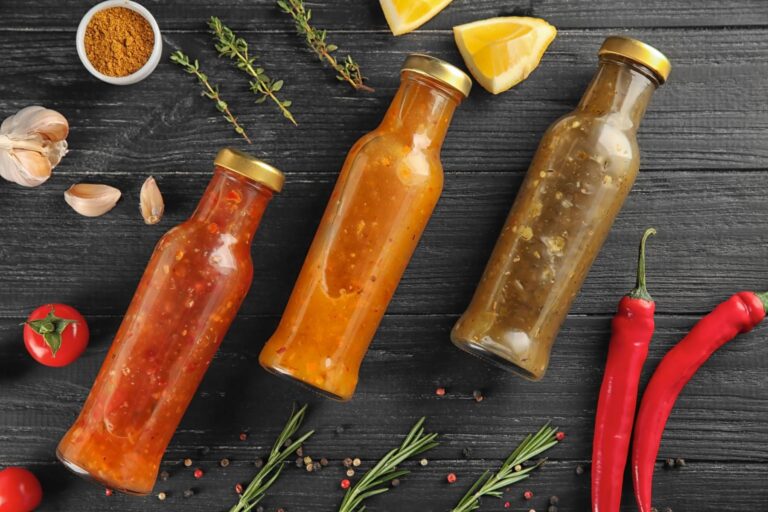
Ever thought of selling homemade hot sauce? Learn how to develop a hot sauce recipe and how to start a hot sauce business that outpaces the competition.
Many hot sauces begin as a homemade concoction, which grows into a legend among friends and family and eventually develops into a business that one hopes is lucrative. Maybe you run a restaurant, have a sauce that your customers crave, and decide to take the plunge and bottle it, to sell at the restaurant or to a wider audience. Or maybe you are a hot sauce collector, have tasted hundreds of sauces, and think you could make one that’s better. Perhaps you’re a computer programmer by day and an amateur sauce maker by night, you have been dreaming up culinary concoctions and think you’ve stumbled upon a great formula. Whatever your pathway to getting sauced, the first step is to come up with a recipe. There are several aspects to consider.
How to Start a Hot Sauce Business
- Test, test, test. Work on your recipe, refine it, change it, experiment with it. Take your time and really develop it. As Miracle Max said in The Princess Bride, “You rush a miracle man, you get rotten miracles.” Once you’re convinced that you’ve got a few great versions, invite friends whose palates you trust to come over for a tasting and some honest feedback. Perhaps you decide to serve three different styles of a sauce you love — one’s hotter, one has more curry, one has more ingredients. Set them out in bowls to test, and within each of those three categories, offer two or three versions (maybe one has a teaspoon of cinnamon, or mustard, while another doesn’t). Ask people to comment honestly; ask which sauce they’d buy for $5. Keep a careful log of comments and a record of what ingredient proportions went into each sample. Keep repeating these tastings, throwing out the versions no one likes, and asking strangers to taste them as well, until you hone in on a recipe that you and others think you can’t live without.
- As you develop recipes, think about cost. I once came up with an awesome recipe for ginger-fig chutney, which I still adore; I make it every fall to give away as gifts. People love it. However, the price of the ingredients (fresh figs, fresh ginger) made the chutney prohibitive to bring to market. Plus, I could get fresh figs only in the fall. When tested using ground ginger, it wasn’t good, and dried figs didn’t work either. So the recipe died on the vine. If you make a sauce at home, say, with fresh artichokes, consider that you’ll want fresh artichokes (and what that implies in terms of cost and availability) when you bottle it, too.
- Think about color. People will be turned off by an ugly sauce. Consider the five senses: sight, hearing, smell, touch, and taste. I don’t recommend putting hot sauce in your ear, but you definitely want yours to have an appealing look, smell, texture, and taste.
- Consider the implications of your homemade hot sauce recipe as it relates to flavor, marketing, and future sales. Do you want it to be all-natural? How do you feel about salt? Does your sauce need thickening, and if so will you use a natural thickener? How do you feel about thickening your sauce with xanthan gum, which is a common thickening and stabilizing agent?
- Ponder the heat. How aggressive a sauce do you want? What kind of heat do you want it to have? Lingering? Front of mouth? Back of tongue? Do you want a singular heat (of one chile) or a medley of chiles playing off each other?
- What’s your vision? Do you see yours as an authentic regional sauce? A funny boutique sauce? A gimmick? Are you making sauce that will taste great on flounder in order to promote your seafood restaurant? Is it one of the smoldering “untouchables” that pushes the bounds of civility and decency? Articulating your vision will help shape the total package.
- Consider your theme when coming up with the name. (And check to see if your name has already been taken.) Are you going for a straight name, like Smokey Chipotle Sauce? A restaurant tie-in name, like Dinosaur Bar-B-Q Sauce? A hellfire kind of name? (My all-time favorite in this genre was a sauce called I Am on Fire Ready to Die.) Tongue-in-cheek poetry such as Inner Beauty? Chip Hearn, owner of Peppers, a shop in Dewey Beach, Delaware, that carries more than 3,000 spicy products, has these words of caution for getting into a crowded market: “My advice to someone who wants to start now is you better be 100 percent committed to your product being the best you can make it. Worry about the product first. After you’ve got it, then worry about the pricing. Do something that’s better than anybody else, something that’s special.” Dave Hirschkop of Dave’s Insanity fame echoes that sentiment: “Make sure you’re coming out with something that gives something to the marketplace. Test it, not with family and friends, but with strangers. Make sure people think it’s different or better.”
Consider Your Hot Sauce Packaging
Once you have a recipe and a name, you should think of how best to present your sauce to the public. Your product may be the best-tasting sauce in the world, but if it doesn’t stand out and grab people’s attention, or meet food safety and industry standards (which vary state by state), your product won’t sell.
One of the first considerations is the bottle style: 5-ounce woozy? Hip flask? Ketchup bottle? How’s your sauce going to look on the shelf at Walmart next to other products? Flask bottles are clever because they take up twice the shelf space in terms of width, and the label is easier to read because it’s flat rather than curving. But these bottles are typically bigger (6.7 ounces compared to 5), which has product pricing and shipping implications. Does your bottle pack easily, and how many fit into a case? Don’t forget the design of the cap: Cholula is increasingly known worldwide for its iconic cap. (“Oh, yeah, the great sauce with the round wooden cap.”) In making Jump Up and Kiss Me, I splurged on a red (rather than the standard black) cap and a clear neckband dotted with red kisses.
You might also want to consider a nontraditional package. Dave’s Insanity sauce was sold in a wooden coffin, sealed with yellow and black caution tape. The package was funny and brilliant, catching the attention of buyers at food shows, retail customers, collectors, and the media. (The fact that Dave went to food shows wearing a straightjacket added to the buffoonery.) Scorned Woman was draped in a black velvet bag. Ultimate Burn featured a girl in a bikini that could be scratched off like a lottery ticket. Before making any decisions, figure out the cost; I once thought it would be great to create a hot sauce called “Squeeze Me” in a plastic bottle shaped like a woman (similar to the plastic honey bear bottles), but the cost of the package molding was prohibitive on the scale I was contemplating. Gimmicks aren’t all bad, and you should never underestimate the power of making your audience laugh. Just be mindful that if you have a clever package, a lot of people will buy it once, but if the sauce doesn’t taste good, they won’t buy it twice, and you want repeat customers.
Another key consideration is the label. At Wharton, my husband was told that blue food labels aren’t appealing. Think about it; you don’t see blue labels except maybe for Morton Salt. (We thought a powder blue label would look gorgeous next to our yellow passion fruit hot sauce in our Jump Up and Kiss Me line, and bucked the winds of wisdom, but I have to admit it’s our least popular seller.) In addition to color, think about what is required on a food label and what will matter to your audience. Nutrition labeling, for example, is not required to sell your product, but it matters to health-conscious buyers. Similarly, UPC codes are not required, but given that these codes are an increasingly common way to track merchandise, having one will bolster your chances of being picked up by chain stores, if that is your goal. If you’re just selling to friends and at local farmers’ markets, your label can be handmade. If you aspire to more than that, you should consider a printed label. A handmade label has a lot of charm and will appeal to collectors, but that’s a small segment of the market; many stores are not going to sell photocopied pictures taped to a bottle. And you’re going to get tired of the glue gun.
Find a graphic designer if you aren’t one. Look at products you like, call the companies, and find out who designed them (they needn’t be food labels; I once commissioned a graphic designer whose record cover I liked.)
Research Successful Homemade Hot Sauce Brands
Attend food shows and check out the competition — the Fancy Food Show (held twice a year, once on each coast) is overwhelming, with 180,000 products, 2,400 exhibitors, and 24,000 attendees, but what better way to get a sense of trends and who’s coming out with what new products. You’ll also make invaluable contacts and find sources for bottling, labeling, and other aspects of manufacturing. The National Fiery Foods & Barbecue Show, usually held in March in Albuquerque, is also one to consider attending. And there are scads of regional shows — food shows, chili cook-offs, chile pepper festivals — that are invaluable. Attend what’s reasonable for your budget.
Go to farmers’ markets and other consumer shows on weekends. These are a great way to get started: You get cash from selling your sauce, you expose your product to consumers directly, and you get honest feedback.
Research the competition to determine whether you are unique. Visit hot food shops, scour the Internet, check out the sauce section in stores ranging from corner delis to Walmart. Keep a log of what you like and dislike about sauces — their color, flavor, consistency, ingredients, and packaging.
Research the market. When asked what has been his biggest blunder in 20 years of running Dave’s Gourmet, Dave Hirschkop sighed and said, “There were so many, it’s hard to pick only one.” He thought about it, then mentioned that at one point he acquired a few products, including flavored mayonnaise. The mayos were great-tasting, and he liked the idea of them, so he spent a lot of time promoting the product. “But in the end, it didn’t work out,” he said. “The logic of flavored mayonnaise is great, but in reality nobody has succeeded much in that category.”
Take care of the grunt work that can sink you in the end if you ignore it: Call county and state health departments and find out about health codes. Can you make sauce in your home kitchen or do you need to use a licensed commercial kitchen? (Some states offer cooperative kitchens.) Do you want to find someone who bottles for you on contract? You’ll also want to figure out your business structure — for example, do you want an LLC (limited liability company)? You want to protect your family and your trademark. Hire a lawyer for this.
Where to Start Selling Homemade Hot Sauce
Okay, you’ve got the sauce, the bottle, and the label … now what do you do?
Offer free samples to buyers for stores and online companies. Buyers generally welcome samples. Include with your sample a product sheet with basic facts (wholesale information, suggested retail price, shipping costs, minimum order, whether you split cases, and your contact name, phone number, and e-mail) as well as any supporting evidence, such as whether you’ve won awards, what makes your product unique, and whether you have any endorsements by someone other than your mother, preferably someone who is well known (from the mayor to the movie star). Give them a few weeks to respond before you follow up with a call.
If a buyer rejects you, benefit from the criticism. Try not to be offended; instead, listen carefully. Buyers will usually tell you what they liked or disliked, be it the flavor, packaging, or price. They may leave the door open to having you resubmit products later.
Offer to host free tastings at health food stores, gourmet shops, and grocery stores. Include a recipe sheet for customers, and make sure that the recipes really work and taste good; check carefully for typos — you don’t want to mistakenly type 1/4 cup of salt when you intended 1/4 teaspoon.
Try to get nontraditional outlets, like bookstores, bars, or restaurants, to carry your sauce. Is your sauce regional? If so, consider approaching buyers in airport gift stores or souvenir shops. I once made a maple syrup and persuaded two New England museums to carry it in their shops. Sell the sauce at farmers’ markets, craft fairs, or wherever they’ll let you hawk your wares.
Tap into the locavore trend. People want food that’s locally grown and made. They want to connect to their community and their food sources. Hot sauces are easy to make, inexpensive, and tasty. They tell a story and tie us to a place. They were one of the earliest locavore products. Think of ways to tell your story: Offer samples and sell your bottles at farmers’ markets, your CSA farm, and your neighborhood school. Many hard-core locavores make exceptions in their diet for items such as coffee, salt, liquor, and spices. Your chiles may not be locally grown, but you may provide a locally made sauce.
Promote yourself: Start a website and sell your product online. Start a blog. Start contributing comments (always informative) to other blogs. The same goes for Facebook (although a too-obvious push will backfire). Write a press release about your sauce. If you win an award, or go to the Fiery Foods Show, write the story and submit it to regional media outlets. I have a friend who has appeared in several newspaper articles (free advertising) this way. Make copies of those articles and include them with your sales sheet.
See if a restaurant will host a Hot Night, or a Hot as Hell Night, with you and your product. It needn’t be a restaurant that features spicy foods. Some restaurants — especially in the dead of winter, when business is slow — will consider a hot foods night that celebrates spicy dishes and the cult of hot. The evening could feature a menu inspired by hot sauces, a contest for the best homemade sauce, and a hot sauce tasting. Pair it all with live blues and locally brewed beers and it’s a party.
The Growing Hot Sauce Business
The hot sauce world has come a long way since 1990, when Chile Pepper magazine was the primary source of information. There are still niche markets — the macho group that plays upon a cowboy theme of taking the pain or the pornographic labels — but overall the hot sauce market has passed from an eccentric fad to a mainstream product because of America’s increased desire for local, healthy, tasty, interesting food, not to mention the fact that Hispanic and Latino Americans have accounted for more than half of the U.S. population growth in the last decade. Twenty years ago you’d find Mexican restaurants in cities and, if you were lucky, college towns. Today you’ll find Mexican restaurants in most small towns, and often Vietnamese and Indian restaurants as well.
But it all starts in the kitchen, making and cooking with hot sauces, shaking it up. Ultimately, hot sauce is a state of mind. “It’s like love,” as one Tabasco sauce advertisement stated so succinctly. “You always want more no matter how badly you got burned last time.”
Designing Hot Sauce Labels
Hot sauce labels have always pushed the envelope in terms of what’s politically correct (you’ll never find an olive oil with a name like Screaming Sphincter, for example, and there are still stores in the South that won’t carry sauces with a devil on the label). But in the past decade some makers have come up with pornographic names and labels to make a lady blush. In considering the name and graphics, think about who your audience is and how much you want to grow. An obscene label will attract certain buyers but will limit your market. One of the four hot sauce posters I created featured obscene labels, which I thought was interesting from a culinary history point of view (what other food type would go so far?), and it was my least popular seller — by far.
No Escape Hot Sauce
In Tampa, inmates are selling their own hot sauce, with proceeds supporting the Falkenburg Road Jail’s vocational outreach program. Called Jailhouse Fire Hot Sauce (“made with conviction”), sauces are created from chiles grown by Hillsborough County inmates on the prison grounds. With the sauces described as “murder on your taste buds,” flavors range from Original to No Escape.
Add a shot of hot sauce to your favorite dishes, and spark a fire to thrill your taste buds. Make the hot sauce yourself, and you can boost the heat, try out different vinegars, play up a favorite spice, or adjust other ingredients to make a fiery condiment that’s truly your own. In Hot Sauce! (Storey Publishing, 2012), Jennifer Trainer Thompson offers everything you need to know about making hot sauces, and then gets you started with 32 recipes that span every style, from a three-ingredient Louisiana hot sauce to a Caribbean concoction redolent of tropical fruits and ginger. The following excerpt from the book’s appendix outlines the basics of how to bottle and sell your own sauce.

Excerpted from Hot Sauce! © Jennifer Trainer Thompson, photography © Tara Donne used with permission from Storey Publishing.