Here’s the seventeenth in a series of articles about beneficial insects that will
help you tell friend from foe in your garden.
PART XVII: Chalcids
In my last column (in MOTHER EARTH NEWS N0. 97), I mentioned that one
natural, effective means of controlling cutworms and other
caterpillars in your garden is to introduce a tiny
parasitic wasp species — known scientifically as
Trichogramma — whose larvae feed upon the
eggs of harmful insects. This time around, I’d like to
expand on the use of Trichogramma and other
chalcids as a natural means of controlling insect pests in
your garden.
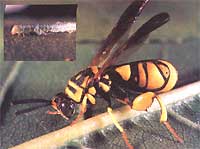
The 2,200 or so North American species of chalcids are
members of a large superfamily (Chalcidoidea) which is
divided into 22 families. Chalcids are typically wasplike
in appearance and have elbowed (jointed and bent) antennae
resembling those of ants. They differ dramatically from
other wasps in size, averaging only two to three
millimeters in length (though some reach 12 mm or more), as
well as in the fact that their wings are practically
veinless. Many chalcids have dark bodies and yellow legs,
but some are brightly colored with a gorgeous metallic
sheen.
Despite the chalcids’ diminutive size, these garden helpers
are death on the eggs and larvae of some of the most
destructive varieties of insect pests, including two-winged
flies, beetles, moths and butterflies, aphids, leafhoppers,
scale insects, and whiteflies.
In addition to their devouring other insects in the
embryonic or larval forms, certain chalcid species display
a number of unusual, and therefore interesting, habits. For
example, some chalcids are well known for
polyembryony , in which anywhere from ten to over
a thousand larvae develop from each egg . . . good news for
the gardener who’s plagued with insect pests and wants to
introduce a large number of beneficial parasites quickly
and with little effort.
On the other hand, another chalcid phenomenon — known
as hyperparasitism — can work against the
gardener, and occurs when a chalcid uses another parasitic
insect for its host, thus negating the beneficial effect of
the victim parasite. (In one species of chalcid, this
hyperparasitism takes on a bizarre twist in that while the
females are parasites of scale insects, the males are
hyperparasites that attack the parasites of scale
insects . . . including the females of their own species!)
The big success story among the chalcids, of course, is
good old Trichogramma , which feeds on such
infamous garden pests as codling moth caterpillars,
cutworms, armyworms, bollworms, hornworms, cankerworms, and
a great many others. (If you decide to purchase a batch of
Trichogramma eggs for pest control, go with T.
minutum to protect orchards and ornamentals, and T.
pretiosum for vegetable and field crops.)
Another particularly beneficial chalcid species is
Encarsia formosa , which has proven helpful in
controlling stubborn infestations of the greenhouse
whitefly ( Trialeurodes vaporariorum ). Because
this little wasp lays its eggs under the skins of whitefly
larvae, its young will hatch right in the midst of an ample
supply of food. (Tests have shown that. this control
measure works best in greenhouses with temperatures
averaging 75 degrees Fahrenheit or higher. In cooler conditions, the
whiteflies may develop faster than the chalcids and thus
lessen the parasite’s effectiveness.)
To round out this discussion of chalcids, I should mention
two species that display atypical habits — one
beneficial, the other harmful. The first of these two
oddball chalcids is the fig wasp (family Agaonidae), to
which nature has given the responsibility of pollinating
the commercially important Smyrna fig — a tree that can
produce fruit only after being pollinated by the wild fig,
or caprifig. And because of the peculiar nature of the
Smyrna fig flower, the fig wasp is the only creature that
can accomplish this feat. The black sheep of the chalcid
family is the clover seed chalcid ( Bruchophagus
phatyptera ), which infests the seeds of several
varieties of legumes and is one of the very few harmful
members of the chalcid clan.
All in all, though, chalcid wasps are among the most
valuable insects you can have in your garden, packing one
heck of a lot of pest control wallop in a very small,
totally natural package.
EDITOR’S NOTE: For more information on fighting pest
and disease attacks without resorting to toxic pesticides,
you might want to check out a copy of MOTHER ‘s latest
special publication, Green Thumbs and Blue Ribbons.
This $3.95 magazine format paperback —
which will also help you plan a productive and healthy
garden — should be available at your
newsstand now!