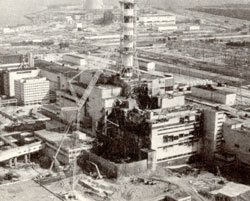
The international nuclear power
industry was quick to distance itself from the Chernobyl nuclear meltdown.
Officials in nearly every nuclear nation assured the public that 1) the
Soviet plant’s design was unique, 2) it didn’t have a protective
containment around its reactor and 3) it lacked sophisticated safety
systems. We were to believe that deficient design was responsible for
the largest release of long-lasting radioactive material ever. The
palliative was, “It can’t happen here.”
The Chernobyl Nuclear Meltdown: What Happened?
Until the Soviets released
a detailed report at an international meeting in Vienna in late August
1986, most pronouncements about Chernobyl were idle speculation. Very
little was known about what actually happened on April 26, 1986. Now we
know that two of the power industry’s initial contentions were false.
1.
Chernobyl No. 4 did differ significantly from most nuclear plants in
the West. It combined common elements in an uncommon way. The nuclear reactor
was graphite-moderated and cooled by pressurized water, which means that
the uranium fuel rods were arrayed in a matrix of graphite that slowed
(but didn’t absorb) neutrons to facilitate self-sustaining fission, and
that heat was removed by pressurized water flowing around the core.
There
are, in fact, many graphite-moderated reactors in use in the West, but
most are gas-cooled. Pressurized water reactors (PWRs), which use water
for both moderation and cooling, are more common, but most of the plants
in England are graphite-moderated and gas-cooled. Graphite-moderated
reactors are also used in France, Italy, Japan and the United States (at
Hanford, Washington, and Savannah, Georgia), and a few of these are
cooled by pressurized water. The reason for the popularity of
graphite-moderated reactors is simple: Their internal geometry is
particularly good for producing plutonium for bombs. (Surprisingly,
Chernobyl doesn’t seem to have been used for this purpose.)
Graphite
core reactors aren’t inherently more hazardous than PWRs–each type has
advantages and disadvantages–but the combination of graphite moderation
with pressurized-water cooling may have been a crucial factor at
Chernobyl.
Chernobyl No. 4’s design has what is called a positive
void coefficient. If the core overheats and actually boils the cooling
water, neutron absorption declines and the reactor may become hotter
yet. In a pressurized- or boiling-water reactor, the opposite happens
because the water is also the moderator. As the moderator/coolant boils,
fission declines despite reduced absorption, because neutrons begin to
move too fast. Gas-cooled reactors, an entirely different can of worms,
are designed to be self-limiting. Had the Chernobyl reactor been
designed with a negative void coefficient, the accident might not have
happened and certainly would have been less serious.
2. Despite
official statements made in the U.S. right after the accident, Chernobyl
No. 4 did have a reinforced-concrete containment–one that was installed
in 1980. Whether the shell was comparable to what you’d find on the
average U.S. reactor isn’t clear. In any event, Chernobyl No. 4’s outer
shell was probably breached by a powerful hydrogen explosion, which, you
may recall, was the greatest fear in the days following the Three Mile
Island accident. The power released in such an explosion could be great
enough to destroy any existing reactor’s containment.
3. Chernobyl
No. 4 was one of the Soviet Union’s best nuclear power plants. Prior to
the events of late April 1986, the Soviets had planned to add units 5
and 6 to give a total output of 6,000,000,000 watts, enough to light up
all the homes in England. No. 4 had a many-tiered safety system that
differed from Western versions mainly in that its control was not fully
automatic. Since the Soviets judged completely automatic safety systems
to be unreliable, they made it possible for operators to deactivate or
override the systems–a fatal miscalculation.
A Tragedy of Human Errors
The Chernobyl nuclear meltdown appears to have been caused almost entirely by
human error–errors, actually, an incredible string of them. The plant
was, by design, more vulnerable to an accident than most, but it still
took bungling to bring one about.
Reactor No. 4 was being powered
down for an annual fuel change and maintenance. During power reduction,
which takes more than a day, the operators planned to do a test to see
how long the generators would continue to produce electricity after
steam had been cut off to the turbines. Emergency systems were dependent
on the reactor’s own power production until back-up diesel generators
could be brought on line, so it was important to know how long the
reactor could support its own safety net.
Operators began to
reduce power in the wee hours of the morning on Friday, April 25. By 1
o’clock that afternoon, output had dropped to half of normal, and the
operators switched of the emergency cooling system. An hour later they
received an urgent request to maintain power until later in the day, so
they stopped the shutdown. Unfortunately, they failed to turn the
emergency cooling system back on-the first of six violations of
operating rules.
Near midnight on the 25th, the plant’s
electricity was no longer needed, so the operators continued the
shutdown. However, a disconnected automatic control allowed the power to
drop too rapidly to perform the required test. Rather than abandon the
experiment and face the music with their superiors, they decided to try
to restore enough power to do the test.
At this stage a reactor
can be very difficult to get going again, but the operators continued
undaunted. They pulled a number of the control rods all the way out of
the core in an effort to restore power. When inserted between the fuel
rods, the control rods slow fission by absorbing neutrons. Normally,
it’s against Chernobyl’s rules to leave fewer than 30 control rods in
the core; the best guess now is that they left in only six or eight.
With
so much of the fuel exposed, the reactor began to behave very unstably,
heating more in some areas than others and running at a critically low
coolant level. To counteract this, the operators switched on more pumps
to circulate coolant. This actually worsened the instability, and the
reactor quickly reached the point where it was ready to shut itself down
automatically. Rather than give up the test, the operators switched off
the automatic shutdown system.
At 1:23 a.m., April 26, they
started the experiment. As the turbines spun down, water flow declined,
and Chernobyl’s engineers were quickly faced with a crucial lack of cooling. Within half a minute they realized that the reactor was running
out of control, and they tried to shut it down by dropping all the
control rods into the core. Probably because the fuel rods had already
overheated and distorted, some of the control rods failed to go all the
way into place.
Within seconds, power in a small part of the core
went from less than 10% to perhaps hundreds of times normal. In fact,
the first explosion may actually have been a slow-motion version of an
atomic bomb going off. The fuel in the Chernobyl reactor didn’t melt; it
shattered when the reactor reached “prompt critical”-something that
nuclear engineers had considered all but impossible. The blast blew
apart the top of the reactor’s core and destroyed the service crane
above it. The zirconium on the fuel rods then reacted with steam from
ruptured cooling lines to produce hydrogen. The subsequent explosion
shattered the containment, sending radioactive material into the air and
spreading fire about the plant. Only acts of heroism by firefighters
(many of whom died) prevented the flames from destroying reactor No. 3.
At
this stage, the graphite in the reactor’s core had a profound effect on
Chernobyl No. 4’s release of radioactive isotopes. It caught fire and,
with the hydrogen, burned with intense heat, carrying radioactivity
straight up into the windless night. Flames may have reached a height of
500 meters. The prevailing wind at altitude (to the northeast) happened
to be over relatively unpopulated areas, and there was no rain in the
Chernobyl area to drop the radioactivity on nearby inhabitants. Though
even the Soviets estimate that 30,000 to 40,000 of their citizens will
eventually die as a result of the Chernobyl accident, the casualties
were (and will be) far lower than could have been the case. Of course,
the radioactivity that didn’t fall in the immediate area was carried on
the wind to places such as the Forssells’ small organic farm to the
northeast in Sweden.