


Tax credits for energy-efficient home improvements; blower
door tests to fix drafty houses; and preventing window
condensation.
By Ken Sheinkopf
NEW ENERGY INCENTIVES
Back in the early 1980s, we bought a solar water heater for
our home and took advantage of a great federal tax credit
(I think it was around 40 percent). I heard on the news
that the new energy bill signed by President Bush has tax
credits for solar energy systems. Are these the same
credits we had before?
–Joseph W.
Scranton, Pennsylvania
Actually, they are much more comprehensive. The Energy
Policy Act of 2005 is the first major federal government
program for energy in the past 13 years, and it gives tax
credits far beyond the solar-only ones that started during
the Carter administration and ended in 1985.
The new bill provides tax credits for highly efficient new
homes, improvements to existing buildings, high-efficiency
air conditioners and home fuel-cell systems, as well as
solar water-heating systems and photovoltaics (solar
electric systems) installed after Jan. 1, 2006.
Credit amounts range from 10 percent to 30 percent–or
offer a fixed dollar amount depending on the measures you
take–and you can take advantage of multiple tax
incentives when you buy a home or improve your current one.
Keep in mind that these are credits, not deductions. The
amount of the credit is subtracted directly from the taxes
you owe, unlike deductions, which are subtracted from your
income to determine your tax liability.
If you buy a new home that uses at least 50 percent less
energy compared to the requirements in the model energy
code–which contains energy-efficiency criteria for
new residential buildings–you will receive a $2,000
tax credit. Even if you aren’t buying a new home,
many incentives are available that can make your next home
more efficient. Fix up your current home with insulation,
new windows or doors, and you can receive a credit of 10
percent (up to $500). Buy a high-efficiency air
conditioner, water heater or fan and you can get a credit
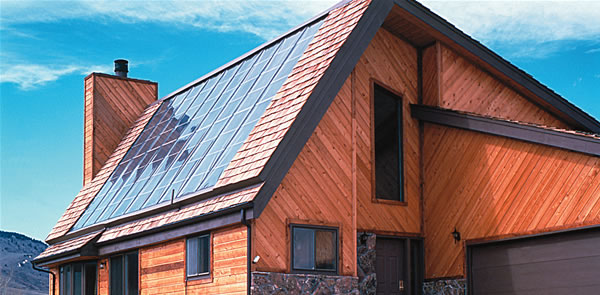
up to $300. Solar water-heating systems and solar electric
systems are eligible for credits of 30 percent (up to
$2,000 each). Other products and building strategies are
eligible to receive credits, including incentives
specifically for manufactured homes. You can check out this
easy-to-follow summary of the incentives at
aceee.org/press/Tax_incentive05.pdf, or get a summary of
the various programs at fsec.ucf.edu/EPAct-05.htm. For more
detail, you can find the entire 1,724-page bill at
energy.senate.gov/public/_files/ConferenceReport0.pdf.
DO YOU NEED A BLOWER DOOR TEST?
We’ve had contractors come to our home and talk to us
about energy-saving ideas. They told us we need a blower
door test. Is this some kind of gimmick or will it actually
help us?
–Jason G.
San Diego, California
In a world where e-mail messages promise us great riches
and incredible bargains every day, people are extremely
skeptical about sales claims. However, in this case, the
answer is a resounding “do it!”
One of the most likely causes of high energy bills is air
leaking into and out of your house. The easiest way to tell
if your home is leaking air is to walk around your home on
a windy day and hold your hand near windows and doors, in
front of electrical outlets and against walls to feel for
any air currents. Odds are good you’ll find places in
your home that need to be sealed better–usually
around openings from the outside for wires and pipes, in
places where different building materials meet, and where
cracks and holes have developed in walls or floors. Sealing
these openings will dramatically reduce the amount of
cooled or heated air that escapes outside and, conversely,
will keep outdoor air where it belongs.
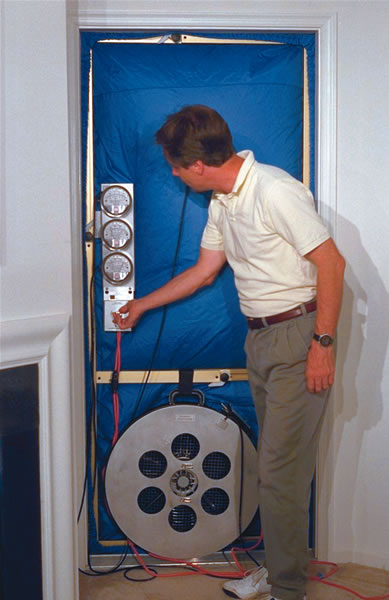
Since the 1970s, heating, ventilating and air-conditioning
(HVAC) contractors have used blower door tests to measure
unwanted airflow problems. It’s a fairly simple test:
A special panel system with a variable-speed blower is
fastened securely into one of your home’s doorways,
and the blower creates a pressure difference between the
inside of your home and the outdoors that pushes air
through any openings. The contractor probably will use a
little smoke stick that allows him or her to see where the
air is flowing. The problem spots then can be identified
and sealed to stop the air leakage. HVAC contractors also
can identify leaky places in your home’s ductwork,
which can be another major cause of high energy bills.
Your contractor often can perform these tests at a fairly
low cost, and repairing the sources of unwanted airflow is
not expensive. Take the advice of the HVAC contractor and
have the leaks sealed. Be sure to hire someone with
experience in this field and check his or her references.
This isn’t a job for the casual DIYer or for a
company without experience and knowledge of home ductwork
systems.
REDUCING WINDOW CONDENSATION
We live in an older house that hasn’t been remodeled
much over the years, and we get a lot of condensation on
our windows. I know you would recommend replacing them with
newer windows, but can we do anything about this without
spending much money?
–Bernice W.
Omaha, Nebraska
Basic windows with single or even double panes that have
standard aluminum frames can cause water vapor to condense
on the inside of the windows during winter. That water
often drains to the bottom of window sills where it can rot
the sills and even ruin the wall finish and sheetrock.
Condensation can be a problem in summer, too, when moisture
collects on the outside of windows after the glass surface
falls below the dew point.
Certainly these problems can block your exterior view, but
what’s worse is the damage they can cause to your
home. Frankly, it’s hard to eliminate all the
moisture that accumulates on windows, which is especially
prevalent in single-pane windows or in homes with
inadequate ventilation. But controlling this moisture
problem can help reduce the growth of mold, mildew and
damage to the walls.
One thing you can do is lower your home’s indoor
humidity. Use vent fans in your kitchen and bathrooms to
remove moisture from the house. Make sure your clothes
dryer is vented to the outdoors and the exhaust is flowing
freely out of the machine and into the vent. In winter,
cover your windows with storm windows or insulation kits
available at hardware stores. If you have a humidifier,
make sure it’s not set to put too much moisture into
the home’s air.
Ken Sheinkopf is a communications specialist with the
American Solar Energy Society (www.ases.org).