
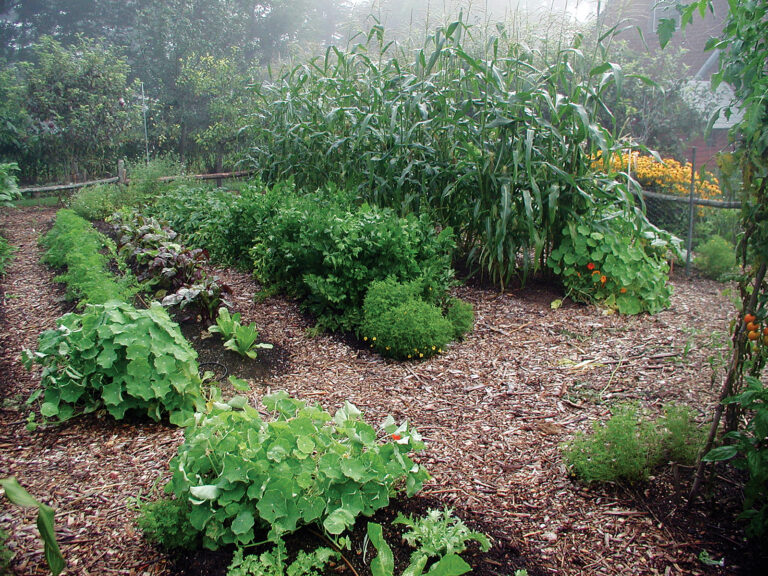
Learn how to keep weeds out of a vegetable garden by following these four simple rules. Organic weedless gardening is not as impossible an idea as it seems!
Weedless gardening! That’s an oxymoron, an impossibility, right? Well, my gardens may not be 100 percent weed-free, but they are 100 percent free of weed problems.
I’ve achieved this happy state in four ways:
- Never till or otherwise disturb the soil. Dormant weed seeds stay asleep, away from light and air.
- Designate permanent areas for walking and planting. Avoid compaction and the need for tillage.
- Maintain a thin mulch of weed-free organic material. Snuff out any weed seeds that blow in or are dropped into the garden by birds
- Use drip irrigation. Whenever watering is called for, avoid watering with a hose to avoid promoting weed growth in paths and between widely spaced plants.
Those are the basics of keeping my garden free of weed problems, with different techniques to counter the spectrum of defenses put up by the worst garden weeds. Over the years I’ve honed some details of this weedless gardening system, and I’d like to share them with you.
Organic Fertilizer and Mulches
A particularly nice aspect of this weedless gardening system is how much it simplifies fertilization. I rarely use commercial fertilizer. It’s not that my plants don’t need food, it’s just that the slow and steady decomposition of the organic mulches fulfills most of my plants’ nutrient needs.

Where extra nitrogen might be needed, I use soybean meal, which supplements the diet of young trees, bushes and intensively grown vegetables. The soybean meal is inexpensive, readily available at farm and feed stores, and only needs to be applied once a year. The nitrogen in soybean meal applied anytime from late autumn to late winter will not leach out of the soil during the cold months, but begins to release as spring’s moisture and warmth awakens hungry plants. For plants that regularly need that extra nitrogen, I spread 1 to 2 pounds per 100 square feet. Other meals, such as cottonseed or alfalfa meal, can be used similarly, but generally cost a little more.
If your soil is naturally poor, you may want to apply other nutrients as fertilizers, such as phosphorus and potassium, until organic mulches decompose and build up a reserve of those nutrients in the soil. Bone meal, seaweed and wood ashes are all good sources of phosphorus and potassium.
Because organic mulches are the main source of nutrients in weedless gardening, I tailor which mulch I use to the particular plant’s needs. Generally, this involves nothing more than using nutrient-rich mulches for plants that are heavy feeders, and other mulches for light feeders. Two nutrient-rich mulches for my vegetables are compost and grass clippings; I make both right here at home.

If you’re not up to making your own weed-free compost, you often can buy good bulk compost locally. I often spread a thin layer of grass clipping on top of the compost in my vegetable beds. The thin layer of grass clippings helps smother any weed seedlings that survived composting, and keeps the compost moist to make the nutrients in it more readily available. Be careful about using neighbors’ grass clippings, however. I found this out the hard way 30 years ago, as I watched my potato vines wilt overnight after using what I later learned were clippings from a lawn that was treated with weed killer.
Wood chips or leaves (whole or shredded) are good mulches for plants that aren’t particularly heavy feeders, such as established trees and shrubs, most flowers (delphiniums and roses are notable exceptions), and just about everything else. I get wood chips from local arborists, and “harvest” bags of leaves from my neighbors, who call me when it’s time to pick them up — a supply I occasionally supplement with a truckload of leaves from a local landscaper.
Cover Crops for a Weedless Garden
Over the years, I’ve become increasingly interested in living mulches, also known as cover crops — plants specifically grown to protect and improve the soil. Like traditional mulches, cover crops smother weeds, enrich the soil with humus that increases nutrient availability, and add nitrogen to the soil in the case of leguminous cover crops.

Two big advantages of using cover crops as mulch are that the cover crop roots improve the soil as they grow and die, plus you only have to carry a small bag of seeds out to the garden, rather than hauling garden carts full of bulky materials.
You can set aside part of the garden to plant a season’s worth of cover crops, or try my approach: squeeze in cool-season cover crops at the end of summer and again in early autumn. Because of my no till gardening technique, I grow cover crops, such as oats, peas and barley that naturally succumb to winter cold here in New York. By winter’s end, I just rake up the stems and leaves on top of the soil, leaving the dead roots intact, along with the myriad channels they’ve created.

Crops that don’t naturally winterkill can also be used. Just mow them over when they’re about to flower, or dispose of them with repeated mowing. To learn about the best choices for your region, download “Managing Cover Crops Profitably.” To order cover crop seeds by mail, contact Peaceful Valley Farm Supply or Johnny’s Selected Seeds.
Drip Irrigation
Drip irrigation helps keep my garden weed-free, because it doesn’t water weeds along the paths or between rows the way regular sprinklers do. Slowly dripping water onto the crop’s root zone also conserves water. In fact, drip systems can reach 95 percent application efficiency, and save up to 75 percent of the water used by sprinkler systems.

You can buy drip irrigation system installation kits at garden centers, hardware stores and home improvement stores. For larger systems, consider hiring a landscape professional. A basic drip irrigation system consists of five elements:
- Feeder tubes. Often called “emitters” or “drip tape” because it’s sold flattened on a roll, these tubes are made from black polyethylene plastic, with holes spaced at regular intervals to dispense water at a relatively constant rate, even with changes in elevation and water pressure. For widely spaced plants, individual emitters can be plugged into mainline piping as needed.
- Mainline piping. Also called a lateral line, this piping connects the water supply to feeder tubes.
- Fittings. You’ll need a variety of fittings, such as valves, connectors and end caps, to connect irrigation lines, close them off, control the flow of water, and keep it from flowing back into the main water source.
- Filters. Sand or screen filters pull impurities from the main water supply to keep feeder tubes from clogging.
- Pressure regulators. Spring or valve regulators help reduce water pressure to the feeder tubes.
I use a drip irrigation system in parts of my garden that need regular watering, such as vegetables and young blueberry bushes.
In my vegetable garden, I run half-inch mainline piping perpendicular to the 3-foot wide beds. Then I plug in a quarter-inch barbed transfer fitting, and attach quarter-inch feeder tubing and run it down the length of the bed. The tubing comes with emitters at 6-inch intervals, each dripping a half gallon of water per hour. For wider beds, in drier climates, or locations with lighter soils, you might want to run two dripper lines down each bed.
Young blueberry bushes require at least 1 inch of water a week, since they have shallow root systems. To water them, I run half-inch mainline piping along the row of plants, then plug a quarter-inch barbed transfer fitting into the mainline piping at each bush. I attach a short length of quarter-inch solid tubing to the mainline, which is terminated by an emitter that drips a half gallon per hour at the roots of each bush.
How To Keep Weeds out of a Vegetable Garden
Weeds constantly threaten to invade the edges of any garden. The most direct way to thwart interloping weeds is to just grab them by hand and pull them out. I also maintain a 6-inch-wide bare soil “Maginot line” of defense around parts of my garden with a Winged Weeder hoe, which has a sharp blade that lies parallel to the ground as you work with it. In a more formal part of the garden, I created a low-maintenance weed barrier with half cinder blocks laid flat right next to each other in a fitted, shallow depression, so I can run the wheel of my lawn mower along it.
If you have ever chopped the tops off dandelions with a hoe, you know that it’s only a short time before they sprout yet again from their robust roots. To eliminate the possibility of an encore, I pull out these weeds individually to be sure I get their tops along with their roots.
Removing one weed at a time would be too tedious where a colony of young weed seedlings has sprouted. When this happens, I recommend using a hoe for how to keep weeds out of a vegetable garden. I think the traditional garden hoe that most gardeners have hanging in their garage is far better at mixing concrete than killing weeds. If you’re focused on how to select garden hoes for gardening tasks, a better choice is a collinear hoe, stirrup hoe or the Winged Weeder. With a Winged Weeder, a few simple strokes back and forth (like mopping a floor), just a hair beneath the soil’s surface, will do the job quickly while you barely break a sweat.
A Safe, Natural Herbicide
For larger areas, such as my brick terrace and beneath fruit trees, I resort to herbicide — not the toxic stuff that lines shelves of nurseries and hardware stores, but household strength (5 percent to 6 percent) vinegar. For maximum effectiveness, I spray vinegar on small plants because they have weaker root systems and fewer leaves to be “shaded” from the spray. Established weeds will resprout new leaves following a vinegar spray, but if you kill back the leaves several times, eventually the plant will starve to death.
You can increase the vinegar’s ability to spread and stick to leaves by adding 1 tablespoon of dish detergent and 2 tablespoons of canola oil per gallon of vinegar. The vinegar is most effective at temperatures above 70 degrees, and while it will burn just about any greenery, it’s most effective against grasses. Early in the season, once the weather warms, spray weekly, then progress to a biweekly or monthly schedule, depending on the weather and weed growth.
My final attack on weeds entails (dare I say it?) regular weeding. I’ll hoe or pull weeds here and there as I walk through the garden, and as I harvest and plant. Just think of your hoe as your walking stick. For all the negative connotations of weeding, I consider it part of any pleasant visit to the garden, probably because the few weeds I have are neither ominous nor demanding these days.
Lee Reich is the author of numerous gardening books, including Weedless Gardening.






