



I farm the soil that yields my food. I shared creation. Kings can do no more. — Ancient Chinese Proverb
Perhaps you spent a dreamy winter day among the sweet promises of seed catalogs, or maybe you’ve been seduced by the memory of granny’s tomatoes. It could be that the latest ticker tape of grocery receipt provided the trigger. Or was it the wholesome fantasy of trading jogging shoes for a hoe? At any rate, you’ve decided to plant your first-time-ever garden. Congratulations! And welcome to the 44% of American families that share an addiction that we euphemistically call a hobby. Oh, you’ll hear the same old rationalizations from most of us: We’re gardening to save money, to keep fit, to put good food on the table, or to spend time outdoors. And those reasons might have provided motivation when we were at the same beginning gardening stage as you.
As you’ll come to know, though, what makes us pull out our tools year after year is the sheer wonder of sticking that pinhead-sized little ball of a broccoli seed into the ground and — ta-da! — eventually harvesting something that holds up the hollandaise. Big crop, little crop — it doesn’t matter really. As much fuss is made when just one fine head ripens as when we cart off bushels.
In short, it’s being smack-dab in the middle of a real-life miracle that makes this pastime pretty hard to resist. Who can get enough of it? Building a cabinet or piecing a quilt just aren’t quite the same. Only gardening (and having children) lets you stand so close to the miracle of life that, like the ancient Chinese quoted on this page, you feel as if you’re sharing in creation.
Yes, welcome to gardening. None of us can ever claim to really know the territory. We’re all learning as we grow. Each year’s a mystery — a renewed challenge — during which you’ll reap plenty of mouth-watering vegetables at the very least. What’s more important, you’ll occasionally have the opportunity to feel like the only person who ever saw a honeybee wake up after spending the night on a morning-glory, or the only soul who’s seen the wind rattle a corn leaf, making the plant appear to be scratching its own back. And like a brand-new parent, you’ll be blind to the beauty of any broccoli other than your own.
Getting Started
When learning to ride a bicycle, you don’t read up on aerodynamics, physics, gravity, and inertia. Instead, you simply ask someone how to start, steer, and stop the thing, then hop on and give it a go. And you keep hopping on until you’re pedaling vertically. The same goes for gardening. You might want to read a few good books, and you will want to find at least one neighbor who’s gardened in your area awhile and pester him or her to death (the odds are great that most gardeners won’t mind at all). Then simply go get your fingernails dirty. To get you started, I offer the following basic advice. (You’ll have to find the neighbor yourself.)
1. Learn your climate zone: It’s on that little map you’ll see in seed catalogues or comprehensive gardening books. Climate zones are bands where weather conditions (average rainfall and temperature) fall into the same range, and seed catalogues will list (by number) which ones are suitable for certain plants.
2. Memorize your first and last frost dates: Planting times for everything from radish seeds to fruit trees depend on when frosts occur in your location.
3. Know your soil’s make-up: Have a soil test done. (See “Fertilization” below.)
4. Be aware of available warm-and cool-weather crops: Some vegetables grow best in warm weather and some in cool.
5. Look into local clubs: Check the library or chamber of commerce for a list of garden-related clubs, organic growers’ organizations, and native plant societies
are widespread, and their members will be more than willing to help you get started.
6. Read one or more of these books on gardening basics: How to Grow More Vegetables by John Jeavons; The Self-Sufficient Gardener by John Seymour, The Healthy Garden Handbook by the staff of MOTHER EARTH NEWS.
Soil Fertilization
Soil testing is the map to any good fertilization program; it tells you how to “get there from here.” It’s all too easy to waste money and risk nutrient imbalances by guessing at what your soil needs. Labs whose personnel are not chemically oriented will give custom-tailored recommendations in terms of compost and such natural amendments as rock powders and animal bone and blood by-products that are dried, ground, and bagged. These additives break down more slowly than synthetic fertilizers, are gentler to plants and soil, and are much less likely to be leached away.
Best of all, “natural” soil testing firms speak a language you can understand. Granted, the local agricultural extension service, home kits, and many standard labs are much cheaper — but will you know what to do with all those unexplained numbers and equations?
Fall is the best time to send samples for evaluation, and you should plan to prepare for next year’s garden this autumn. I guarantee the results will be quicker than in this year’s unavoidable last-minute spring rush.
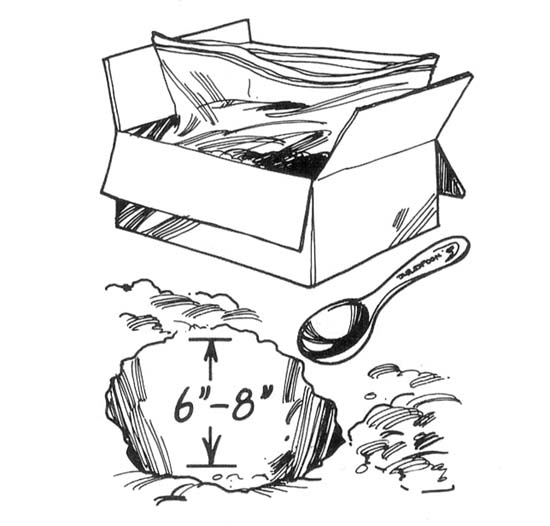
With clean utensils, and without touching the soil with your hands, gather samples at a depth of from six to eight inches, and do so in 10 to 15 places around the garden. Mix the soil thoroughly to create a composite specimen. Secure at least a pound of dirt in a plastic bag enclosed in a small but sturdy box, and mail it off.
Gardening Tools
I’ll bet a quart of fresh raspberries that no two sheds in America contain the exact same set of garden tools. My neighbor’s traditional hoe has a deep, smooth gully worn in the handle from years of use. I, however, tended to avoid hoes until I discovered the more recently introduced stirrup kind.
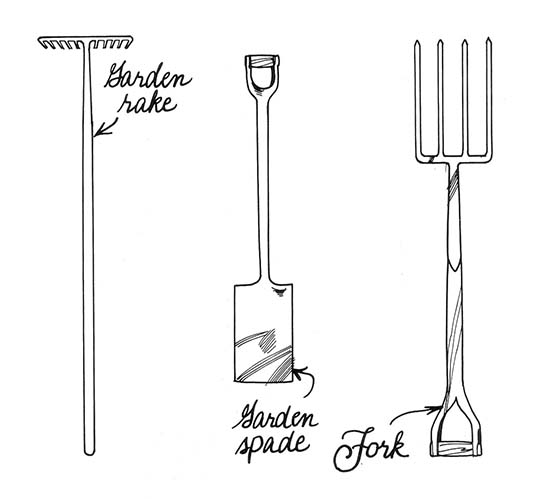
Equip yourself with at least the basics, some of which you may already have. You can always add more equipment if and as the need (or, let’s face it, simple covetousness) arises. For starters, round up a wheelbarrow, leaf rake, garden rake, trowel, soil-turning tool of choice (motorized tiller or garden fork), spade, hoe, and sharp knife (for harvesting, cutting twine, etc.). Add some quality hoses, a few sprinklers, and a hose attachment (such as a fan sprayer or, better yet, a watering wand) for watering by hand. You’ll also need a hammer, pegs, and twine for laying out lines and patterns, plant tags, a file for keeping a sharp edge on things, buckets (plastic are often free for the asking) and an assortment of empty containers (coffee cans, milk jugs and such).
After you’ve obtained the basics, anything you can imagine — from the practical to the absurd — is out there for your pleasure. I’m pretty sure I can forgo ornate brass faucet handles and copper watering cans, but don’t ask me to give up my soft-spray nozzle attachment, hand pruners, or minimum-maximum thermometer.
Site Selection
Think big — dream of future orchards, vine-covered walkways, and stone walls — but start small. A compact garden will leave you with enough time to get to know your piece of earth and the plants and insects that share it with you; time to do things right.
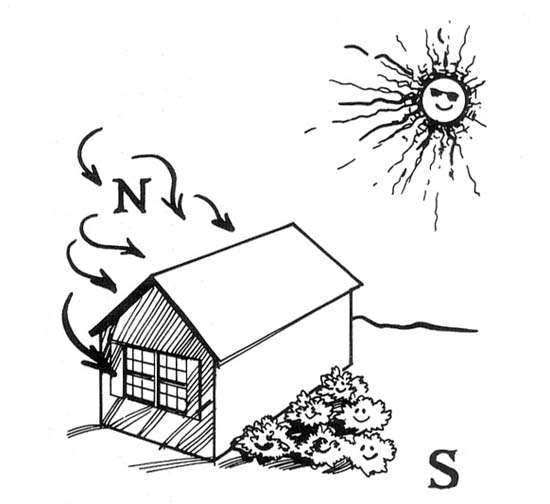
Think weather. The placement of a garden, even within the framework of a small lot, can significantly determine how much energy you’ll have to expend battling the elements. Generally speaking, hillsides are better locations than either the tops (where wind can batter plants) or the bottoms (where water and cold air accumulate). A south-facing slope gets the most sun and turns its back on cold north winds. Western slopes allow frozen plants to thaw slowly, though higher overall temperatures occur there than on east-facing hillsides, which shelter heat-sensitive plants in midsummer. And even northern slopes can be put to good use as orchard sites, since lingering spring cold can keep early buds from opening too soon.
You might not know it, but there’s a great little microclimate on the south side of your house or outbuilding, which offers protection against north winds and provides mass to absorb radiant heat during the day and slowly release it at night. Lakes and ponds also reflect heat and light to edge-of-the-water plants, but sometimes they provide open pathways for winds as well.
Watch what happens to rain and snowfall. Does the ground drain or puddle? Does snow melt quickly (a sunny spot) or linger for days (possibly too shady)? Will crops get at least six to eight hours of direct sunlight each day?
Think water. Is the area in mind close to a source of reliable, easily tapped water? If not, consider what it will take (laying pipe, purchasing a pump, etc.) to bring the life-giving liquid to your crops.
All factors considered, it pays to choose a location close to your house. The farther you must go to weed the carrots or pull some greens for dinner, the greater the chance you won’t. If you’re lucky enough to have several small sites, plant herbs, lettuce, tomatoes — things you cook with most often — within plucking distance of the kitchen door.
Last, but not least, kick the dirt around a little. Dig up a spadeful at each potential site. Handle it, squeeze it, smell it. Crumbly, loose and sweet-smelling earth will be easier to work with than soil that feels like modeling clay, or sand that sifts through open fingers.
There, that didn’t take too long, did it? And now — get out the champagne, straw hat, and red-ribboned spade — it’s time to finally break ground.
Site Preparation
If weeds and grass now stand tall where your dreams call for corn and tomatoes, top them with a mower or swing blade, pile the cuttings near the site of your compost heap, and consider yourself fortunate to have found a good source of organic matter. Then, pull out any large rocks and clear the area of trash.
Now stand back and once again envision that garden-to-be. Try to put borders on that dream. To do so, simply ask yourself: How much time will I honestly be able (and willing) to devote to this garden?
A postage-stamp plot (so called for its tiny dimensions) is perfect for people with busy schedules. One or, at the most, two 4′ x 20′ raised beds or a single 20′ x 20′ row plot is garden enough for most folks to start with. For those who can (and will) put in four to six hours per week of garden time, four (4′ x 20′) raised beds or one 20′ x 40′ row plot can produce all the fresh vegetables needed by a family of four, and then some.
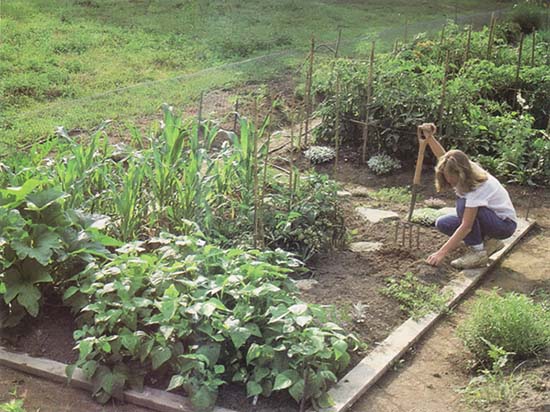
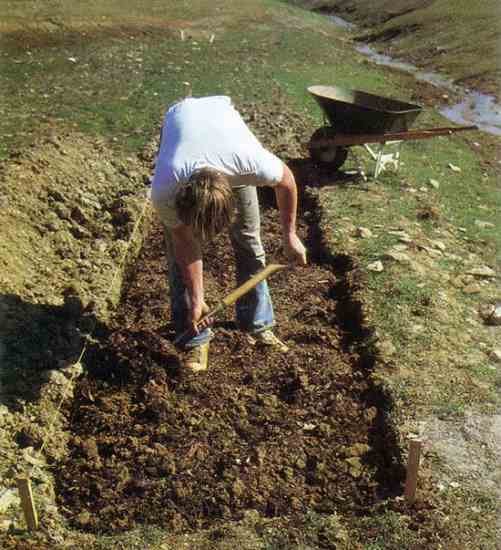
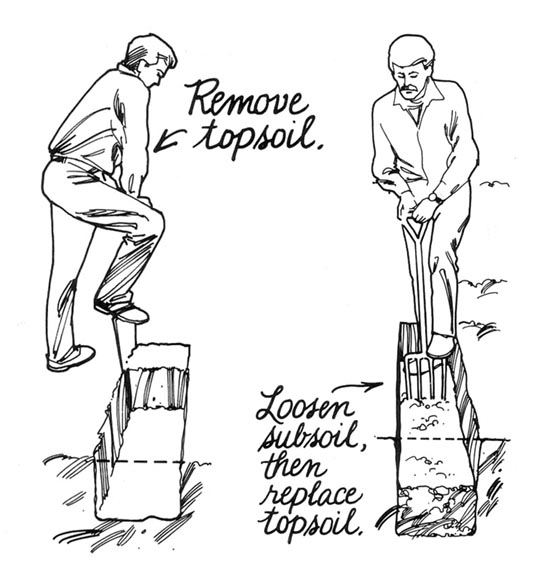
Areas that have been in sod for many years are among the toughest to prepare. So is heavy clay. In the best of all worlds, you’d be able to first turn the soil in fall and plant a winter cover crop to break up hard clods and choke out grass. If you’re starting now, though, at least plan on the autumn cover crops to come. If the turf has a persistent root system, remove it, roots and all, and shake the topsoil back onto the plot. Small areas can be worked by hand with a spade and fork; large plots will probably require a garden tiller or tractor (you might borrow or rent this tool, at least for the first year).
And how thoroughly should you work your soil? If using a tiller, break up the earth to the maximum depth of which the machine is capable. Then, if you’d like, use a garden rake (or even a shovel) to pile the loosened earth into wide beds or rows. If you’re doing the job by hand, try to break up the soil thoroughly to at least the depth of your garden fork’s tines. Once again, a rake can be handy for the final shaping and pulverizing of the seedbed. Double-digging, a technique used to prepare wide, raised beds, is very popular among our staff. This involves first using a spade to remove the upper soil to about a foot in depth, then loosening the undersoil to the depth of a garden fork’s tines and finally replacing the removed soil to produce a “Huffed” bed that’s higher than the surrounding soil and loosened to a depth of almost two feet. For more information on this valuable technique, see John Jeavons’ book listed above or any of a number of articles on the subject that have run in past issues of MOTHER EARTH NEWS.
Previously used garden sites are, of course, relatively easy to prepare, and you should think seriously about using one if available. Whatever the situation, as you work and shape the soil, incorporate an inch of compost (purchased, if you haven’t had time to make your own yet) and the natural amendments recommended in the results of your soil test. Again, this would best be done in fall to give these slow-releasing fertilizers a chance to break down, though spring is a good second choice.
Now it’s time to give yourself a pat on the back. Behind you is some of the hardest work you’ll ever need to tackle in the garden.
Seed Starting
Many seeds (peas, beans, carrots, corn and potato eyes, among others) are best sown directly in the ground. Others, like broccoli, cauliflower, tomatoes, and peppers, need to be started indoors. You might wonder if it’s worth it to raise them yourself when it’s possible to buy seedlings from a local nursery.
Come on. Remember the broccoli seed — the real-life miracle — the sharing of creation? Go for it!
After all, should you fail, the nursery stock will be there to fall back on. Seed starting is a skill worth developing, allowing you to decide what kind of broccoli you want (purple-headed, chartreuse cone-shaped, old heirloom or sprouting), instead of settling for whatever the stores offer.
Today there are special-interest catalogues offering seeds and plants to suit nearly every locale or gardener’s desire: hot-climate, cold-climate, high-altitude, open-pollinated, and nontreated seed; gourmet, unusual, and ethnic vegetable varieties; aquatic plants; container vegetables;
blue corn and white carrots.
You’ll want to send for next year’s seed wishbooks in November and order in December and January. For this season, shop for seeds at the nursery, and buy seedlings for anything that you won’t have time to start yourself. Many flower seeds must be planted indoors in February, and some vegetables must be started in March.
Make selections based on the foods your family likes to eat. Grow more of things that you hope to can, freeze, or dry. Smaller-than-average seed packets (sometimes labeled “kitchen,” “mini,” or “trial”) are great for little gardens or for growers interested in just trying something new. For this first year, pick varieties specifically listed as “easy to grow.” And do include a few flowers and maybe some herbs. They’ll not only help attract beneficial insects and confuse pesty ones, they’ll also add bright splashes of color and fragrance that will draw you into the garden often.
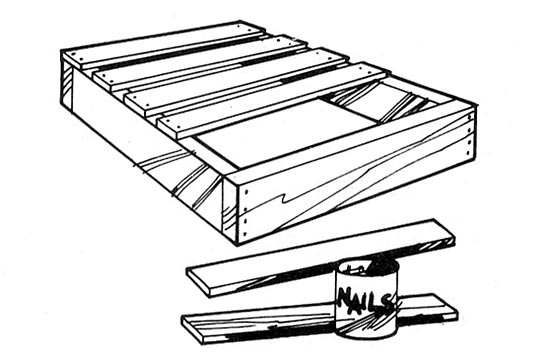
Are you the handy type? Then build wooden flats for starting your seeds, preferably out of cedar or any other rot-resistant wood. The standard size is 14 inches wide by 23 inches long. Make some three inches deep and others six inches deep. If scrounging’s more your forte, use paper cups, butter tubs, or anything deep enough to allow roots to expand (be sure to punch holes in the bottoms for drainage).
Of the endless variety of commercially available seed starters, I recommend two: Speedling trays are polystyrene pyramid-shaped cells molded into a one-piece solid tray. They’re available from Peaceful Valley Farm Supply. Try model 200 with 72 cells, two inches square by three inches deep.
The APS system is also based upon a polystyrene tray, but one with fewer cells for the money. However, this system features a water-wicking base and a clear cover to automatically keep the growing medium moist for up to a week at a time. It’s available from Gardener’s Supply. Try the APS-24 with 24 two-inch-square cells.
Though garden soil can be used with success as a seed-starting medium when incorporated into a homemade mix, if used alone it tends to crust over, carry weed seeds, and expose tender seedlings to damping off and other soil-borne diseases. Sterilized soilless mixes are widely available and will ensure a new gardener a greater chance of success.
Seedlings can perform some pretty strange contortions in order to reach available light — don’t you let them do it. A sunny south- or southwest-facing window with ample sill will grow some fine specimens, but you’ll need to turn the containers whenever you notice plants developing a permanent lean toward the sun, and also to keep them from becoming dangerously spindly or even from touching the glass on cold nights.
If you don’t have such a window, you’ll have to use artificial lighting. Fluorescent bulbs are preferred over incandescents because they most closely imitate the spectrum of natural light, are cost-efficient to run, and give off cool light. Newly started seedlings require from 12 to 16 hours of light each day, so plug in the fixture first thing in the morning, and unplug it just before you retire. Rotate the containers to ensure even exposure. Be sure to keep the light three to five inches above the foliage as the seedlings grow.
Plant extra. If you want five heads of cabbage, plant 15 seeds. Some won’t make it, and you’ll be able to choose the strongest plants from the ones that do.
Each seed contains enough food to nourish the resulting plant until its first set of true leaves appear. (Those first funny-looking leaves are called cotyledons.) After that, a weak fish-emulsion solution is all that’s needed. Oh, and please don’t let the little guys get root-bound. Move them to deeper containers if they stay indoors longer than four to six weeks.
Transplanting Young Sprouts
Young sprouts accustomed to warm temperatures and the cushy life can’t simply be plunked outside into the cool spring ground and expected to survive. Instead, toughen them up gradually. This process is called “hardening off.” Two weeks before setting them out for the summer, move plants outside during the day. Find a location that receives only partial or indirect sun and is protected from strong winds. At the same time, begin gradually limiting their food and water (but never let them dry out!).
A week before setting out, let your plants experience the joys of direct sunlight. Then, for the last three days or so before transplanting, let them camp out overnight as well.
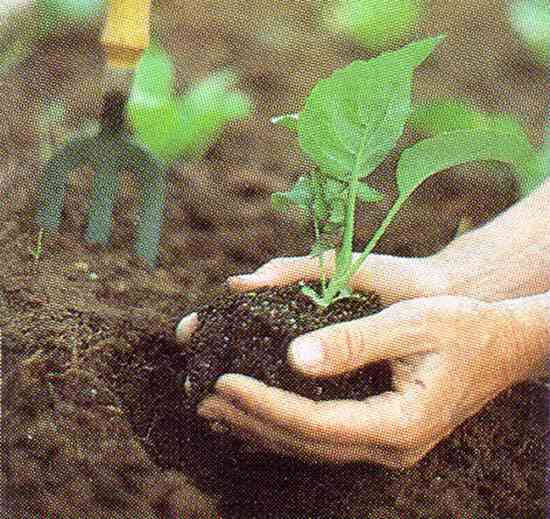
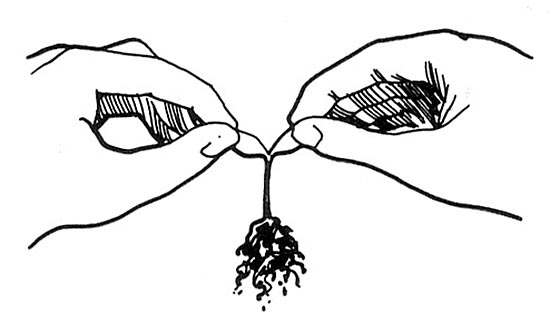
Late afternoon — or any time during an overcast, drizzly day that is sure to stay that way — is ideal for transplanting. Carefully remove seedlings by tapping on or poking from the bottom of their container, using the leaves as a handle if necessary. Never pick up a seedling by its stem. That’s where its delicate food and water transport system is located. With open flats, dig out a clump of plants at a time with a garden fork or your hand, and wrap the roots in a damp cloth to keep them moist.
Open a small pocket of earth with your fingers, a trowel or a large kitchen spoon, then bury the young plant a little deeper than it grew indoors. Set cole crops (broccoli, cauliflower, cabbage) in up to their first true leaves to ensure the solid footing they’ll need to support those weighty heads. A lush root system is encouraged in tomatoes by pinching off all but the top cluster of leaves and burying the bare stem.
Lightly firm the soil around each plant with your hands, water it thoroughly, and, if you have it, add a dose of manure tea made by steeping a small porous bag of manure in a container of water for at least several days.
Garden Culture
At this stage, the garden looks orderly — but somehow timid — with its small, green points of life hopefully punctuating the brown of the soil. But those green dots will quickly spread, so don’t blink or you’ll miss something. Make sketches; take notes and photographs. Enjoy the full spring blush of colors and textures, the bounty of late summer and the rebirth of fall (which can be much like a second spring).
Throughout the year, your care will ensure your plants a long and healthful life. Perhaps the most important job is to learn how and when to water. Plants need ample liquid, and what rain doesn’t provide, you’ll have to. Whenever you think things look dry, dig down a finger’s depth to see how much moisture is in the root zone. Sandy soil loses moisture rapidly, while clay can be hard to drain. When you decide it’s time to water, do so deeply. Shallow watering encourages shallow roots that become susceptible to drought and are unable to anchor plants.
Early mornings and late afternoons are the best times to water. You’ll lose less to evaporation, and plants will have a good supply to carry them either through the night (when much of their
actual growing is taking place) or through the heat of midday.
Second, give heavy-feeding crops additional nutrition by side-dressing them with compost or dosing them with manure tea or nursery-purchased fish-emulsion tea. Do this several times a season for nonfruiting plants (spinach, lettuce, cabbage, potatoes), but not after flowering for fruit bearers (tomatoes, cucumbers, squash, eggplant).
Third, be on the lookout for insects and disease. Catching a problem early can mean the difference between a Band-Aid or a coffin to your crops. Actually, many insects are on your side, consuming hundreds of their damaging kin every day. The only way to know which is which is to use a good reference book such as the recently published The Healthy Garden Handbook, which the MOTHER EARTH NEWS gardening staff put together in conjunction with Simon & Schuster.
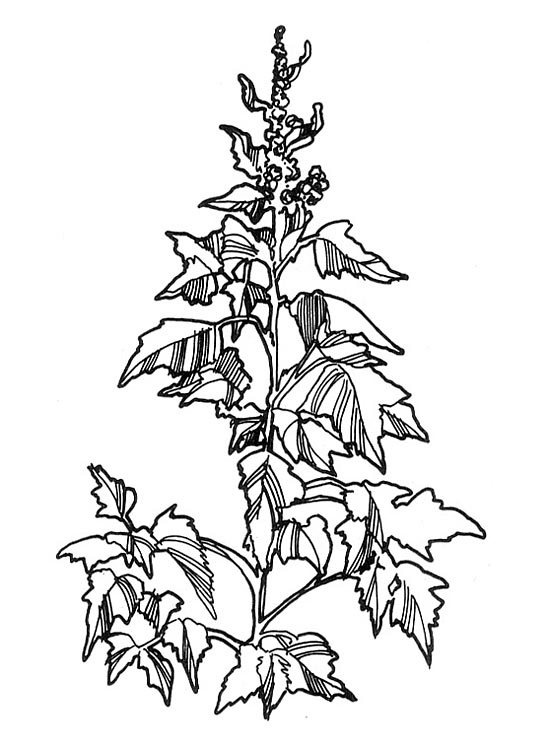
Fourth, pull weeds when they’re young. It’s easier on you to cart out handfuls now instead of armfuls later — and it’s easier on your plants, too. You can actually get even by eating any edible weeds. Many, like lamb’s-quarters, are delicious and vitamin-packed to boot (be sure of your identification before sampling any wild edibles).
There’s an old saying that your shadow is your garden’s best fertilizer, so, finally, be sure to spend time there. Not just time spent working either. Construct a simple bench, picnic table, barbecue, or sandbox — put up a hammock — anything to give people an excuse to play in the garden.
General Tips
Crop rotation: Planting the same vegetable in the same place every year concentrates disease and harbors insects. Rotate light feeders, heavy feeders, and legumes, such as beans and peas, which put nitrogen back into the soil.
Thinning: It’s hard to pull out anything that’s green and thriving, but force yourself. Crowded carrots grow no larger than pencils, and bunched-up beets are marble-sized at best.
Succession planting: To ensure a steady supply of crops like lettuce, radishes, corn, mustard, carrots, and beans, make not one planting but several, spaced about two weeks apart. Plug extra seeds or seedlings into holes that result from harvesting.
Fall gardening: Check catalogues for varieties specifically listed as fall crops, and include seed for these in your initial order. Consult planting charts for when to sow in late summer.
Timing: Plant crops a little earlier or later than normal to miss major insect-pest cycles. This year I’m planting only a fall crop of beans in hopes of starving out the early-summer emergence of the Mexican bean beetle, which thrives here in North Carolina.
Disease resistance: Should you find that certain vegetables always become sickly in your garden, look for varieties specifically labeled “disease-resistant.”
Wrapping Up the Year
There’s a simple way to have a zero-maintenance crop of greenery when other gardens are only a brown memory — to have a crop that checks erosion, aerates soil and supplies spring compost material. Sound too good to be true? As (or even just before) each vegetable crop is harvested, sow a cover crop in its place. We use winter rye mixed with hairy vetch. For other cover-crop choices, read “Green Manure Crops” or check your local feed-and-seed store to see what’s used in your area.
Before the weather gets too cold, gather up garden tools, clean them, and rub them down with vegetable oil. Run the gasoline out of power machines, and store all tools under cover.
Bring in hoses, trellises, stakes, benches, and anything else that winter will wear hard on. Remove plant debris to the compost pile, and tidy up any trash. If you have carrots, leeks, parsnips, or other overwintering crops in the ground, mark them with visible stakes for easy location under snow.
Crowfoot, a Blackfoot warrior and orator, was a gardener, though not in our sense of the word. His plot was that which man neither planted nor tended — nature’s garden — the out-of-doors. With his dying words he reflects on this garden and the lessons he learned there.
“What is life?” he questions — and answers, “It is the flash of a firefly in the night. It is the breath of a buffalo in the wintertime. It is the little shadow which runs across the grass and loses itself in the sunset.”
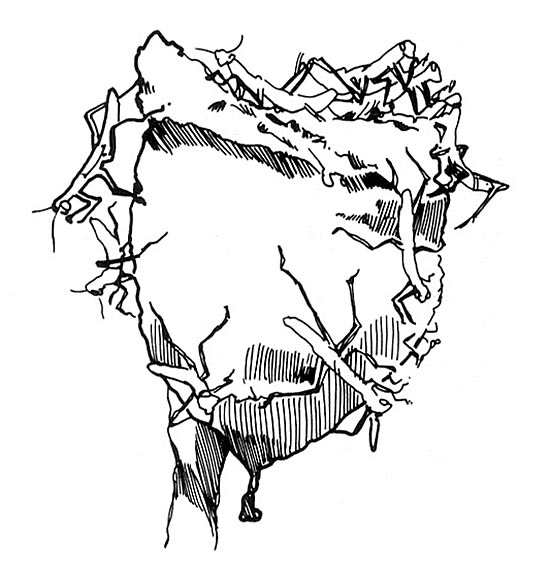
There’s no end to these little miracles that await your observation in the garden. Soon you’ll be adding trees, shrubs and small fruits, or perhaps designing an entranceway of climbing roses. Maybe you’ll save your own seeds, build a small pond, or a simple birdhouse, or just learn to identify praying mantis egg cases and watch as the tiny hatchlings pour out.
When you think about it, the real miracle, after all, may be not in the procession of growth in the garden, but in the birth and development of a brand-new gardener.
Soil Testing Services
The following firms offer personalized soil testing and make recommendations in terms of natural fertilizers. Prices quoted are for basic soil analysis (more extensive testing is available).