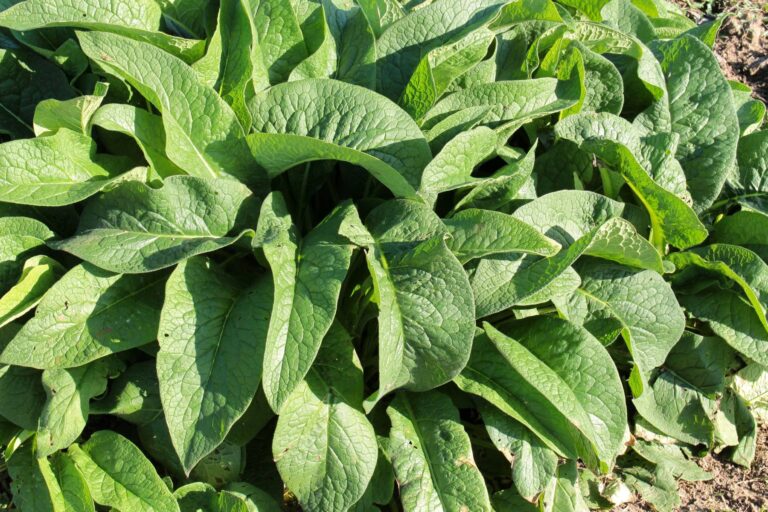
Learn comfrey plant uses and how to grow comfrey, a strong-growing perennial of the borage family. Great for topical application to aid the healing of bruises.
We set aside a small rectangular spot on our acre for a bed of 30 comfrey cuttings because we’d heard so much about the plant’s virtues. They grew like mad. We harvested comfrey leaves all summer, and found so many uses for comfrey that, at the end of the season, we ordered 150 additional roots and expanded our little patch to a plantation of 200.
In case you’re not familiar with comfrey (Symphytum officinale), it’s a member of the borage family, a strong-growing perennial with somewhat hairy leaves 12 to 18 inches long, rising on short stems from a central crown. The flower is a pretty blue bell, fading to pink. We don’t wait to see the blossoms, however, because the foliage is at its best if cut before blooming time. The plant reaches a height of over two feet and spreads to more than a yard across, but — since comfrey doesn’t throw out creeping roots and hardly ever sets seed — it’s remarkably non-invasive for such a sturdy being.
Comfrey leaves have a high moisture content and dry more slowly than some of the herbs you may be used to working with. Just give them a little extra time. Make sure the leaves are crumbly before you store them, though, since any remaining dampness will cause mold. Then pack the foliage into jars and close the containers tightly.
Medicinal Comfrey Plant Uses
Comfrey has long been used as a cure by the Romani and other healers, and has an ancient reputation as a mender of broken bones. Comfrey contains allantoin, a substance known to aid granulation and cell formation . . . which is what the healing process is all about. The effectiveness of this valuable plant can now be accounted for and is therefore more widely accepted. (Funny how pinning a name on the curative property makes it possible for us to acknowledge it!) Here on our acre, we follow Mrs. Levy’s advice and treat both people and animal hurts with comfrey. Generally we use an infusion (strong tea) of fresh or dried leaves, either to soak a part such as a sore finger or to dab on the skin with cotton. Crushed foliage can be applied externally, or a raw leaf rubbed on skin lesions such as rashes and poison ivy blisters. (Scratch and heal in one operation!) Comfrey should not be applied to open wounds or broken skin. (Please Note: Comfrey is toxic to the liver for both humans and livestock and should not be taken orally or used on open wounds. –MOTHER.)
The most common medicinal use of comfrey are in poultices to help heal swellings, inflammations and sores. To make such a dressing, let the leaves mush up in hot water, squeeze out the excess liquid and wrap several handfuls of the hot, softened foliage in a clean cloth. Apply the pad to the affected part–comfortably hot, but not scalding–and cover the area with a thick folded towel to keep the heat in. The moist warmth enhances the healing effect of the allantoin.
Poulticing is a warm, comforting treatment, and making one is a caring act . . . something you can actually do for a person. After all, that too counts in the healing process.
If you wish to use comfrey for topical applications to aid the healing of bruises and rashes, be certain that you can positively identify the plant. Comfrey is often confused with deadly foxglove and can lead to accidental and fatal poisonings, according to A Field Guide to Venomous Animals and Poisonous Plants by Steven Foster and Roger Caras. If you grow comfrey, you can make your own herbal medicine.
Comfrey Can Activate Compost
Town dwellers who must buy manure for their compost piles could save money by keeping a few comfrey plants. Bocking No. 14 — a narrow-leaved, fine-stemmed type with very high protein and potash content — is especially good for kicking the decomposition action into high gear. For best results, scatter comfrey cuttings throughout the compost heap. (Our planting is a mixture of Bocking No. 4 and 14 and we’ve used the two interchangeably. When time and supply allow selectivity, however, it’s good to know about the special properties of each variety.)
You can also condition your soil with comfrey — it’s one of the best plants for this. The roots range to depths of 8 to 10 feet, bringing up nutrients from the mineral-rich subsoil, breaking up heavy clay and aerating the land with their channels. The leaves themselves may be buried as “instant compost” to give row crops season-long nourishment.
How to Grow Comfrey
Comfrey may be planted whenever the soil can be worked (the cuttings will do best, however, if transplanted while dormant). We’ve had good luck with root cuttings started both spring and fall. When we expanded our patch we put out 150 sets in late autumn, with a raw wind in our faces, and every single one made a plant. They came up later in the spring than their full-grown neighbors, but soon bushed out like all the rest. We’ve even transplanted 50 whole, growing comfrey specimens in midsummer, about the worst time we could have chosen. Cutting off all the leaves, taking a big ball of soil each time and watering very well by bucket brigade kept each of our victims alive . . . better luck than we had any right to expect.
The least expensive way to plant a comfrey patch is with root cuttings (see the box with this article for our supplier’s current prices). They come in 2- to 6-inch lengths and are planted in a flat — horizontal — position at a depth of 2 to 8 inches . . . on the shallow side for heavy clay soil, deeper in sandy loam. Even hopeless-looking little nubs of roots can form good plants, so be sure to make use of all those crumbs and pieces in the bottom of the shipping box.

Crown cuttings cost a little more, include eyes or buds and are set out flat at a depth of 3 to 6 inches. We bought some of these along with the root cuttings in our first order. The latter were less impressive at first but soon caught up, and by transplanting time we couldn’t tell the difference. Probably any advantage crown cuttings have in size and development is canceled by the greater shock of relocation.
We wouldn’t even consider buying a whole plant by mail order. If you can get one locally, however, you can bring it through with good care.
Once you’re growing comfrey on your own grounds, propagation can be done by dividing multiple-crowned plants . . . or simply by digging up a piece of root and setting it in the earth as I’ve described. Magic!
The best planting layout — recommended by North Central Comfrey Producers — is a grid of lines three feet apart each way with the plants located at the intersections. (No, that isn’t too much space . . . just wait a couple of years!) This plan leaves clear aisles in all directions for cultivation while the crop is young. We rototill our patch several times a season, and any weeds that remain close to the stalks are sickled down when we harvest.
As easy as comfrey is to grow, it does need good soil. We enrich our patch with manure from the henhouse and goat shed, and add a bag or two of rock powder every three years.
Comfrey Pests
In the four years we’ve been growing comfrey, we’ve seen no insect damage. (Yes, we do know what bugs look like . . . we have ’em on our beans, squash and cucumbers.) Possibly the thick, fuzzy leaf discourages marauders.
Neither have we had any diseased comfrey plants in all that time. In fact, the original specimens have grown into thick, bushy crowns with new offsets which may be used to start fresh plantings or to sell or trade. On the basis of our reading and our own experience, I think it’s safe to say that comfrey is highly resistant to pests and to illness.
Harvesting Comfrey
Bringing in the sheaves of comfrey is a natural hand task that has its own rhythmic satisfaction. When the foliage is 12 to 18 inches tall, we cut the leaves with a sickle by gathering a bunch together and shearing them off two inches above ground. After such a harvest, the plants will grow enough to be cut again in 10 to 30 days. About two weeks is the average in our experience.
At the end of a sunny, non-humid day — when food value in the leaf is at its peak — we sickle our way through the patch. On such occasions, the garden cart becomes our hay wagon to convey the cuttings to their drying spot on the grass. Since comfrey leaves are so high in moisture and protein, we spread them out well to avoid the heating and spoilage that would take place if the foliage were heaped up. Two days of good clear weather does the job, and we pile the result in big cartons and store it in the garage.
One point about laying your crop on grass to dry: You’d best finish harvesting your winter’s supply by mid-August, or the heavy dews that appear later in the summer (here in the East, anyhow) will hinder the process. A rack or wire netting screen that holds the drying comfrey up off the ground can considerably extend your “haying” season for the plant.
Comfrey for Self-Sufficiency
Since this article was written, we’ve found the farm we’d wanted for so long. Living here, we depend more than ever on our goats, rabbits, hens, pigs and–now–sheep. And so, of course, we’ve laid out another comfrey patch, based on starts we brought from our acre homestead . . . mostly the wide-leaved variety, Bocking No. 4.
As we live into our farm, walking the fields, listening to what they want to be, we think more and more of a large plantation of comfrey . . . larger than the one we left behind. Rototiller cultivation and hand harvesting would still be practical, and soil improvement could be carried out gradually on a spot basis. (A shovel of manure and wood ashes for each plant gives us more value from the materials at hand than we’d get from broadcasting the stuff.)
Whatever the scale of your comfrey operation — whether you set out a whole field’s worth with a tobacco planter or plant a row beside a city garage — you’ll find the plant pays for its keep. Maybe, once you start your experiments with this crop, you’ll come up with uses we haven’t discovered. If you do, let us know!
Originally published as “Comfrey for the Homestead” in the May/June 1974 issue of MOTHER EARTH NEWS and edited to reflect today’s knowledge of the plant as well as terminology.
SPECIAL NOTE: Comfrey contains at least 8 pyrrolizidine alkaloids, which can build up in the liver to cause permanent damage and sometimes death in livestock and humans. Because of this, comfrey preparations are not sold for oral or internal use in the United States, the United Kingdom, Australia, Canada, or Germany.