

The Seasonal Almanac shares astronomical events in October and November 1997. This issue includes autumn acorns from oak trees, a parade of planets and colors around the moon.
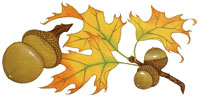
We all know that autumn acorns from oak trees fall and accumulate on the ground
in fall, of course. And we all have been reminded at some
time or other that mighty oaks from little acorns grow. But
how often do we really look at this fruit in all its
variety of size, shape, and styling?
Each acorn has its cup, but that cup may be very shallow or
may almost completely enclose the nut. The cup may be
rough, prickly, or have smooth scales. The nut itself may
be roundish, tapered, or even cylindrical. The surface of
the acorn nut sometimes has a rather rough finish but may
also have a seemingly waxed or varnished look and feel.
Then there is the color of acorns. The variety is not as
great as that of autumn leaves, but you’ll be surprised if
you start picking them up and looking. You’ll see mixtures
of green, yellow, and every kind of brown from tan to
mahogany. The hues are muted compared to some autumn
leaves, but perhaps that is a pleasant contrast–and
it seems appropriate for so humble a thing.
Acorns come only from oaks. There are two major classes of
oak, the white oak group (with rounded leaf lobes) and
black oak groups (with pointy leaf lobes), and their acorns
are remarkably different in their life-stories as well as
in some other ways.
Perfect acorns of the white oak itself are hard to find
because they grow and fall in just a few months, and then
quickly decay or are seized as food by a wide variety of
animals and birds. They’re also hard to find because the
white oak doesn’t mature enough to bear acorns for about 50
years! In contrast, acorns of the black oak family take two
years to ripen, so some are always on the tree. In fact,
there may be two generations of them, distinguishable by
size, on a tree at once. Furthermore, once these acorns do
fall to the ground, they prove quite resistant to
disintegration and are not a favored food of wildlife
because they are bitter. The acorns of the chestnut oak, a
member of the white oak family, are said to be the sweetest
(in northern forests at least) for human beings to roast
and eat.
Can acorns or their gatherers be weather prognosticators?
Some people say that if squirrels are collecting unusually
great numbers of acorns in autumn, a hard winter is sure to
follow. That either trees or squirrels or both could be
affected by a prolonged spell of cool weather in summer or
autumn seems reasonable enough. But temperatures rarely
remain significantly below-average (or above-average) for
several seasons in a row–a very cold autumn is not
frequently followed by a very cold winter. Only factors
like certain ocean current temperature changes in parts of
the mighty Pacific seem to be reliable predictors of what
some regions’ general weather will be like months in the
future.
A Parade of Planets
During much of October and November 1997 a very unusual
circumstance occurs: all the planets are above the horizon
at one time for a while after sunset! Actually, dim Pluto
is too low in bright sky during these months for anyone to
see, and you need binoculars and detailed finder charts
(like those in Sky & Telescope
magazine’s May issue) to locate Uranus and Neptune. A
wonderful feat to try in mid-to-late November, however, is
to see all five of the classic naked-eye planets at one
time. Mercury will be the hardest to see, a bright point of
light but one that appears very low in the west-southwest
before dusk is over.
The other four bright planets are easy to spot as long as
your view of the southwest sky is not obstructed. Low in
the southwest for a few hours after sundown are Venus,
brightest point of light in the sky, and Mars, much fainter
but forming a close companion with Venus week after week.
Jupiter is the second-brightest planet and is fairly high
in the south at nightfall. Saturn is the brightest object
rising in the east at nightfall these months.
Our Almanac table lists the many, many arrangements of
these planets with each other, with the Moon, and with the
stars. Something to bear in mind is that the separations in
“degrees” can be estimated in a simple way: your fist held
out at arm’s length is about 10 degrees wide. Most of the
sights are easily visible to the naked eye, but two of the
most remarkable do require a telescope. They are the hiding
of a star by Jupiter on November 12 and the “grazing
occultation” of Saturn by the Moon on November 11. The
“graze” occurs when Saturn and its rings pass right along
the edge of the Moon so that they are partly visible behind
lunar mountains and valleys for several minutes. The graze
will only be visible in a band several dozen miles wide,
running from southern Texas to southern New Jersey and Cape
Cod (south of the band Saturn goes completely behind the
Moon; north of the band it is a close miss).
Another astronomical event to look for is the Leonid meteor
shower, zooming from the southeast in the hours before dawn
on November 17. It is next year and 1999 that the passage
of the Leonids’ parent comet may cause this annual display
of shooting stars to burst into a “meteor storm,” thousands
of meteors per hour, as seen from some parts of the world.
But last year there was a remarkable display of almost
entirely very bright Leonids. In a single 20-minute period
I saw two Leonids bright enough to light up the landscape
and cast shadows, and the trails left by them remained
visible to the naked eye for several minutes. If a similar
display occurs this year, not even bright moonlight will
severely diminish its splendor.
Colors Around the Moon
If you ask people who are generally observant of nature
whether they have ever seen lovely colors in clouds passing
by the Moon, some of them will say yes. But how many people
could name those colors and correctly recall the
arrangement of the hues? Very few people know the facts
about lunar coronas.
These beautiful patterns of color must be distinguished
from “halos,” rings of light which are far larger and which
are caused only by ice crystals in cirrus clouds. The most
famous halo is the huge “ring around the Moon.” A lunar
corona occurs in a disk-shaped area right up close to the
Moon. Closest to the Moon is a greenish or bluish color,
bounded on the outside by a thick band of reddish light.
This is the first or innermost set of colors in a lunar
corona, but sometimes there are fainter repetitions of the
sets of colors outside of the first set (blue or green then
red, blue or green then red, and so on.) Lunar coronas can
occur in almost any cloud which is not so opaque as to hide
the Moon altogether, but most of them are caused by clouds
with water droplets, only some of them by high clouds with
ice needles. And, instead of being caused by reflection and
refraction (bending) of light by ice crystals (as is the
case with halos), coronas are caused by a process called
“diffraction.” Diffraction occurs when a tiny aperture
(like a pinhole) or particle (like a cloud droplet or ice
needle edge) is similar in size to the wavelengths of
light. Different colors of light are produced by different
wavelengths, and (to simplify) cloud particles can block
light from certain positions around the light source and
intensify others. (Interestingly, the colors we sometimes
see on roads after a rain are formed by the diffraction of
light from incredibly thin deposits of oil on the road
surfaces.)
Sometimes clouds are too scattered or too far from the Moon
to reveal the concentric bands of a fully formed corona,
and we just see patches of color here and there on the
clouds as they pass the Moon. We call these “iridescent
clouds”:
As October gives way to November, the weather in much of
the U.S. becomes much cloudier. Many locations have their
cloudiest conditions of the year in November and December.
But one consolation for sky-watchers is the appearance of
numerous lunar coronas. The bigger the corona, the smaller
the droplets or ice needles causing it. The more uniform
the size of the droplets or needles (all else being equal),
the more intense and pure the colors. But the pastels of
coronas are beautiful. So is the changeability of
coronas–and the way it often seems to be the Moon
itself that is moving, wading through a sea of surrounding
color.
Seasonal Almanac for October-November 1997
October 1997
1 NEW MOON, 12:51 P.M. EDT.
2 Rosh Hashanah (actually begins at sunset
of October 1–date of New Moon nearest to autumn
equinox)–start of Jewish year 5758.
4 St. Francis of Assisi Day; crescent Moon
far to right of Venus.
5 Look in southwest about 1 hour after
sunset to see Moon, Venus, and much dimmer Mars form a
triangle about 7 to 8 degrees on each side (this distance
is about that of a wide-field binocular views)–Venus
at bottom, Moon and Mars at top (with star Antares to the
left of Mars).
6 Moon about 9 degrees (a bit less than 1
width of your fist at arm’s length) upper left of
Mars.
8 Jupiter halts retrograde motion in
Capricomus, resumes direct (eastward) motion in relation to
the background stars.
9 FIRST QUARTER MOON, 8:22 A.M. EDT; Leif
Eriksson Day.
10 Saturn at opposition, rising at sunset,
and visible all night long–for weeks around this
time, the planet is closest, brightest, and in telescopes
appears its biggest; Moon to the upper right of
Jupiter.
11 Yom Kippur (actually begins at sunset
of October 10); Moon well to the left of Jupiter; Mars and
its “rival” (the similarly orange-gold star Antares, the
heart of Scorpius) closest together (about 3 1/2 degrees
apart) tonight and tomorrow night they are to the left of
the very brilliant Venus.
12 Venus equally far (5 degrees) from Mars
and Antares.
13 Columbus Day (observed); Thanksgiving
(Canada); Native Americans Day (South Dakota); Mercury at
superior conjunction with Sun–technically, all of the
planets are now above the horizon after sunset until
November 27.
14 Venus-Mars-Antares “trio”–that
is, all three celestial objects fit within a circle about 5
degrees wide (the field of view of an average pair of
binoculars); Moon well to upper right of Saturn at
dusk.
15 FULL MOON, 11:46 P.M.
EDT–“Hunter’s Moon” (the Full Moon after Harvest
Moon); Moon just to the lower left of Saturn at dusk (low
in east).
16 Succoth; Venus less than 2 degrees
north of Antares.
17 Asteroid 4 Vesta at opposition (visible
all night long–but requires binoculars and finder
chart like those in Sky& Telescope
magazine to locate and see).
18 Alaska Day; almost perfect line, about
5 1/2 degrees long, of Mars, Venus, and Antares (from upper
left to lower right).
19 Moon hides the star Aldebaran before
dawn as seen from most of the U.S.
20 Sightings of the Orionid meteors (from
the south in the hours just before dawn) are hindered by
bright moonlight these next few days.
21 Venus straight below Mars–less
than 2 1/2 degrees from Mars now through October 29.
23 LAST QUARTER MOON, 12:48 A.M. EDT; the
swallows leave San Juan Capistrano until the spring; at 5
A.M. EDT, Sun enters astrological sign Scorpio but is
really still in constellation Virgo.
24 Venus and Mars almost identically close
to each other from now through October 26.
25 Venus-Mars closest together tonight
Oust over 2 degrees apart).
26 Daylight Saving Time ends at 2:00 A.M.
local time.
30 Sun leaves Virgo, enters constellation
Libra, 6 P.M. EST; Moon 23 to 20 hours before New Moon,
amazingly thin crescent, possibly visible very low in east
45 minutes before sunrise.
31 Halloween (All Hallows’ Eve); NEW MOON,
6:01 A.M. EST; Nevada Day.
November 1997
1 All Saints’ Day; Samhain (ancient Druid
holiday, ancestor of Halloween–pronounced like
“savin”); through a telescope Venus may look like an
exactly half lit Moon one of these next few days.
2 All Souls’ Day.
3 Venus-Mars-Moon line tonight, with Moon
far to right.
4 Election Day; Will Rogers Day
(Oklahoma); Moon far above Venus tonight (with Mars to the
right of Venus).
5 Guy Fawkes Day; Jupiter at east
quadrature (in the due south about sunset).
6 Venus at greatest elongation from Sun in
evening sky, 47.1 degrees–but Venus also farthest
south in the heavens this day, so it will appear highest in
the dusk sky next month.
7 FIRST QUARTER MOON, 4:43 P.M. EST;
halfway point of autumn; Moon just above Jupiter
tonight.
9 Mars at its farthest south in
heavens–just three days after Venus was; Mars about
1/2 degree from Lagoon Nebula in telescopes tonight and
tomorrow night.
11 Veterans Day; Admission Day
(Washington); Martinmas; Moon hides Saturn around 7 P.M.
EST as seen south of a line running from southern Texas to
southern New Jersey and Cape Cod–within a few dozen
miles of this line, viewers with telescopes see amazing
“grazing occultation” (see text and Sky&
Telescope for details).
12 Jupiter passes in front of star almost
as bright as its four big moons around 8:30 P.M. to 8:45
P.M. EST (see text of accompanying article and Sky &
Telescope magazine for details of how to see this with a
telescope).
13 Star very near Jupiter’s moon Callisto
tonight (telescope needed).
14 FULL MOON, 9:12 A.M. EST–“Frosty
Moon” or “Beaver Moon.”
16 Start looking for Leonid meteors from
the east this evening.
17 Peak of Leonid meteor shower may be
this morning, and despite bright Moon, dozens (or more)
meteors might be seen each hour–maybe even in bright
moonlight if they are as bright as those in last year’s
Leonid shower.
19 Discovery Day (Puerto Rico).
21 LAST QUARTER MOON, 6:58 P.M. EST.
22 At 2 A.M. EST, Sun enters astrological
sign Sagittarius–but is really still in constellation
Libra until 10 P.M. EST; Sun leaves Libra, enters
constellation Scorpius at 10 P.M. EST (will be in Scorpius
for only 6 days).
26 St. Catherine’s Day.
27 Thanksgiving Day; Pluto at
superior conjunction–end of all 9 planets being in
the sky at dusk.
28 Mercury at greatest eastern
elongation–but a generally poor showing.
29 NEW MOON, 9:14 P.M. EST; Sun leaves
Scorpius and enters Ophiuchus at 5 P.M. EST.






