

Note: This piece was originally published in 1985, and some of the medical information and advice within the article may be outdated and/or incorrect. Please consult a medical professional for up-to-date breastfeeding advice.
According to a recent study, only 57.6 percent of new American
mothers breastfeed their babies. But instead of repeating
the common arguments for nursing — in an attempt to
convert the other 42.4 percent — I’d like to share, with
all parents, some of the recent scientific
findings concerning breastfeeding and how the mother-child
relationship can develop during this special time.
Colostrum Benefits Baby
Before the breasts of a new mother produce milk, they
release a thick, yellow substance called colostrum, which
has immune properties and which is actually higher in
protein, minerals, vitamin A and nitrogen than milk is.
Colostrum coats the baby’s stomach and intestines to help
ward off harmful diseases, such as polio and pneumonia, and
helps the baby pass meconium — a tarry substance that
accumulates in the intestines. Also, cells in colostrum
called macrophages destroy potentially dangerous bacteria.
How breastfeeding Works
When breast milk begins to flow (approximately two to three
days after delivery), it, too, provides important vitamins
and minerals for your baby, including the
brain-cell-builder taurine. While taurine is not an
essential amino acid, its high concentration in breast milk
does seem to indicate a need that cannot be met by the
child’s own body. But how much taurine is in formula or
cow’s milk? None! (Have you ever seen a smart
cow?) Yet, extremely high levels of this “smart” substance
are found in the brains of children, indicating that it is
an important aid to brain growth. Perhaps not
coincidentally, 96 percent of brain growth occurs by the age of
5 years, and the average age at which a child is weaned
in most cultures that practice infant-led weaning
is — you guessed it — five years.
Two commonly told stories about breast milk are that it has
very little iron and that it lacks vitamin D. But the fact
is that breast milk does contain sufficient
amounts of both nutrients, providing the mother has them to
give (she should follow a balanced diet and boost her daily
caloric intake to about 3,500). True, cow’s milk and
formula might contain more iron, but it is in a form that
is poorly absorbed by infants. So babies fed these
substitutes get anemic around 6 months of age if they
don’t receive supplemental iron. This is not true of
breastfed infants. For example, a group of babies in Japan
were totally breastfed for two years without any
difficulties.
In the case of vitamin D, researchers spent a lot of time
and money fruitlessly looking for that essential nutrient
in the fatty portion of breast milk. But where was it? In
the watery part they normally threw down the sink! Now
scientists realize that there is no reason to give a
nursing child vitamin D supplements, even if Mom is an
Eskimo and doesn’t see the sun for six months!
Breast Milk Aids in Disease Prevention
Disease resistance is another benefit of breast milk, which
contains 37 known immune mechanisms. These are present the
entire time a mother breastfeeds her child and can be
divided into the following categories: protective bacteria,
enzyme “attackers,” protein binders, antiviral agents and
antibody “defenders.” It is the job of these “fierce”
mechanism groups to find and destroy any viruses or
bacteria that may harm the baby, while also making sure
the youngster gets enough protein and nutrients. However,
as soon as the baby is exposed to solid foods — or even
a bottle of sugar water — 17 of these immune mechanisms
are destroyed (by the E. coli bacteria that are
introduced) and can never be restored.
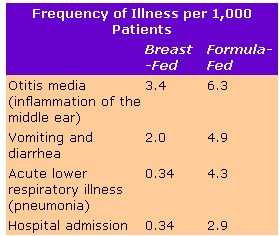
Overall, studies have shown that bottle-fed babies are sick
more often than breastfed babies. This is evident in the accompanying chart in the image gallery.
A study done in India (where breastfeeding is more the
norm than the exception) indicated that out of 3,684 babies
observed, seven out of the 2,031 breastfed children got
pneumonia, whereas 48 out of the 1,653 who were bottle-fed
got the disease.
If you become sick with a “bug” while nursing, don’t fret
about spreading the sickness to your child. Amazingly
enough, white blood cells appear in the breast milk on the
fourth day after the mother is exposed to the
illness — cells her body has created specifically to
eat that bacterium or virus. Thus your milk will
give your child a specific antidote for the illness you are
worried about. (This sickness-healing sequence obviously
works better if the mother gets sick first.
Fortunately, most times, mothers are “considerate enough”
to do so.)
Drug Usage for Nursing Moms
In general, it is best to avoid drugs (including the social
ones) while nursing. Even aspirin must be taken with
caution, since approximately one-twelfth of an adult dosage
is equivalent to a full dosage for a 10-pound
baby. To find out if a particular medicine is safe, please
consult your local La Leche League leader.
Advantages of Nursing for Mom
breastfeeding benefits the mother by stimulating the
release of the hormone prolactin, which has been found to
induce maternal behavior in laboratory animals. Another
“nursing” hormone, oxytocin, helps to squeeze the milk into
the ducts that lead to the nipple; it also works to relax
the mother. Then too, the baby’s sucking helps the mother’s
uterus contract to normal size, lowering the amount of
blood loss.
Of course, the increased opportunity for parent-child
bonding offered by breastfeeding is a widely known benefit
of nursing, which brings up an interesting sidelight. A
baby can have lots of brain cells, but they won’t do any
good unless they’re interconnected. The nerve fibers that
connect these cells are called dendrites. And what develops
dendrites? You probably said breast milk, right? Wrong!
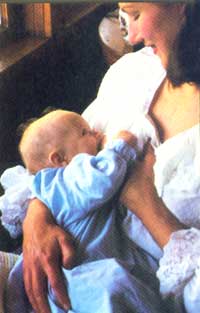
Touching develops dendrites. Holding, touching and stroking a baby, as a mother naturally does while
nursing (you can prop a bottle but not a breast!), helps
the child develop the way nature intended.
When to Start Solid Foods
If this thin, watery stuff called milk is so good, when do
you need to start feeding your baby “real” food? This is a
difficult question to answer. Recent studies have shown
that hydrochloric acid — used to digest most
protein — doesn’t even appear in the stomach until the
end of the seventh month and doesn’t reach a peak until the
18th month. Coincidentally, 18 months is
approximately when rennin — used to digest the protein
in breast milk — has disappeared. Also, it seems that
the digestive juice for
carbohydrates — ptyalin — doesn’t appear until the
end of the baby’s first year. (The old books on baby care
always recommended that mothers pre-chew any solid food.)
You may say that your baby was so hungry that he
or she was fighting for solid food at five months, but
actually this probably isn’t what was happening. The fact
of the matter is that in your house you have this strange
custom. Each day without fail you gather the clan around a
square board and all of you stuff strange-looking things in
your faces. The baby probably just wanted to be part of the
clan ritual. Remember — babies tend to mimic the
behavior of those around them.
With this, I leave to you the decision of when to start
foods, but let me offer two pieces of advice. First, don’t
force food on your baby. He or she will let you
know when breast milk isn’t completely satisfactory by
showing an increased interest in nursing sessions (which
you will soon discover is not due to a growth
spurt). Second, instead of feeding your child, just let the
youngster feed him- or herself, from food you place on the
high chair tray. (As the father of 11 children, I know
this can be quite a messy experience!)
This way, not only will your child be less likely to
overeat, but the little one will also tend not to eat foods
he or she may be allergic to. By the way, heavily sweetened
foods, honey, spicy or salty foods and nuts are definitely
not recommended for babies.
When to Wean from Breastfeeding
As soon as the baby is introduced to anything other than
breast milk, the weaning process has begun. It is best to
do this slowly, and, as with solid foods, let the baby tell
you when he or she is ready to “leave home.”
(Remember — release, not reject.) Contrary to popular
belief, a child who is weaned at a late age is not any more
dependent than a child weaned earlier. In fact, the late
nurser may be more independent because the choice
to break away from Mom was his or her own. So, don’t let
yourself be influenced by the behavior or reaction of other
mothers — this should be a decision between you and
your child.
Breast milk is species-specific. It has everything in it
that the baby needs, in the right amounts. It fulfills both
physical and emotional needs. It is not habit-forming, and
all children wean themselves when they have had enough.
Try it. You, and yours, will like it.
Helpful Tips for Breastfeeding
Does the though of nursing give you butterflies? If so, here are some helpful hints:
- The first two or three weeks of breastfeeding can be very difficult for a new mother, but take a deep breath and relax! It is very important to get plenty of R and R during the nursing period, as this will stimulate the let-down reflex — the squeezing of milk from the alveoli. Fear, anxiety, confusion or fatigue can hamper this reaction, so find a comfortable, tension-free spot to nurse.
- Two common misbeliefs are that small-breasted women cannot produce enough milk and that if you do not have enough milk when you begin nursing, you will never satisfy your baby’s great need for nourishment. Not true! In all pregnant women a physical change occurs in the milk ducts that enlarges the breasts. Likewise, the more your baby nurses, the more milk your breasts produce. And a new baby nurses approximately every 1 ½ hours at first.
- Initially, try 7 to 10 minutes on each side to help prevent nipple soreness, then gradually increase the time. (Nipple-toughening exercises during pregnancy, such as frequent exposure to air, are highly recommended.)
- It may take almost a week for you and your baby to nurse successfully — but don’t give up! Going to a series of La Leche League meetings while you’re pregnant will help establish a support system, in case you have problems later.






