

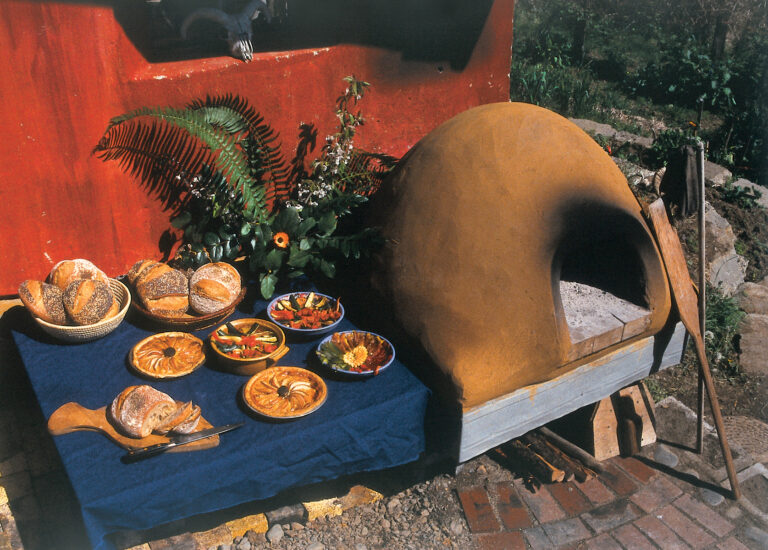
Learn how to build a wood-fired pizza oven in your backyard with this easy-to-make oven to bake crusty bread, tasty pizzas, and roasted meats.
Build a Wood-Fired Pizza Oven
Did you love to make mud pies when you were a kid? Even if you didn’t, you can still build this easy outdoor oven that works as well as a custom-built masonry or ceramic model. Cost? Next to nothing. Material? The Earth under your feet — one of the best building materials on the planet. And the skills you need are just the ones you were born with.
Follow the steps outlined below and you’ll enjoy crusty, chewy and richly flavored bread, pizza, other baked goodies, meats, and roasts in no time.

Preparing to Make Your Wood-Fired Pizza Oven
Collect your shovel, a wheelbarrow and/or some buckets, a tape measure, scraps of lumber, a plastic tarp and kitchen utensils (for sculpting).
To start, prepare a base for the oven. If you’re going to use the oven a lot, you’ll want to build the oven floor at waist-height. Use what you have — rocks, broken-up concrete, logs, old metal barrels or even sawhorses. If you don’t mind working low, build on the ground.

The Wood-Fired Oven Floor
Twenty to 27 inches is a good size to the oven floor, but to determine your exact needs make a mock-up of what you want to bake and calculate how much space it takes. Make your oven floor by setting standard red or fire bricks on a level bed of smooth, tamped sand, 4 to 6 inches deep. Used bricks are great, but should be free of old mortar. Set the first one level and solid. Hold the next brick level and just above the sand; gently kiss its long side to the long side of the previous one. Set it down flat and firm. Don’t wiggle it. If one brick stands up a bit proud, tap it down to make it flush with the rest.
Make a Sand Form
Shape a pile of moist sand on the floor bricks. (This can he any kind of sand, or even loose topsoil. The form will be covered with your mud mix, then removed to form the oven’s interior.) The form should be a few inches higher than half the oven floor’s width. [For example: An oven 27 inches wide (one-half of which equals 13-1/2 inches) should stand 16 to 20 inches high.]

Hold a level across the top; measure the distance to the floor to calculate the interior height of your oven. Multiply it by 63 percent (0.63) to determine the proper height for your oven door. Write this number down!
Mixing Mud for Your Pizza Oven
Good oven building soil usually is found below the topsoil. It contains clay which, like cement, holds things together. Use it straight out of the ground or mix it with sand. If you have nowhere to dig, look for construction sites, road cuts or river banks. Clay subsoil should feel sticky, slippery and a bit greasy (in contrast, silt and organic matter feel floury and crumbly). Wet, you should be able to roll it into snakelike ropes and bend it easily. The mix is usually one part clay subsoil and anywhere from one to three parts sharp sand (also known as builders or masonry sand); pure clay subsoil also works, but tends to shrink and crack more. Make a test brick or two by mixing sand and soil. Dried, the bricks should be dense and hard with few or no cracks.
A tarp makes mixing mud easier on your back (6-by-8 foot minimum; bigger is easier). To mix, two people should hold opposite corners of the tarp and roll, but not lift, the mix from side to side. You also can stomp the mud while wearing boots or better yet, mix it with your bare hands and feet. If you muck around in the mixture, be sure it is free of sharp debris.
Add water a little at a time, then jump in and do the twist, breaking up the clay and mashing the sand into it. Dance until it starts to clump like dough for piecrust.
Pack a hard ball (50 to 100 pats), and drop it from chest height. It should hold together. If it doesn’t, add a little water. If it’s too wet, add dry mix. Or you can continue and just allow more drying time, whichever is easier to do.
How to Build a Wood-Fired Pizza Oven in Your Backyard
Cover your sand form with sheets of wet newspaper to keep the mud walls from sticking to the sand form, smoothing the sheets flat. Next, cover it with a layer of mud 3 to 4 inches thick. To maintain an even thickness, use the width of your hand as a gauge, maintain a clean, square edge on the layer as it arches up and over the form, and angle the top of the mud layer inwards as you go up (see diagram below). Press the mud against itself, not against the sand form, and don’t worry about the doorway, you’ll cut that out later.

When it’s done, take a flat board and pack the material until it sits solidly against the form. If it sticks to the board, your mix may have been a bit damp and will need more drying time before you pull the sand form. After the first layer dries, you can add more layers and a fine finish plaster if you want.
Remove the Oven Sand Dome Form
If your sand dome was 18 inches high, your doorway should be 63 percent of the height, or 11 -1/4 inches. The doorway’s width should be one-third to one-half of the oven’s inner diameter. Scratch a line in the mud where the door will be, cut a hand-sized hole to start and dig a narrow channel into the form.
Before you remove the sand form, the mud walls should be dry enough to resist denting when you poke your finger into them. If your finger easily dents the mud, wait and let the mud get leather-hard. (This can take days or weeks depending on the weather.)
Then, carve out the rest of the door and dig out the rest of the sand form. Remember to stop when you hit the newspaper layer. Refine the doorway so it’s smooth and even and so the doorway’s inner edge is the right height. Use a spoon, or smooth piece of wood or stone, to rub, integrate and polish the material until it seems right.
Make Your Pizza Oven Beautiful
Basic finishing can be done by rubbing the oven’s exterior smooth with a chunk of milled lumber, a metal trowel or spoon, or a polished rock. More complex shapes and finishing require more mud material with additions like straw, manure, lime and Earthen pigments. Make your oven into a sculpture, a hemispherical mural, a bench or a whole building, or keep it simple and abstract.
A rain-soaked oven takes a long time to heat up, so building a roof — as simple or complex as you choose — will protect your oven from the weather. But do not cover the oven with paint or cement! An earthen oven needs to breathe — trapped moisture will destroy it.
Making the Pizza Oven Door
To make your door, cut a paper template to fit the opening, then use it to cut out the door. The door doesn’t need to fit perfectly, since you can drape it with a wet cloth, which also keeps the door from charring and adds moisture for baking. (You also can soak the door in water or line the back of it with metal or foil.)

To use the oven, build a fire in it and let the smoke come out of the door opening. When the oven is fully dry and has been fired for two to three hours, you’ll notice that the black soot on the inside of the dome has disappeared; that’s the sign that the oven is ready to use. Rake out the coals and begin baking, putting the door in place to hold in the heat.
Kiko Denzer is a sculptor and oven builder living in Oregon. His book, Build Your Own Earth Oven, provides details on building and using wood-fired Earth ovens, including selecting soils, firing techniques, insulation, chimneys, sculpture and fancy finish plasters, as well as oven photos and references.






