
If you accept the ecologists’ view of the “energy
crisis”–that the heart of the problem, at least in
overdeveloped countries, is toomuch use, rather
than too littlesupply–the framework of the
debate concerning our possible future energy sources changes
fundamentally. Its focus is no longer on how to get rapid
short-term increases in supply and long-term superabundance,
but instead on how to achieve rapid short-term
reductions in demand and a long-term sufficient supply, with a minimum of destructive ecological and
social side effects.
Even those who take the “too little” view of the energy
situation are beginning to realize that conservation, which
dampens demand, is the only feasible solution in the
very short term. The fact is, you see, that even
the most dramatic possible commitments to more nuclear
power plants, synfuels (coal gasification and liquefaction,
fuels from oil shales and tar sands), solar power, or what
have you will produce little impact on energy supplies for
a decade or more.
The need to conserve in the near future is, then, more or
less agreed upon. But such necessity is seen as a
permanent feature of our energy economy by those
with the ecological view. The long-term commitment to
conservation is not espoused, of course, by the
“too little” crowd. For example, Roy Meader has written in
Future Energy Alternatives (Ann Arbor Science
Publishers, 1979): “When fusion energy becomes available,
as the experts confidently expect, it may come suddenly
like a blinding flash of light and inspire a worldwide
religious revival, singing in the streets, and a veritable
orgy of turning on all lights and air conditioners and
letting them run till dawn.”
But divergent as the different points of view are, we
believe that both schools of thought would concur on
another point: Whatever energy is mobilized for
society–everything else being equal–it should
be mobilized in a manner that is least disruptive socially,
as well as environmentally.
Safety in Decentralization
In a previous column we argued that the
renewables–which are primarily various forms of solar
energy–appear to be the most benign alternatives
from the standpoint of the health of both human beings and
ecosystems. Fusion might be equally (or more) benign, but
this cannot be judged at the present time.
One significant advantage of a variety of renewable power
sources is that of decentralization. Today’s major energy
technologies tend to be highly centralized and thus
subject to control or disruption by actions taken at “key”
points, from nuclear power plants to the oil tanker
routes through the Straits of Hormuz. An accident or
terrorist action at any such central locale could result in
inconvenience, danger, or injury to many people over vast
areas.
On the other hand, home solar water heaters and farm
biomass systems are so widely dispersed that no accident or
terrorist action is likely to inconvenience or threaten
great numbers of people. No special “solar police force” is
likely to be required to guard rooftop solar collectors,
or–for that matter–square miles of similar
units making up solar electric power plants. But Britain
already has an extraordinary Nuclear Police Force, and
such a potentially freedom-threatening organization is
thought by many in the United States to be a necessary
price to pay for the “benefits” of nuclear power.
Another enormous advantage in the use of decentralized
renewables comes in the area of risk/benefit analysis. As
should be evident from our previous columns on energy
matters, the costs of different energy technologies are
difficult to assess.
For one thing, such results are often hard to predict: Is,
for instance, a fossil-fuel-CO2 /climate-induced famine
that kills a billion people more likely to happen than a
nuclear-power/terrorist-induced atomic war that kills the
same number?
For another thing, even where costs can be
predicted with certainty, it’s often extremely difficult to
quantify or compare them. For example, while it’s possible
to say that acid rains are a serious threat to ecosystems,
a quantitative assessment of their overall impact
is impossible today and may well remain so permanently. And
how is one to compare such ecosystem impact with, say, the
risk of deaths, cancers, and mutations in the human
population from a possible nuclear reactor meltdown? The
apples vs. oranges problem pervades the assessment of
costs–both realized and potential–of all energy
technologies.
Indeed, the complexities of risk analysis are such that,
even when it’s done properly–which is certainly not
always the case–the results will, at best,
merely provide rough guidelines rather than sharp
distinctions.
Who Pays?
A major complication, which physicist John Holdren has
often pointed out, is that very often the benefits of an
energy technology tend to be reaped by one group, while a
large fraction of the costs are borne by other people
distant in space or time.
Often, the rich power-users live in the clean air upwind
from the utility plant, while the poor–whose
per-capita energy use is lower–live in the smog
downwind. And, as is well known, the lives of native
Americans in the Southwest and ranchers in Montana are
disrupted by the mining of coal, which primarily benefits
people on the coasts. Hardly an equitable arrangement.
Should a climate change be brought on by CO2 in
the atmosphere, generated primarily in the rich countries,
the worst of the ensuing famines would almost certainly
occur in poor nations. The mutations resulting from
exposure to radioactivity and mutagenic chemicals released
by power plants will cause health problems for centuries to
come… and a thousand generations of descendants of those
who use electricity generated in nuclear power plants may
have to be concerned about the plutonium-laced waste that
has been produced by such installations.
Holdren, one of the top experts in the field of energy risk
analysis, has developed a two-pronged approach for dealing
with these problems.
First, society should try to select energy options that
allow the most significant external costs (like pollution)
to be “internalized” by conventional means. For example; if
the principal social and environmental impacts of a certain
energy facility can be–and are–largely
ameliorated by an expenditure of money, the costs will be
“internal” to the bookkeeping of the utility company and
therefore paid by the users of the power.
The second approach is set forth in Holdren’s
Principle: Energy options should be selected that
tend to deposit on the same people who reap the benefits
any costs that cannot be internalized monetarily. In other
words, those who choose and use a particular energy
technology should, as far as possible, pay the external as
well as internal costs.
This would, of course, help solve the problem of “how much
is enough.” After all, if electricity is flowing to your
house and the smoke from the generating plant floats into
someone else’s, you may demand more and more energy until the other person chokes or is buried in soot. But if
you receive both the electricity and the
pollution, you’re likely to become a conservationist at a
much earlier stage in the game … since you can then
subjectively measure the pleasures of high-energy living
against the physical discomfort of choking and dealing with
filth, as well as the mental anguish resulting from the
specter of future cancers.
It’s clear, even with the imperfect sort of risk analysis
now possible, that decentralized renewable energy
technologies are the most desirable under Holdren’s
Principle. More than any others, they place their
environmental and social burdens on those who benefit from
the energy produced.
Room for Mistakes
Reasoning similar to that presented in this column (and in
our last one) has led energy expert Amory Lovins to urge
strongly that society choose what he has labeled a “soft
energy path”–based primarily on decentralized
renewables–for future energy development … a path
that has room for many technologies. Lovins has concluded
that there’s already a large enough highly centralized,
capital-intensive energy-mobilizing system in place, and
that attempting to meet society’s future needs with more of
the same would be a serious error. The soft path, however,
departs from–and is rooted in–a hard
base.
There’s been a great deal of debate regarding the
feasibility of Lovins’ path. “Hard technology buffs”
(especially nuclear power advocates) tend to claim that not
“enough” energy will become available from decentralized
renewables … whereas ample supplies can be
provided by the “proven” technology of nuclear fission.
We believe that there’s a simple way to resolve this
argument. With reasonable conservation measures, more than
enough fossil fuels are available to maintain industrial
society for 50 years … although a great deal of money
will have to be spent on developing the most efficient ways
to use them so that environmental impacts are minimized.
Without conservation and care, dependence on fossil fuels
could be a recipe for disaster.
With conservation and care, though, the continued
use of fossil fuels can be a bridge to the future. At the
same time, we can give careful attention to the most
promising of the new technologies rather than engaging in
crash programs that may turn out badly.
In short, the next two decades can be spent following
Holdren’s principle and exploring Lovins’ path.
By the year 2000, the question of feasibility for many, if
not most, of these new technologies should be answered. If
all the decentralized renewables prove
impractical, there will still be time to deploy an
appropriate mix of hard technologies. And, by that time,
it’s possible that many of the technical problems (if not
the social ones) associated with centralized solar power
generation, synfuels, and/or both fission and fusion will
have been solved.
On the other hand, if the hard path is taken now, there may
never be a return to a soft one: It’s very possible that
the capital requirements of, say, going fully nuclear would
so tax the world economy that another full-scale
alternative couldnot be attempted if the
nuclear route were later perceived to be a disastrous
error. And some of the possible side effects of the hard
path–notably climate modification and world war–might be
irreversible.
The “soft path” strategy will–at the very least–leave
our options open. The “hard” route might well foreclose
them… and could be an extremely expensive road to a dead
end.
The key article by Lovins is “Energy Strategy: The Road
Not Taken” (Foreign Affairs, October 1976). Debates by
Lovins and those advocating the “hard path” can be found in
The Energy Controversy: Soft Path Questions and Answers,
Hugh Nash, editor (Friends of the Earth, 1979). Holdren’s
Principle was formally enunciated in his “Observations for
the California Energy Futures Conference” (Sacramento, May
20, 1978).
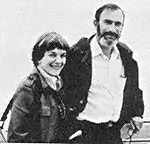
Paul Ehrlich (Bing Professor of Population Studies and Professor of Biological Sciences, Stanford University) and Anne Ehrlich (Senior Research Associate, Department of Biological Sciences, Stanford) are familiar names to ecologists and environmentalists everywhere. As well they should be. Because it was Paul and Anne who–through their writing and research–gave special meaning to the words “population,” “resources,” and “environment” in the late 1960’s. (They also coined the term coevolution, and did a lot to make ecology the household word it is today.) But while most folks are aware of the Ehrlichs’ popular writing in the areas of ecology and overpopulation (most of us–for instance–have read Paul’s book The Population Bomb), far too few people have any idea of how deeply the Ehrlichs are involved in ecological research (research of the type that tends to be published only in technical journals and college textbooks). That’s why it pleases us to be able to present these semi-technical columns by authors/ecologists/educators Anne and Paul Ehrlich.