Learn how to start sowing seeds indoors with grow lights. Make homemade seed starting trays, prevent damping off and watch your seedlings grow.
You’ll love the benefits of growing your own transplants. You can grow unique heirloom selections as well as the best varieties for your garden’s conditions — which will boost your yields and reduce losses to pests, disease and severe weather.
The potential money savings aren’t small potatoes, either. Consider the cost of filling a single 4-by-12-foot bed with purchased transplants — typically selling for $4 to $5 each — versus paying $2 to $3 for a packet of at least 50 seeds. If you grow a big garden, the savings can quickly grow to hundreds of dollars. Indoor seed starting is easy, and the small initial investment in equipment will pay off quickly. Learn how to start seeds indoors with these 11 steps.

Things to Consider When Starting Seeds
Starting seeds indoors gives you a jump on the growing season, allowing you to harvest heat-loving crops such as tomatoes, peppers and melons earlier and over a longer period of time. (If you have a short growing season, it’s the only way to get mature produce from these crops.) Some cool-weather crops, such as broccoli, also benefit from an indoor start so they have time to mature outdoors in spring or fall, before midsummer heat or winter freezes set in.
Not every crop is a good candidate for indoor seed starting. Beans, peas and root crops should be sown directly in the garden because they don’t transplant well.

Seed Matters
Start with high-quality seeds and varieties suited to your region’s conditions. Buy from reputable suppliers who do their own germination tests and, preferably, their own variety trials, advises Steve Solomon, founder of Territorial Seed Co. in Cottage Grove, Ore., and author of Gardening When It Counts. Quality seeds sprout faster and at a higher rate, they grow into stronger seedlings, and they produce more, he says.
Try getting seeds well-adapted to your region from local seed swaps, or you can buy from regional suppliers. Companies that do their own germination tests and field trials usually say so in their catalogs. Most seed companies offer a free catalog, or you can order seeds from their websites. For background on nearly 100 mail-order seed companies, go to our Directory of Companies Offering Mail-Order Seeds and Plants. To search for varieties among a stock of more than 500 seed companies, use our Seed and Plant Finder.
Timing Matters
Most beginning seed-starters jump the gun, says Rob Johnston, founder and chairman of Johnny’s Selected Seeds in Maine. Transplants held indoors too long can become root-bound and weak — a setback that makes plants more susceptible to problems outdoors. However, starting seeds too late can mean you miss the optimum growing window. To find out when to start seeds of specific crops in your area, check out our What to Plant Now pages and click on your region.

Cells, Flats or Blocks?
You need 2- to 3-inch-deep containers with drainage holes to hold your seed-starting mix. If you have plastic six- or eight-packs from nursery transplants, use them. Many people use recycled yogurt cups, or you can buy a simple seed-starting tray with cell pack inserts. Some come with a plastic dome that will help preserve moisture (more about that in a minute), but covering trays with a sheet of plastic wrap will also work. Some gardeners sow their seeds in furrows in a single flat, but sowing in individual cells saves time and reduces the risk of disturbing roots at transplant time. Smaller cell inserts called “plugs” are useful for bigger transplants — such as tomatoes — that you plan to pot up indoors. Soil blocks, made by squeezing prepared starting medium out of a tool called a “soil blocker,” are another option. Soil blocks use no containers at all — each block serves as its own seedling container.
The Planting Mix
It’s important to use a loose, well-drained mix for indoor seed starting. Commercial peat-based mixes are widely available in garden centers and hardware stores, but peat moss is virtually nonrenewable because of its extremely slow growth rate and because harvesting it destroys the wildlife habitat provided by the peat bogs. You may be able to find seed-starting mixes that contain coir instead of peat.

“Coir, a byproduct of the coconut industry, is a better alternative,” says Solomon, whose homemade seed-starting mix consists of one-third coir, one-third compost and one-third good garden soil. “Coir provides the same porous texture as peat moss and is easier to keep wet,” he says. To supply nutrients for the seedlings, the mix should include quality, screened compost and an organic fertilizer blend, suggests Eliot Coleman in his book Four-Season Harvest. The compost supplies trace nutrients and helps prevent disease.
Feed and Water Wisely
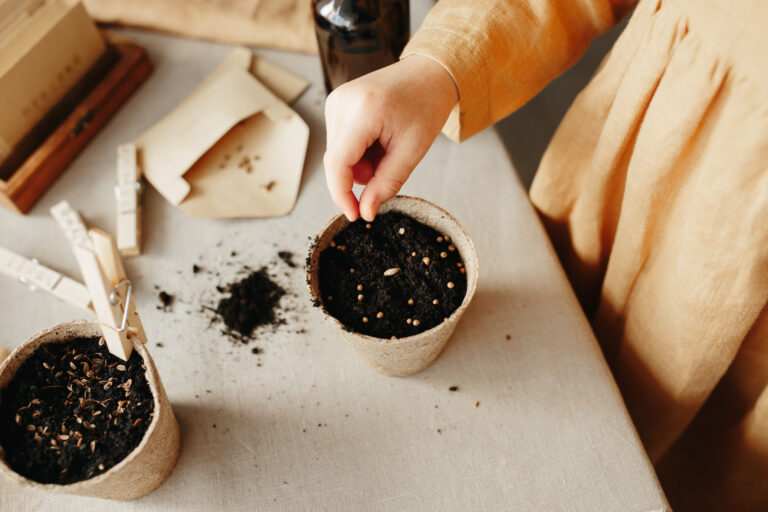
Several hours before you fill your containers with seed-starting mix, put the mix in a bucket and stir in enough water to moisten it uniformly. (This is much easier than watering the mix after you sow, and it prevents you from dislodging newly sown seeds.) Fill your containers with the pre-moistened mix, then plant two or three seeds per cell at the depth recommended on the seed packet. Cover the containers with plastic wrap or a plastic dome if you have one — the plastic will hold just enough moisture to encourage germination. Remove the plastic as soon as sprouts emerge. Water seedlings gently when the soil feels dry to the touch, either with a mister or by filling the tray below the cells with water. If your starting mix didn’t contain an organic fertilizer blend, feed seedlings a diluted, liquid organic fertilizer (such as fish emulsion) when they form their first true leaves.
Prevent Damping Off
Too much moisture and humidity can encourage damping off, a fungal disease. Prevent this problem by adding a half-inch layer of light-colored sphagnum moss to the top of your seed-starting mix. Research from the University of California at Davis shows that sphagnum moss absorbs 20 times its weight in water while offering excellent aeration for seedlings. The moss also contains bacteria known to inhibit certain plant diseases and fungi that attack young seedlings. The researchers estimated that using sphagnum moss could prevent 80 to 90 percent of damping off problems.
Warm Up to Heat Mats
Ideal germination temperature for most vegetable seeds is between 70 and 90 degrees Fahrenheit — a range most homes can’t provide steadily in winter. Encourage fast sprouting by providing warmth from below your seedling flats, which is easiest to do with an electric germination mat. You could also simply set the container on or near another source of heat, such as a shelf placed above a radiator (not on the radiator itself!), near a furnace or in the same room as a woodstove.

Light Right
Seedlings need brighter light than the average home can provide in late winter. You could buy grow lights for your seedlings, but standard fluorescent lights will do just fine. Keep the lights suspended an inch or less above the tops of seedlings, raising the lights (or lowering the containers) to maintain that distance as seedlings grow. Seedlings do best with 14 to 18 hours of light per day. Using an inexpensive timer (about $20 or less) makes achieving that range easy.
Strong and Steady
Help your seedlings grow steadily, without interruption from insufficient water, nutrients or root space. After they’re well established, pinch out the weakest seedlings in each cell, giving the strongest survivor room to grow. Lightly brush your hand over the tops of seedlings daily to promote sturdy stems (this simulates the effect of wind). If your starts appear to be outgrowing their containers, move them into bigger ones as soon as possible.
Transitional Tactics
After four to six weeks, your seedlings will have grown into sturdy plants ready for the outside world. Help them make the transition by allowing them to adjust to outdoor conditions slowly, a process called “hardening off.” To do this, keep your transplants in a sheltered location, such as on a porch, for about a week, bringing them in at night and gradually moving them into brighter sunlight each day. (If you move seedlings from indoors into a full day of sun, they’ll sunburn.) After your plants have been hardened off, they’re ready to grow in the garden, where they’ll reward you with a bounty of tasty, nutritious food.

Seed-Starting Problems and Solutions
- Seedlings suddenly keel over and die: Prevent “damping off” by using a porous seed-starting mix, and don’t over-water.
- Seedlings look tall, pale and spindly: Increase the light. Use fluorescent lights (not a window), and keep them no more than 1-inch above the tops of seedlings. Keep the lights on for 14 to 18 hours daily.
- Tiny dark “flies” show up: These pests likely are fungus gnats, which can damage seedling roots. The gnats commonly feed on decaying organic matter, so be sure any compost you’re using is mature. Don’t over-water and use yellow sticky traps or Knock-Out Gnats, a biological pesticide to control these pests.
To find out when to start seeds and when to plant out transplants based on your ZIP code, try our Vegetable Garden Planner.