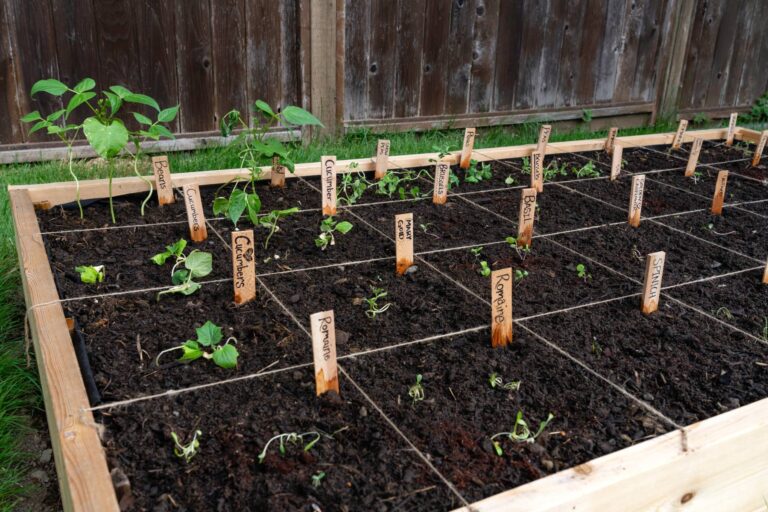
Create an organized garden plan that ensures proper spaces by following this square-foot gardening planting guide, and you’ll have a thriving veggie garden in no time.
In square-foot gardening, begin by visualizing what you want to harvest. This simple step prevents you from planting too much. Picture a large plant like a head of cabbage. That single cabbage will take up a whole square foot so you can only plant one per square foot. It’s the same with broccoli and cauliflower. Let’s go to the opposite end of the spectrum and think of the small plants like radishes. Sixteen can fit into a single square foot. It’s the same for onions and carrots — 16 per square foot. (Yet that’s a 3-inch spacing between plants, which is exactly the same spacing the seed packet recommends as it says “thin to 3 inches apart.”)
Consider Plant Size
Think of your plants as if they were shirt sizes. Shirts come in all four sizes: small, medium, large and extra large, and so do our plants. It’s that simple.
The extra large, of course, are those that take up the entire square foot — plants like cabbages, peppers, broccoli, cauliflower and geraniums. Next are the large plants — those that can be planted four to a square foot, which equals 6 inches apart. Large plants include leaf lettuce, dwarf marigolds, Swiss chard and parsley.
Several crops could be one per square foot if you let them grow to their full sizes, or they can be planted four per square foot if you harvest the outer leaves throughout the season. This category includes parsley, basil, and even the larger heads of leaf lettuce and Swiss chard. Using the square-foot gardening method, you snip and constantly harvest the outer leaves of edible greens, so they don’t take up as much space as in a conventional garden.
Medium plants come next. They fit nine to every square foot, which equals 4 inches apart. Medium plants include bush beans, beets and large turnips.

To help keep up with this, you may want to print out the handy plant spacing chart in the Image Gallery, so you always have it handy. Some people even have it laminated so they can take it outdoors without worrying about the weather destroying it.
Another Plant Spacing Technique
Another way to get the proper spacing and number of plants per square foot is to be a little more scientific and do a little arithmetic, as shown below. You can see that one, four, nine, or 16 plants should be spaced an equivalent number of inches apart. This is the same distance the seed packet will say you should “thin to.” Of course, we don’t have to “thin to” because we don’t plant a whole packet of seeds using this method. So if you’re planting seeds, or even putting in transplants that you purchased or grew from seed, just find the seed packet or planting directions to see what the distance is for thinning. This distance then determines whether you’re going to plant one, four, nine or 16 plants.
Just because we’re talking about measuring in inches doesn’t mean you have to get out your ruler or yardstick, and you don’t have to do any complicated measuring or figuring either. This is when the grid becomes handy. When your square foot is bordered by a grid, it’s much easier to think one, four, nine or 16 plants in each square foot.
All you do is draw lines in the soil with your fingers! For one plant per square foot just poke a hole in the middle of the square with your finger. For four per square foot, draw a vertical and horizontal line dividing the square in half each way. The plants go right in the center of these four smaller squares. You can continue this pattern up to the densest planting of 16 plants per square foot.
How Much to Plant
I recommend, especially at the beginning, that you plant only what you want to eat. Occasionally try something new, of course, but especially at first only grow those vegetables and herbs that you normally eat.
Remember, plant each adjoining square foot with a different crop. Why? Here are several reasons:
- It prevents you from overplanting any one particular item.
- It allows you to stagger your harvest by planting one square foot this week and another of the same crop in two weeks or so.
- It promotes conservation, companion planting, crop rotation, and allows better plant hygiene and reduced pest problems.
- It automatically helps to improve your growing soil three times a year in very easy, small steps. Remember the saying, “Square by square, you’ll soon be there.”
- Besides all of the above, it looks pretty.
Just like a patchwork quilt, the different colors, leaf textures, plant densities, shapes and heights, plus the visible grid, will give you a very distinctive, photogenic garden. You’ll just love and admire it every time you see it.
Some people ask, “Why can’t we plant all 16 squares with leaf lettuce or spinach or Swiss chard or whatever we want to plant?” Oh, that’s going right back to the single-row mentality. Square-foot gardening begins with visualizing the harvest. It’s very difficult to put in four tiny plants of Swiss chard and think that’s going to be enough for the whole family, but one square of red chard and one square of green chard usually is more than most families eat. Proof of the pudding . . . how many bunches of Swiss chard did you buy last week or even last month? The stores have it, it’s fresh, and it looks good, so why didn’t you buy any more than you did? Well, it’s the same answer as to why you shouldn’t plant too much of one thing.
It’s worth repeating here that the biggest problem for single-row gardeners has always been “I planted too much. I can’t take care of it. It’s too much work and I’m sorry now.” All that has changed with square-foot gardening and you now have boundaries (the grid) and the opportunity to ask yourself, “For every single square foot I plant, is that enough? Do I really want more? Would it be better to plant another square foot of the same thing in a week or two or three?”
Time of Year
Keep in mind that you can build a square-foot garden anytime of the year — spring, summer, fall and even winter. For most of the country, you could start planting in any season other than winter. What time of the year is it right now for you and where are you in the sequence of a yearly gardening cycle? Think of it like the movie theater before the main feature. You’re all settled in with your popcorn, ready to devote your full attention to the movie. In the gardening year, this is usually the equivalent of springtime. What if you came in the middle of the picture? For gardening that would be summertime. You can still plant a warm-weather crop even if you missed the spring crop. If it’s now fall, you can still start your square-foot garden with a great cool-weather crop and get some valuable experience before next spring. Start whenever you get the urge to plant.
For convenience, we’ll start with the beginning of the garden year for most of the country, springtime. (Some parts of the country, like Texas and Florida, can grow all year long. You lucky people.)
Seasonal Plants
You can get at least three crops a year in every square foot of your square-foot garden. Every choice is going to be fun, exciting and tasty. Of course, your selection depends on the time of year, and what you and your family need and want. There are two types of crops when you consider weather. The first are called cool-weather crops that do best in the spring and fall, but won’t survive in the hot summer. The second group is the warm- or hot-weather crops that, you guessed it, don’t do well in the cool weather of spring and fall, but thrive in the hot weather of summer.
Plant Hardiness and Protection
Square-foot gardening’s size makes it very easy to protect your new plantings from an extra early or late frost. There’s a lot more you can do, too, if you are interested in extending the season so you can get more from your garden.
Plants aren’t all the same, of course. They are just like people. Some can stand the heat, cold or humidity better than others. We classify these as hardy, and those that can’t handle it as non-hardy. Each of the four seasons has three time periods — the early season, midseason and late season. If you’re thinking about a spring crop, for example, there may be some vegetables that can only grow in the middle of spring while others can tolerate a little more cold in the beginning of the season, but can’t stand any heat at all near the late part of the season. It takes a little while to get used to which is which, and how best they fit in with your planting schedule.
Though the weather is never exactly the same every year, it helps to know a plant’s hardiness. Don’t worry — you’ll learn it in time. This is not an exact science so relax if you’re a beginner and just enjoy the ride. Don’t expect to find a perfect list because how well plants thrive differs in different parts of the country and of course, different years, sometimes for no explainable reason. If you lose a few squares of something one year it’s no big deal. It doesn’t mean you’re not going to be a great gardener.
Frost Dates
Although people like to celebrate the first day of spring (March 20) according to the calendar, plants don’t give a hoot about our calendar — they respond to weather. In the spring we need to know the date of the last frost in our area. That will help us determine when to plant. Each different crop — whether cool-season or warm-season–will need to be planted so many weeks before or after that last day of frost.
For plants, the fall growing season begins not with the first calendar day of fall (Sept. 23), but with the first frost, and continues until the first freeze of the fall. The average dates of your first and last frost depend on where you live in the country and the regional and local variations of weather. All we can do is go by the past and hope it will be similar this year. To help, the government collects dates for your area and calculates the average date from the past 100 years. Of course, the average is only a guide.
How do you find your local frost dates? The Internet is the best resource for detailed information. (Learn more about the frost dates and when to plant different crops in your area with our What to Plant Now pages. –MOTHER.) You can also call your local county extension agent or most area nurseries. To find your local extension agent, look in the Government blue pages for your county in your telephone book, then look for the heading “Extension of [your state] University.”
Sequence of Plant Growth
Did you know that plants grow and bloom everywhere in the same sequence? In other words, throughout the country, daffodils bloom in the springtime, then a little later tulips bloom, then it’s time for the lilacs to bloom. (Did I leave out dandelions?) Start noticing the sequence in your location. It would include trees, shrubs, flowers and even weeds.
I read a book once about following spring North. It’s theoretically possible that if you drive fast enough (and eat and sleep quickly), you could see nothing but tulips in bloom all the way from Georgia to Maine.
If you know what kinds of plants are summer crops (the most popular and well-known vegetables), it’s easy to remember that everything else is a spring or fall crop. Summer crops include beans, peppers, eggplants, tomatoes and squash. If you plant these when it’s too early or cool, they’ll either die or their growth will most likely be stunted for that year.
Plan on a Fall Crop
As soon as the summer crop is finished, you’re ready to plant cool-weather crops for the upcoming fall. These crops are frost-hardy, meaning that both young and mature plants withstand frost. The seeds you plant at the end of summer will sprout quickly because the soil is warmer. Transplants can begin outdoors and grow much faster than the same crop planted in spring.
The fall crop gains an extra advantage from late summer weather. The problem with cool-weather plants in the spring is not cool weather but warm weather at harvest time. A plant’s purpose in life is to reproduce seed, and the rising temperatures of an approaching summer make this happen sooner. As it does so, the plant’s whole character changes. Many people don’t realize that plants like lettuce put up a flower stalk, which then goes to seed. If you wait too long to harvest lettuce, the stalk will shoot up, and the same thing happens to other crops like cabbage. The head splits open, a stalk shoots up, develops flowers and then turns to seed. It’s nature’s way of allowing the plant to reproduce, but the plant changes taste when this happens. All the energy goes toward the seed and the plant begins to taste rather tough, coarse, and bitter.
In cooler weather, this process is delayed. The plant feels no urgency to complete the growing cycle. So in the fall, the plant slows its maturation process, allowing it to maintain flavor for a longer length of time as temperatures continue to grow cooler and cooler. If it’s frost-hardy, it doesn’t matter if it is the middle of fall and you start getting frost. Some plants can endure some freezing and still provide a crop for harvesting. Fall is a great time to plant if you put in the right crops.
Soil Temperature
Soil temperatures vastly influence sprouting times. For example, if you plant carrot seeds in summertime when the temperature of the soil is between 60 and 80 degrees Fahrenheit, the seeds will sprout in less than a week. But if you plant the same seeds in early spring when the ground temperature is perhaps 40 degrees, they will take a month and a half to sprout. Just another 10 degrees warmer and they will sprout in a little over two weeks.
What happens to seeds when they don’t sprout because the ground is cold? They could rot, or fungus could attack them. They could break their dormancy and then go dry. They could be attacked by insects or dug up by animals or birds. So, the quicker you can get them to sprout the better off they will be.
Spring, Summer and Fall Crops
Some crops, like the cabbage family, take so long to grow that there isn’t enough time to plant seeds directly in the garden and wait for the harvest. So you have to buy from nurseries or raise your own transplants indoors ahead of time.
The same situation applies to the warm-weather summer crops like tomatoes, peppers and eggplants. They take so long to produce that you must plant your garden with transplants.
The fall crop is better for raising your own transplants because you will be able to start the seeds in summertime, raise the transplants outdoors in your garden and then move them into their permanent spot in the early fall for late fall harvest.
Starting Seeds and Growing Seedlings
There are plenty of advantages to growing your own transplants and storing the remaining seeds in their packet until next year. First, seeds cost pennies while transplants cost dollars. There are many more varieties offered in seed catalogs than as transplants at the nurseries. The only setback is time because growing your own transplants depends on the time and work you can spare. If you’re a brand new gardener, however, you may want to wait until next year to start your own transplants. Like everything else in life, we tend to go overboard and do too much and then it becomes a chore. Don’t let it happen to you!
How to Store Seeds
If your seeds are stored properly, they will last for many years. Contrary to what the gardening industry would like you to believe, it is not necessary to buy fresh seeds every year or to pour out that whole packet of seeds all at once. Square-foot gardening teaches you to plant just a pinch of seeds, and to then store the rest. By planting just a pinch of seeds instead of a whole packet, you can save a lot of money by saving the excess seeds for next year’s crop, and the next year’s, and so on. Some seeds will last up to five years in storage. Seed companies guarantee that a certain percentage will sprout; this number is always very high, usually up into the ninetieth percentile. Of course the seed industry wants you to buy a fresh packet of seeds every year so they can stay in business. There’s nothing wrong with that! But there’s also nothing wrong with saving money with a more efficient system.
What is the ideal storage condition for seeds? It is just the opposite of the moisture and warmth that make them sprout. You’ll want to store them in a cool, dry place — the driest, coldest place in your home. Some people freeze their seeds. But I find they get moisture even if they are in a zip-lock bag because it never seems to be totally airtight. I prefer refrigerating them in a wide-mouth jar with a screw lid. Label your containers and store them in the refrigerator on a back shelf. In each jar place a desiccant packet from a film container or medicine vial, or add a little powdered milk wrapped in a tissue to soak up any excess moisture in the jar.
Seed Germination Rate
What happens to seeds that are in storage? As they grow older, their germination rate (the percentage that sprouts under ideal conditions) gradually diminishes. But the solution is very simple. Plant a pinch of seeds — just two to three seeds — instead of only one seed to ensure that at least one will sprout. If your seeds are many years old, test the germination rate yourself, or just plant three or five or however many seeds depending on how well they sprouted the year before. If you marked the sprouting rate on the packet, you can reasonably estimate how many to plant the next year.
What Did I Do Wrong?
Knowing that roots sprout first will help your seeds successfully grow. Here’s why. Traditionally, gardeners hoed open a row, planted, covered, watered and then walked away from their garden hoping for the best. If nothing grew, single-row gardeners thought the worst: “Maybe they were bad seeds. Or worse, maybe I’m a terrible gardener!” What all of these gardeners did not realize was that the seed might have already sprouted, perhaps after a week or two, and the root was heading down before the top could come up and break the surface. If the gardener gave up and quit watering, it is possible that their seed did die. Why? Because if the soil dries below the seed — in the root zone only 1 or 2 inches below the surface — the root will wither and die from lack of moisture. But if the gardener had kept the soil moist, then the seeds would have had a good chance to put the root down to support the plant and its new shoot.
Vegetable Garden Planning
Many gardeners keep planting data — when, what and where they plant, how long it takes to sprout, and how well their plants grow. It may sound like a lot of bookkeeping, yet some people enjoy recording their garden data and even set up computerized spreadsheets to make computations from this information. I don’t bother to keep all these details myself, but if you enjoy it, this may help you learn faster and measure the progress more effectively.
(Try the online Vegetable Garden Planner to help you plan the best garden ever! — MOTHER.)
A square-foot garden is small, and I’ve been able to change things around once they were all planted. It doesn’t take much to move and replant something from one square to another if you think it would look better somewhere else. It’s kind of like arranging a room of furniture and pictures on a wall. You can make all kinds of layouts and drawings (even to scale), but I guarantee you once everything is in place, you’ll change your mind.
Drop a Pinch
You can practice planting indoors in the winter before you start your garden. Take different kinds of seeds from the tiniest to the largest and practice picking up and dropping a pinch of seeds onto a piece of white paper to count your results. This is really a lot of fun, almost a family game.
There is a very practical reason for doing this. When I tell people to just plant a pinch of seeds — two or three — I think I have given them all the instructions they need. But I always find so much variation in how many seeds they end up planting. It’s in your finger dexterity, and you may need a little practice. If you are having trouble, you may even want to use a spoon for picking up that pinch of seeds. A white plastic spoon usually works great, especially if you’re using darker colored seeds. If you scoop up too many, you can just shake a few back into the palm of your hand.
How Deep to Plant Seeds
How deep should you plant a seed? This depends a lot on the size of the seed and the soil you plant it in. Generally speaking, a seed’s depth is two to four times the thickness of the seed. It’s important to place your seeds below a moist surface to prevent it from drying out. Too close to the surface and it can dry out from the hot sun. Once a seed receives moisture and begins sprouting (known as “breaking dormancy”), it will die if it dries out so don’t forget to water regularly.

Reprinted with permission from All New Square-Foot Gardening, published by Cool Springs Press, 2005.