Use our PVC hoop house plans with PDFs and step-by-step hoop house building plans to grow earlier in spring and extend gardening into winter.
Gardening inside a hoop house is like moving part of your land hundreds of miles south, all for a modest investment in materials and time. It’s proof that a bit of simple technology can definitely go a long way.
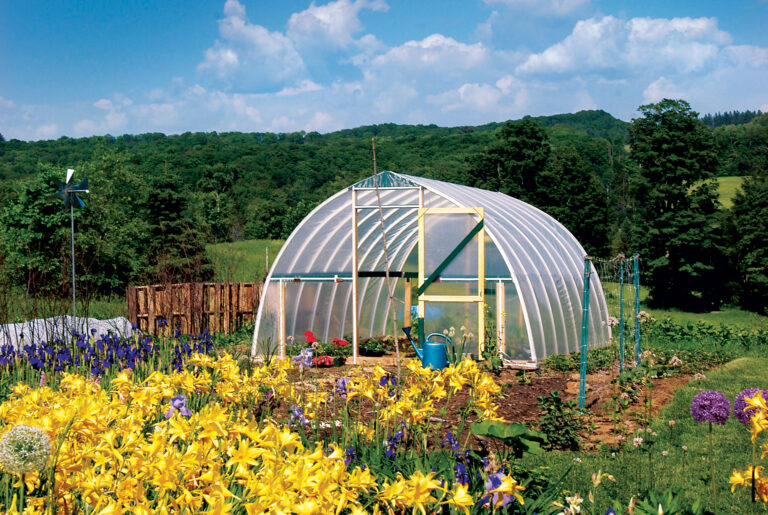
Hoop houses are greenhouses made by covering a plastic or metal hoop structure with one layer (or sometimes two) of clear plastic. They are low-tech and low-cost compared with glass greenhouses.
Hoop houses give benefits throughout your growing season — far more than just the obvious advantage of protection from frost. Decreased wind pressure on seedlings, more humid growing conditions and higher internal concentrations of carbon dioxide during the main part of the season are reasons why they deliver better food, and more of it. For northern gardeners, hoop houses also bring the reality of spring planting and nurturing closer to the actual time the late-winter gardening enthusiasm naturally kicks in. The warmth and serenity of a hoop house offers a pleasant space to work, rest and recharge yourself, too. Hoop houses with roll-up sides and shade cloths even deliver benefits in hot climates by providing variable amounts of protection from blistering sun.

Although hoop houses are structurally simpler than greenhouses, a successful layout still requires planning and care. Building a hoop house that ages gracefully demands construction details that aren’t immediately obvious. The tried-and-true design outlined here will ensure you enjoy the perks of your hoop house for years to come.
Before you begin, get specific about what you want to accomplish. Are you just looking for a small space to nurture seedlings? Do you envision a hoop house you can walk into? Do you plan to make roll-up sides to regulate heat? You can incorporate all of these features into the build-it-yourself design here.
Location and Orientation

Any hoop house requires a flat, level and well-drained site. Even moderate winds exert a lot of force on a hoop house, so choose a location sheltered by tree cover or other buildings if possible. Because excess heat within the hoop house during summer will be an issue even in northern regions, orient your hoop house so the ends align with prevailing winds for maximum ventilation. Choose a location with deep, stone-free soil to make anchoring the structure much easier.
Build Your Own Hoop House
PVC plastic pipes arched over a wooden ground frame and then covered in polyethylene plastic — that’s our DIY hoop house recipe in a nutshell, and it works for structures up to about 18 feet wide. You can also make hoop houses smaller, too — See Eliot Coleman’s Use Low Tunnels to Grow Veggies in Winter: Quick Hoops. Study all of the instructions and plans until you fully understand the construction steps before buying materials.
We used 1-1/2-inch diameter Schedule 40 PVC pipe for the hoops and 2-inch diameter PVC for the ground pipes on this design. See hoop pipe guidelines for recommended pipe diameters and hoop pipe lengths.
The wider and taller your hoop house will be, the longer the hoop pipes needed.

If you’d rather not use PVC, galvanized steel pipe made for chain-link fence installations makes excellent hoop house supports, and several pipe bending tools are made specifically for this task. Although steel pipe is more challenging and more expensive to work with than PVC, it delivers a stronger structure where extreme wind and snow loads may occur.
Parts and Materials
- 6-Rot-resistant lumber 2 x 6 x 12 feet for ground frame sides
- 2-Rot-resistant lumber 2 x 6 x 12 feet for ground frame ends
- 11-Schedule 40 PVC 1-1/2 inch dia. x 20 feet for long hoop pipes
- 11-Schedule 40 PVC 1-1/2 inch dia. x 10 feet for short hoop pipes
- 22-Schedule 40 PVC 2 inch dia. x 18 to 36 inch for ground pipes
- 88-Corrosion-resistant metal 1/4 inch dia. x 5 inch for ground pipe bolts
- 3-Schedule 40 PVC 1-1/2 inch x 20 feet for short purlins
- 3- Schedule 40 PVC 1-1/2 inch x 10 feet for long purlins
- 4-Softwood lumber 1 by 4 x 16 feet for the hip boards
- 1-Greenhouse grade 6 mil x 32 feet wide x 35 feet long for top plastic
- As needed-Construction-grade lumber 2 x 4 as needed for end wall framing
- 2-Greenhouse grade 6 mil x 32 inches wide x 10 feet long for end wall plastic
1. Build a Ground Frame
Regardless of the size of your hoop house, begin by creating a four-sided ground frame from rot-resistant lumber. Place 2-by-6s on their edge for houses 14 to 18 feet wide. Use 2-by-4s for the ground frame on smaller hoop houses.
If the sides of the frame are longer than the lumber you have, use 24-inch battens to splice joints. Hot-dipped galvanized No. 10 x 3-inch wood screws work best here, with No. 10 x 4-inch screws used to secure corner joints. Set your frame in place, and then measure from corner to corner. (As long as opposite sides of the frame are equal in length, corners will be exactly 90 degrees if the corner-to-corner diagonal measurements are the same.) Drive temporary wooden stakes into the earth on the outside corners of the ground frame to prevent it from moving out of square.
2. Drive Ground Pipes
Ground pipes are lengths of 18- to 36-inch-long pipe pounded vertically into the ground with a sledgehammer. If your ground is hard, opt for shorter pipes and soak the area well to make driving the pipes easier. Drive one ground pipe at each corner of the wooden frame and another every 3 feet along the long sides, all tight to the inside face of the ground frame. Each pair of ground pipes will support one hoop pipe.

To avoid breaking the PVC, have someone hold a piece of scrap wood on top of the stakes as you’re pounding them in. Drive the pipes so they’re flush with the top edge of the ground frame boards. You want all ground pipes to be the same height.
3. Raise the Hoop Pipes
The length of hoop pipes required to create the ideal arch depends on the width of hoop house you’re making. One 10-foot and one 20-foot length of PVC pipe is required for each hoop on this 18-foot-wide design. To make the purlins needed for its 30-foot length, you’ll have to cut a 20-foot pipe in half, then join each half to another 20-foot pipe. When you buy pipe, make sure you have a factory-flared end on one of each pair of pipes that will come together for each hoop. One straight end slips into the flared end of its partner, creating the total length required to span the width of the structure (see the plans). Although you could probably get by joining these pipes with friction only, use PVC cement as you assemble the joints to make sure they stay together.
The amount of arch in a hoop house can safely vary depending on how much headroom you want. If your hoop house width is narrower than the design here, you’ll need to shorten the hoop pipes accordingly. See hoop pipe guidelines for suggested diameters and lengths for different hoop house widths.
- Structure width 10-12 feet, 3/4 inch hoop pipe diameter, 19 feet hoop pipe length, 1 inch ground pipe diameter
- Structure width 12-14 feet, 1 inch hoop pipe diameter, 23 feet hoop pipe length, 1-1/2 inch ground pipe diameter
- Structure width 14-18 feet, 1-1/2 inch hoop pipe diameter, 27 feet hoop pipe length, 2 inch ground pipe diameter
Lay your hoop pipes in position across the ground frame next to the ground pipes they’ll fit into, and then get help fitting the ends of the hoops into position. First, slip the end of one hoop pipe into its ground pipe, then bend this pipe so the other end fits into the opposite ground pipe. Install all hoop pipes like this, and then use a drill to bore quarter-inch-diameter holes for lock bolts through the wooden ground frame, the ground pipe and the hoop pipe. Make sure the hoop pipe is pushed all the way down, and drill only on one end of each hoop for now.

Install and tighten a quarter-inch-diameter-by-4-inch carriage bolt in each of the holes, then climb a stepladder to take a sighting along the tops of all the hoops. The peaks should all be more or less the same height, though some adjustment will be required. Have a couple of helpers push and pull the unbolted bottom ends of the hoop pipes until the peaks align, then drill and bolt the ends.
4. Install the Purlins
The hoops may be up, but they’re not strong yet because they’re only supported at the bottom ends. This is where purlins come in. Purlins are horizontal pipes that link the hoops together, adding strength. You’ll need at least one purlin installed along the ridge of the structure, plus two more partway down each side if you’re in a region that gets high winds or lots of snow. Place the purlin pipes on the inside of the hoops, secured with the smooth heads of quarter-inch-diameter-by-4-inch carriage bolts facing upward. If you’d like the option of rolling up the lower sides of your hoop house during warm weather, add wooden 1-by-2 hip boards 2 or 3 feet from the ground to anchor the main pieces of hoop house plastic. The roll-up sides will hang from these wooden strips and can be raised or lowered as needed to control temperatures inside.

5. Add and Anchor Plastic
Chemical interaction between the PVC pipes and the skin of polyethylene can cause premature deterioration of the poly. That’s why you should apply protective tape along all edges of the frame that touch the skin before you install the poly. This tape also makes bolt heads less likely to cause physical damage to the skin.
Use the best grade of greenhouse plastic for your hoop house, even if your structure is small. Plastic from the hardware store looks good, but will degrade in sunlight and tear in a year or two. The best hoop house option is 6 mil, UV-protected greenhouse plastic. This will easily last four or five years, delivering peace of mind for you and better thermal performance for your hoop house. (See “Hoop House Resources” at the end of this article for places to buy the plastic.)
Choose a calm day to unroll all of the plastic you need to cover your hoop house, leaving at least 12 inches of extra plastic along the ground edges and 24 extra inches on the ends. Wrap this excess plastic around soft sponge balls (such as Nerf balls) every 4 or 5 feet, then tie the balls in place with one end of each rope. The balls elevate the leading edge of the plastic a bit and make it easier to pull the plastic up and over. Throw the other ends of the ropes over the peak of the hoop house, and then ask helpers to carefully pull the plastic over the structure. You may find it useful to have extra helpers on stepladders at the peak, to relieve sideways strain on the framework by lifting the plastic by hand as it goes up.
With the plastic draped over the frame, pull it as needed for alignment (fold marks on the plastic usually offer visual guidelines), then get ready to secure it. You could wrap excess plastic around 1-by-2-inch strips of wood and then anchor these strips to the hip boards or ground frame, but something called “wiggle wire” will work best for anchoring plastic along the edges of your hoop house. It works with an aluminum track that fastens to the ends and edges of your hoop house to make securing plastic fast and absolutely reliable.
You’ll enjoy longer plastic life and much better hoop house performance by using a double layer of inflated plastic. Pull two layers of plastic over your frame and secure them with a little slack. Install small, energy-efficient electric fans to continually blow air into the gap between the layers, to keep them taut. The air between the layers of plastic acts as insulation, boosting internal hoop house temperatures during cold weather. Inflation will also keep plastic from flapping in the wind.
If you live in a windy area, consider adding duckbill anchors to secure the ground frame. Pound one just outside each corner, with another one or two along each long side. Lever the cable of the anchor up to set the duckbill horizontally, and then use rope to tie the ground frame down.
6. Build End Walls

You’ll find 2-by-3 or 2-by-4 lumber best for framing the end walls of your hoop house. The plans show how the parts fit together. Notched pipe saddles secure the end frames to the PVC structure. Although you could use wooden battens to secure the plastic along the edges of the end wall frames, the same kind of wiggle wire channels and spring strips that secure the main edges of the plastic will work much better. The wiggle wire, fans for inflating double layers and other supplies are available from the companies listed at the end of this article.
Hoop House Floor
Depending on how you plan to use your hoop house, the floor surface may be more important than you think. If you’ll use your hoop house for seedling flats and pots, the floor is likely to turn into a trampled, muddy mess as you walk in and out for watering, weeding and transplanting. Any kind of pathway you create should be made of light, organic material that won’t permanently affect the soil. Clean straw is one excellent pathway option, though it’s not available everywhere. If you live in a forested area, sawdust or shavings from a saw mill are the perfect choice for your hoop house paths.
You could also dig space for worm bins into the ground and cover them with a wooden pathway made from 3/4-inch plywood, an idea described in more detail in Expert Advice for Greenhouse Growing.

Hoop House Resources
- Charley’s Greenhouse & Garden– Mt. Vernon, Washington
- Farmtek/Growers Supply– Dyersville, Iowa
- Lost Creek Greenhouse Systems– Mineola, Texas
- The Greenhouse Catalog– Salem, Oregon
Steve Maxwell has been helping people renovate, build and maintain their homes for more than two decades. “Canada’s Handiest Man” is an award-winning home improvement authority and woodworking expert.